
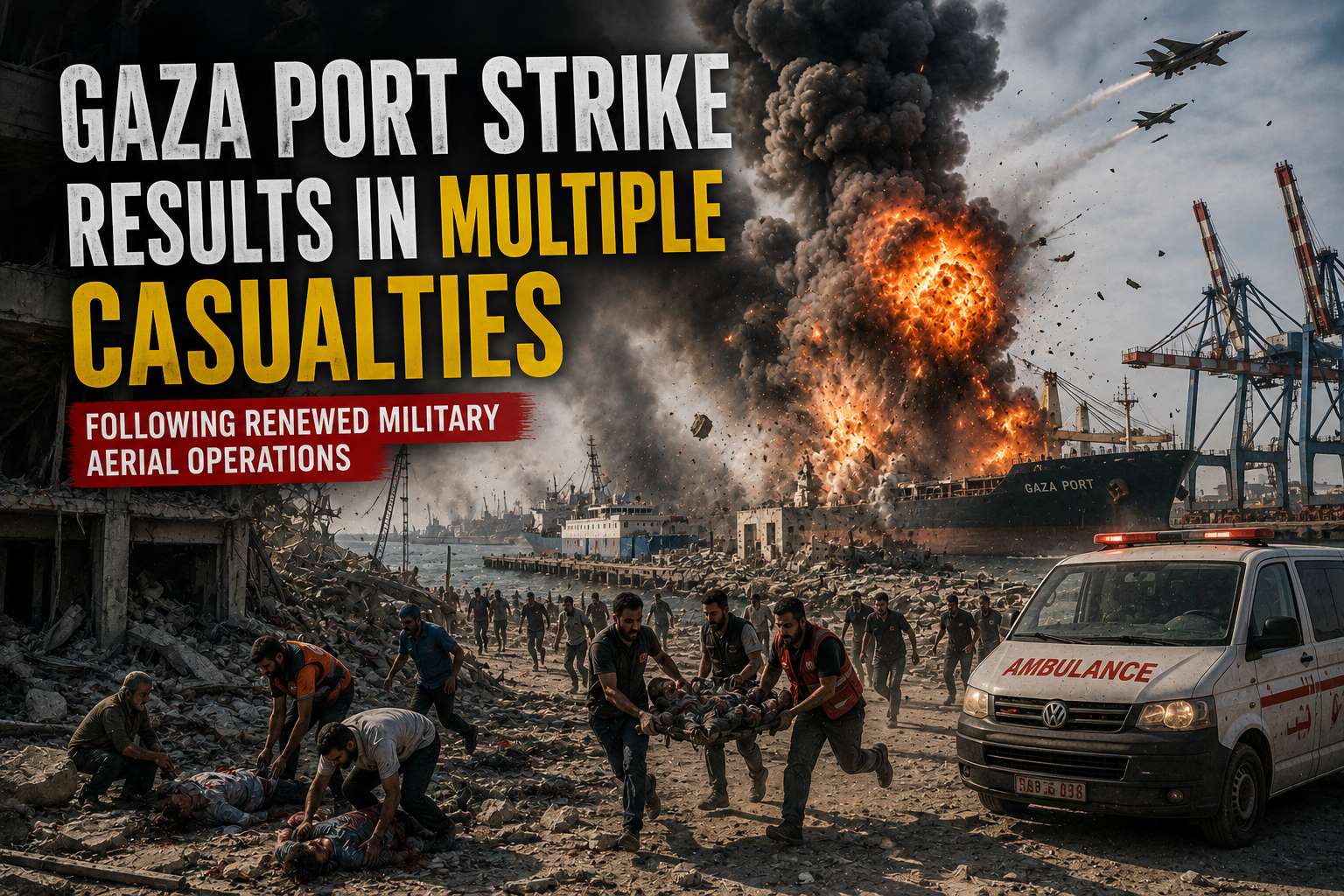
An airborne strike targets a coastal gathering site on the temporary floating dock, generating fresh casualties and adding critical complications to parallel Middle East truce talks.
Publication Date: June 2, 2026
Last Updated: June 2, 2026
Byline: Global War News Editorial
GAZA CITY: An military aerial strike hit a crowded shoreline cafe at the Gaza City seaport, killing at least two Palestinians and wounding approximately a dozen others. The kinetic operation targeting the coastal enclave’s maritime perimeter arrives amid an intensive spike in regional hostilities that has left the nominal October ceasefire framework severely compromised.
According to statements released by Gaza health officials and corroborated by witnesses on the ground, the strike directly impacted a civilian gathering spot located on the emergency seaport, a temporary floating dock structure off the coast. Witnesses reported that local residents had gathered at the seaside venue to escape intense seasonal heat during a public holiday.
While regional news agencies, including Al Jazeera and Reuters, confirmed the localized casualty figures from the health ministry, the Israeli military has not issued an official operational brief regarding the specific parameters of the seaport target. The strike represents a broader pattern of localized aerial bombardments that have continued to impact the coastal strip despite previous international mediation efforts.
The Status of Territorial Control and Stalled Accords
The strike underscores the highly fragile status of the Comprehensive Plan to End the Gaza Conflict, a multilateral peace plan brokered by U.S. President Donald Trump that took nominal effect on October 10, 2025. While designed to establish a phased transition toward long-term stabilization, the reality on the ground has diverged significantly from the signed text:
- Creeping Territorial Expansion: When the initial ceasefire was finalized seven months ago, Israeli forces maintained physical control over approximately half of Gaza’s internal territory. According to geospatial data and official statements from Israeli Prime Minister Benjamin Netanyahu, that footprint has steadily expanded to encompass 60% of the enclave, with plans outlined to claim up to 70% under localized security zoning.
- The Disarmament Deadlock: Progress toward the second phase of the 2025 peace plan—which mandates the complete disarmament of Hamas in exchange for a phased withdrawal of the Israeli army—remains entirely deadlocked. U.S. Special Envoy Steve Witkoff had attempted to revive the implementation track, but negotiations are stalled over the sequencing of security guarantees and the creation of an International Stabilization Force.
- The Human Toll of the Truce Phase: Despite the official cessation of large-scale maneuver warfare, low-intensity attrition remains highly lethal. Figures published by Gaza medical sources indicate that approximately 900 Palestinians have been killed in localized strikes since the October truce was declared. Conversely, the Israeli military has confirmed that four of its soldiers have been killed by internal insurgent operations during the same seven-month period.
Strategic Spillover and the Intermediary Breakdown
The localized bombardment of the Gaza seaport carries immediate consequences for international diplomacy far beyond the borders of the enclave. On June 1, the semi-official Iranian news agency Tasnim reported that Iran’s diplomatic team had officially halted all indirect communications with United States mediators regarding a broader, 60-day regional truce framework.
Tehran’s negotiating team explicitly cited the continuation of intensive military operations in both Gaza and southern Lebanon as the direct cause for the communication freeze. The Iranian Ministry of Foreign Affairs issued a statement asserting that stability in Lebanon and Gaza was a fundamental baseline precondition for any comprehensive maritime or nuclear agreement in the Persian Gulf, demanding a complete withdrawal of forces from newly occupied zones.
In response to the diplomatic breakdown, President Trump stated via social media that he had engaged in direct communications with Prime Minister Netanyahu and third-party intermediaries connected to regional armed groups to stabilize the collapsing agreements. However, Prime Minister Netanyahu subsequently issued a public counter-statement affirming that the Israeli military would maintain its scheduled operational parameters in neighboring theaters, signaling that tactical enforcement actions would continue irrespective of external diplomatic timelines.
ANALYSIS: The Fragmented Security Framework
The strike at the Gaza seaport demonstrates the structural flaw embedded within partial ceasefire agreements that lack rigid, universally accepted enforcement mechanisms. The October 2025 peace plan succeeded in halting the high-intensity block-by-block urban clearing operations that characterized the early years of the conflict, but it left the underlying political and security disputes completely unresolved. By leaving more than half of the enclave under direct foreign military administration while confining remaining populations to shifting coastal slivers, the arrangement created an environment optimized for continuous, low-intensity friction.
For the Israeli command, localized airstrikes are viewed as a necessary defensive counter-insurgency mechanism to suppress a resilient guerrilla presence attempting to reorganize under the cover of the truce. From a tactical standpoint, striking infrastructure nodes along the maritime shoreline is designed to prevent the unauthorized coastal movement of logistics or personnel.
However, the political cost of these continuous strikes is rapidly outstripping their immediate tactical utility. Every incident that results in verified civilian casualties on a public beachfront undermines the credibility of international mediators like the United States, who have staked significant diplomatic capital on the durability of the post-war reconstruction blueprints. Furthermore, because external regional powers like Iran have explicitly linked their own participation in maritime security frameworks to the absolute cessation of hostilities in Gaza, these localized tactical engagements effectively possess a veto over global energy and trade stabilization. Until mediators can bridge the gap between permanent structural disarmament and complete territorial evacuation, the term “ceasefire” will remain a semantic description rather than a physical reality for the residents of the enclave.
What to Watch Next
As emergency teams clear the damage at the floating dock installation, three specific indicators will determine whether this latest localized escalation triggers a wider collapse of regional diplomacy:
- The Resumption of Proxy Interdictions: Whether regional armed groups, such as the Houthi movement in Yemen, fulfill recent organizational warnings to resume full-scale ballistic strikes against maritime shipping lanes in response to the breakdown of the Gaza truce.
- Zoning Implementation at the 70% Threshold: Whether the Israeli military proceeds with the physical implementation of permanent base infrastructure and dirt berm boundaries across central Gaza to secure the expanded 70% territorial control target.
- The Status of the Transferred Messages: Whether Qatari and Pakistani mediators can successfully persuade Tehran to lift its suspension of U.S. bilateral talks prior to the expiration of the current critical diplomatic deadlines.
Source Disclosure Note: This report incorporates verified field casualty data from Gaza medical officials, tracking data from the United Nations International Stabilization Force monitors, official press releases from the Israeli Prime Minister’s Office, and diplomatic cables published by the semi-official Tasnim news agency. Strategic analysis and ground context utilize reporting from the Associated Press, Reuters, and Al Jazeera.
This article is based on publicly available reporting from named international news agencies and attributed official statements. All claims about ongoing events are attributed to their original sources. Analysis sections represent the editorial interpretation of reported facts and do not constitute advocacy for any party to the described conflict. AI tools may be utilized for image generation to assist in explaining complex concepts, as well as for refining grammar, spelling, and other linguistic enhancements. However, all original content is produced, fact-checked, and revised by the editorial team. This publication does not take political positions on active military conflicts.