
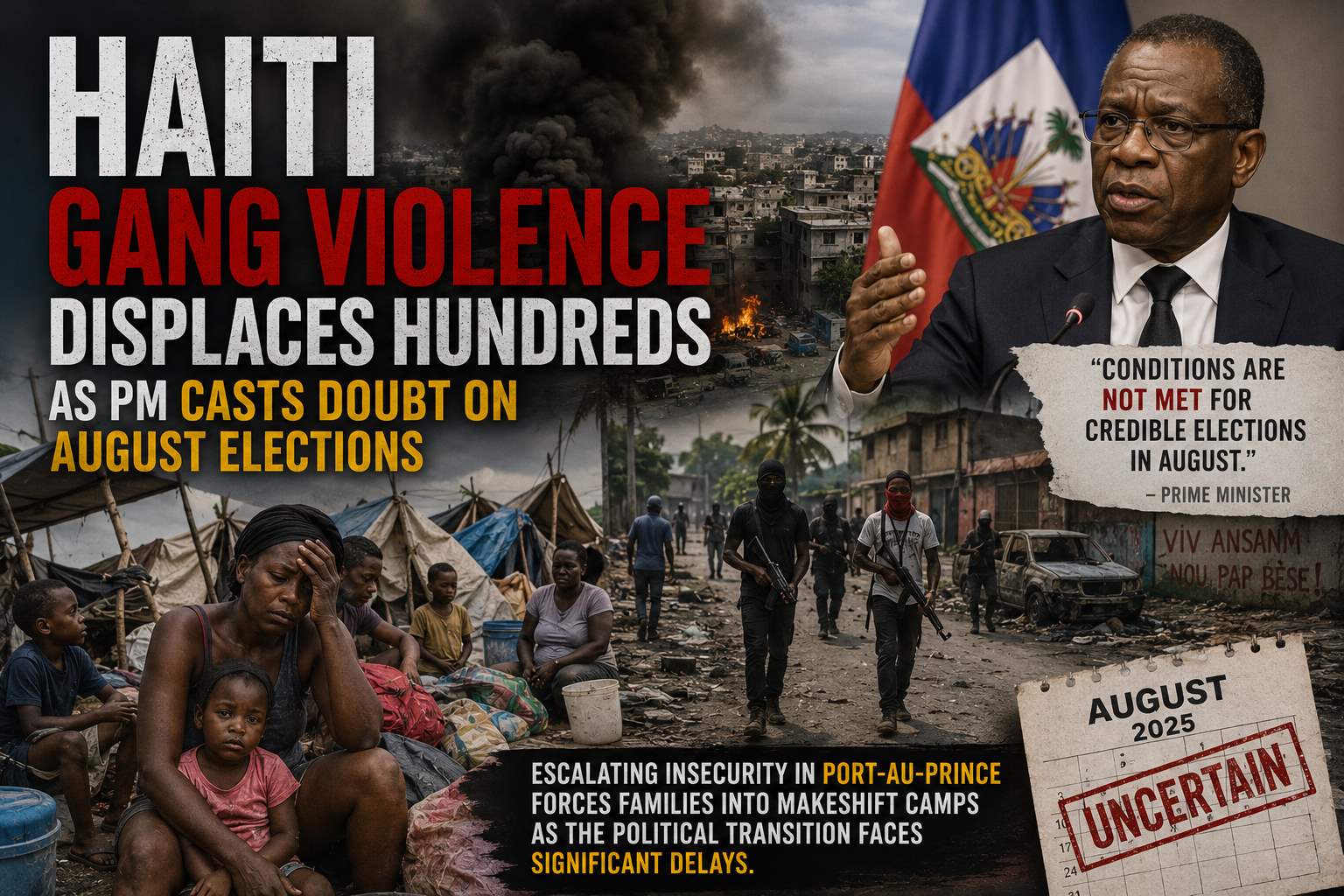
Escalating insecurity in Port-au-Prince forces families into makeshift camps as the political transition faces significant delays.
May 12, 2026
Global War News Editorial
The humanitarian crisis in Haiti has intensified this week as a new wave of gang-led violence in the capital, Port-au-Prince, has forced hundreds of residents to flee their homes. The surge in instability coincides with a pivot in the nation’s political outlook, as the interim Prime Minister suggested that the general elections tentatively scheduled for August 2026 may no longer be feasible under current security conditions.
According to reporting from Al Jazeera, clashes between rival armed groups in the Delmas and Cité Soleil neighborhoods have turned residential streets into active conflict zones. Local human rights organizations, cited by international monitors, report that families have been forced to abandon their belongings, seeking refuge in overcrowded schools and public plazas that lack basic sanitation and food supplies.
The Breakdown of the Electoral Timeline
The displacement crisis has cast a long shadow over Haiti’s democratic transition. In a televised address monitored by the Associated Press (AP), the interim Prime Minister stated that while the government remains committed to a transition of power, the “prevailing climate of terror” makes it nearly impossible to organize a credible national vote by August.
“We cannot ask citizens to go to the polls when they cannot safely leave their homes to buy bread,” the Prime Minister stated, adding that the electoral council requires a stable environment to register voters and secure polling stations.
This development marks a significant setback for the international community, which has been pushing for a clear electoral roadmap following years of political paralysis. The August date was previously seen as a critical milestone for restoring constitutional order in the Caribbean nation.
Analysis: A Cycle of Insecurity and Impasse
Observers note that the delay of the elections creates a difficult paradox for the Haitian government. Without elections, the administration lacks a fresh mandate to implement long-term security reforms; however, without security, the logistical requirements for an election cannot be met.
Analysts have suggested that the gangs—who currently control an estimated 80% of the capital—are intentionally escalating violence to derail the political process. By maintaining a state of perpetual chaos, these groups preserve their influence over local economies and prevent the re-establishment of state authority.
The delay also complicates the role of the Multinational Security Support (MSS) mission. Originally intended to provide a security “window” for the elections, the mission has struggled with funding gaps and personnel shortages. If the election is postponed indefinitely, it remains unclear how long the international community will sustain its support for the mission.
What to Watch
Moving forward, the focus will be on the response from the Caribbean Community (CARICOM) and the United Nations Security Council, both of which have been primary backers of the current transition plan. Market participants and aid agencies are also watching for the release of the updated Integrated Food Security Phase Classification (IPC) report, as the displacement and port disruptions are expected to worsen already critical levels of hunger in the capital.
The next few weeks will determine whether the interim government can propose a new, realistic timeline that satisfies both domestic political factions and international observers.
Source Disclosure: This report is based on official statements from the Haitian interim government, reporting from Al Jazeera and the Associated Press (AP), and displacement data provided by local human rights monitors and the United Nations.
This article is based on publicly available reporting from named international news agencies and attributed official statements. All claims about ongoing events are attributed to their original sources. Analysis sections represent the editorial interpretation of reported facts and do not constitute advocacy for any party to the described conflict. AI tools may be utilized for image generation to assist in explaining complex concepts, as well as for refining grammar, spelling, and other linguistic enhancements. However, all original content is produced, fact-checked, and revised by the editorial team. This publication does not take political positions on active military conflicts.