
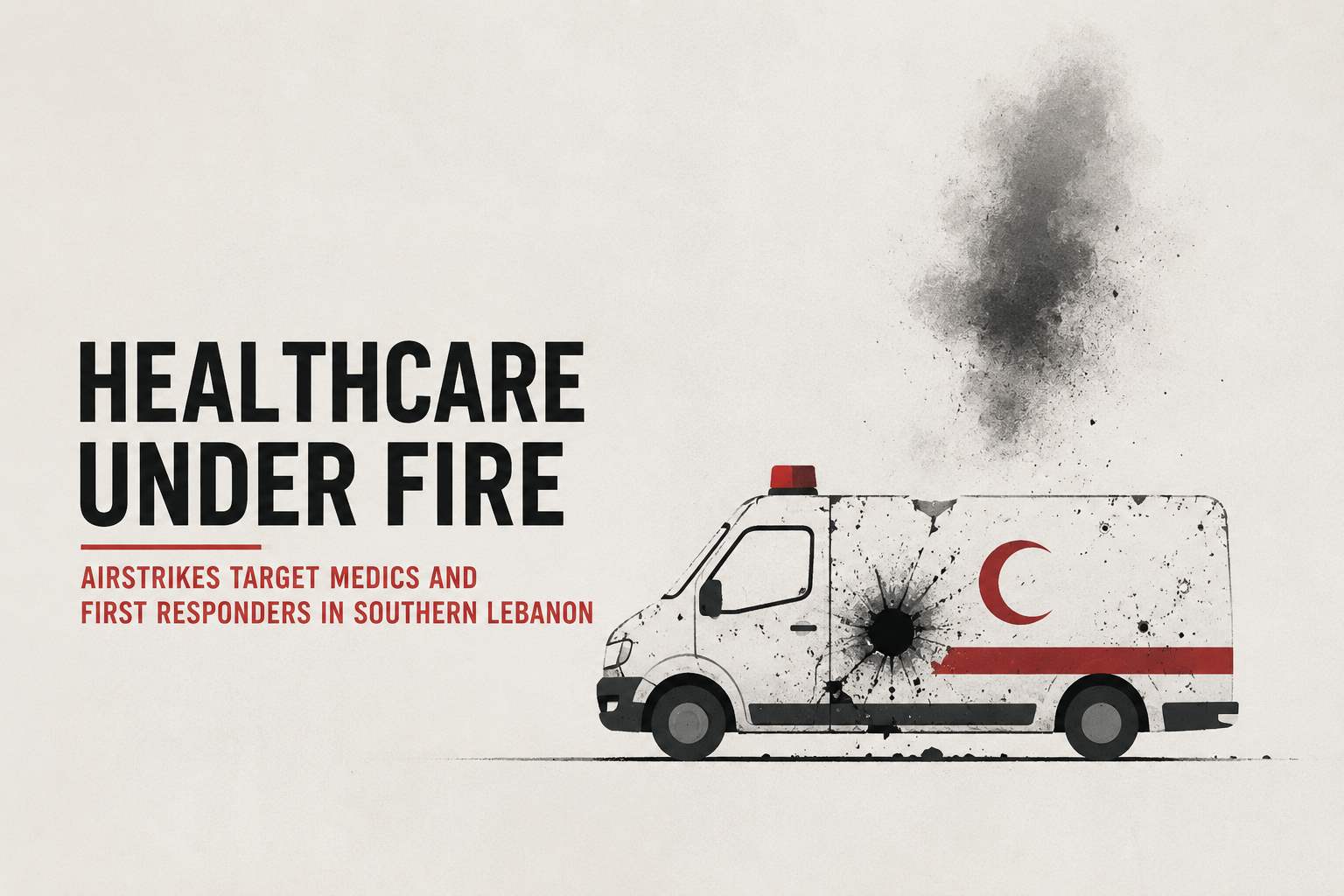
Fatalities mount across Tyre district as recurring strikes hit ambulances and medical personnel, straining the southern tier’s surviving emergency network despite active ceasefire protocols.
Publication Date: May 25, 2026
Last Updated: May 25, 2026
Byline: Global War News Editorial
The Core Event
A series of targeted aerial bombardments across southern Lebanon over the weekend has resulted in the deaths of multiple medical workers and extensive injuries to hospital staff. According to statements from the Lebanese Ministry of Public Health, the strikes heavily impacted emergency response operations within the Tyre district on Friday, May 22, and Saturday, May 23, 2026, directly neutralizing first responders while they were actively attempting to treat frontline casualties.
The state-run National News Agency reported that ten people were killed on Friday alone, including six emergency paramedics and a child. In one documented incident within the town of Deir Qanoun en-Nahr, an Israeli strike initialised a chain of casualties when it targeted an individual on a motorcycle. Footage released by the Lebanese Health Ministry showed civil defense personnel wearing high-visibility vests attending to the wounded individual and gesturing for an ambulance. As the vehicle approached, a secondary strike directly impacted the front of the ambulance, killing two paramedics and a child at the scene.
A separate airstrike on the nearby southern town of Hannaouiyah killed four additional paramedics on Friday. The Ministry of Public Health emergency center later announced on Saturday that a further 25 members of the medical, nursing, and administrative staff sustained injuries at Hiram Hospital, located in the Tyre district, following heavy bombardment in the facility’s immediate vicinity that inflicted extensive structural damage.
Technical Context and Tactical Background
The recent surge in medical casualties highlights a persistent friction point between military objectives and international humanitarian law. The Israel Defense Forces (IDF) issued a public statement via social media channels noting that it was reviewing allegations that several uninvolved individuals were harmed during operations in Hannaouiyah and Deir Qanoun en-Nahr. However, the military asserted that its strikes targeted identified Hezbollah operatives inside the sectors.
The tactical dynamic along the southern front features deeply conflicting narratives:
- The Israeli Position: The IDF has repeatedly maintained that Hezbollah systematically utilizes civilian medical facilities, emergency transport, and ambulances to move personnel, logistics, and weapons across southern sectors. Israeli military spokespersons stated that evacuation orders had been broadsided across Tyre and the village of Burj Rahal prior to the strikes, arguing that remaining personnel assume operational risks.
- The Lebanese and Rights Group Positions: The Lebanese Ministry of Public Health strongly denied allegations of the militarization of its medical assets, emphasizing that all targeted responders were performing strictly humanitarian functions. Amnesty International and the World Health Organization (WHO) noted that while international law permits the stripping of a medical facility’s protected status if it is actively used to commit acts harmful to the enemy, such strikes can only legally occur after a precise warning with a reasonable evacuation timeline has gone unheeded. Rights monitors stated that the IDF has routinely failed to provide physical evidence supporting its claims of ambulance misuse.
Furthermore, the conflict continues despite formal diplomatic mechanisms. A U.S.-brokered ceasefire protocol initially enacted on April 17, 2026, has been extended twice during direct bilateral negotiations overseen by Washington. However, while the framework has largely insulated the capital city of Beirut from heavy bombardment, it has failed to halt kinetic activity south of the Litani River. Since the renewal of full-scale regional hostilities on March 2, 2026, Lebanese health officials state that more than 3,123 individuals have been killed, with over 817 fatalities occurring after the formal ceasefire announcement.
The Humanitarian and Displacement Dynamic
The continuous targeting of emergency infrastructure has fundamentally crippled the humanitarian baseline across the southern governorates. According to a formal flash update published by the United Nations Office for the Coordination of Humanitarian Affairs (OCHA), 161 separate incidents affecting healthcare have been verified since March, resulting in at least 110 confirmed deaths and 252 injuries among medical personnel.
The structural attrition has forced the total closure of three major hospitals and 42 primary healthcare clinics in the southern tier. The destruction of these facilities leaves approximately 150,000 civilians who remain in the southern border zones with near-zero access to emergency trauma care or basic medicine. OCHA noted that a previous airstrike heavily damaged Tebnine Public Hospital, one of the final referral hubs functioning in the deep south, wounding several doctors and severing local ambulance dispatch pipelines.
The inability of first responders to safely navigate the roads has also blocked local evacuation efforts. The UN Refugee Agency (UNHCR) reported that fluid displacement patterns have left more than 129,721 people residing in 632 temporary collective shelters nationwide. Families attempting to flee newly designated evacuation zones face extreme hazards, as major transit routes, including the critical Qasmiyeh Bridge linking Sidon and Tyre, have been systematically severed by previous aerial strikes, trapping vulnerable populations within active combat grids.
International Diplomatic Reactions
The targeting of protected medical workers has generated substantial friction within international diplomatic circles. The British Medical Association (BMA) released a formal statement expressing extreme alarm over the situation, labeling the ongoing strikes an explicit violation of medical neutrality and international humanitarian law that permanently weakens a exhausted healthcare workforce.
At the United Nations, human rights agencies have called for immediate structural accountability. Dr. Abdinasir Abubakar, a senior official representing the World Health Organization, emphasized that the continuous threats against ambulance crews prevent the execution of baseline life-saving measures. UN relief coordinators have warned international donors that the 2026 Lebanon Flash Appeal remains severely underfunded, having secured only 42 percent of its required 308 million dollar target, a reality that threatens to halt water, sanitation, and hygiene support across the country’s crowded refugee shelters within the coming weeks.
Economic and Long-Term Structural Implications
The systemic dismantling of Lebanon’s health infrastructure carries profound economic consequences for a state already struggling under a protracted macroeconomic collapse. The capital required to reconstruct highly specialized clinical wings, replace destroyed high-value diagnostic machinery, and import specialized ambulance fleets will heavily strain future national budgets.
Furthermore, the loss of skilled healthcare professionals through casualties and mass emigration is generating a long-term brain drain. Medical associations in Beirut report that hundreds of certified doctors, trauma surgeons, and specialized nurses have relocated permanently to international jurisdictions since March, indicating that even if physical facilities are eventually rebuilt, the human capital required to operate Lebanon’s healthcare system has been fundamentally compromised for the decade ahead.
What to Watch
As negotiations continue under the Washington framework, observers are monitoring three critical indicators:
- The Litani Operational Limits: Whether upcoming diplomatic revisions to the temporary ceasefire will establish distinct, legally binding verification mechanisms to protect ambulance corridors south of the Litani River.
- Emergency Aid Supply Bridges: The volume and speed of international medical airlifts, such as the European Union Humanitarian Air Bridge, in replacing depleted trauma kits before regional stocks run out entirely.
- Investigative Accountability Tracks: Whether independent international legal bodies are granted the necessary access to review radar and drone data from the Deir Qanoun en-Nahr ambulance strike to determine potential war crimes classifications.
Source Disclosure Note: Data and events compiled in this report originate from official situation registries maintained by the Lebanese Ministry of Public Health Public Center and the Israel Defense Forces. Broad context regarding casualties, displacement volumes, and institutional funding is sourced from formal updates by the World Health Organization, UNHCR, and UN OCHA Flash Update Number 26. Ground details and eyewitness visual summaries are verified through coverage by Reuters, Agence France-Presse, The Guardian, and Al Jazeera.
This article is based on publicly available reporting from named international news agencies and attributed official statements. All claims about ongoing events are attributed to their original sources. Analysis sections represent the editorial interpretation of reported facts and do not constitute advocacy for any party to the described conflict. AI tools may be utilized for image generation to assist in explaining complex concepts, as well as for refining grammar, spelling, and other linguistic enhancements. However, all original content is produced, fact-checked, and revised by the editorial team. This publication does not take political positions on active military conflicts.