
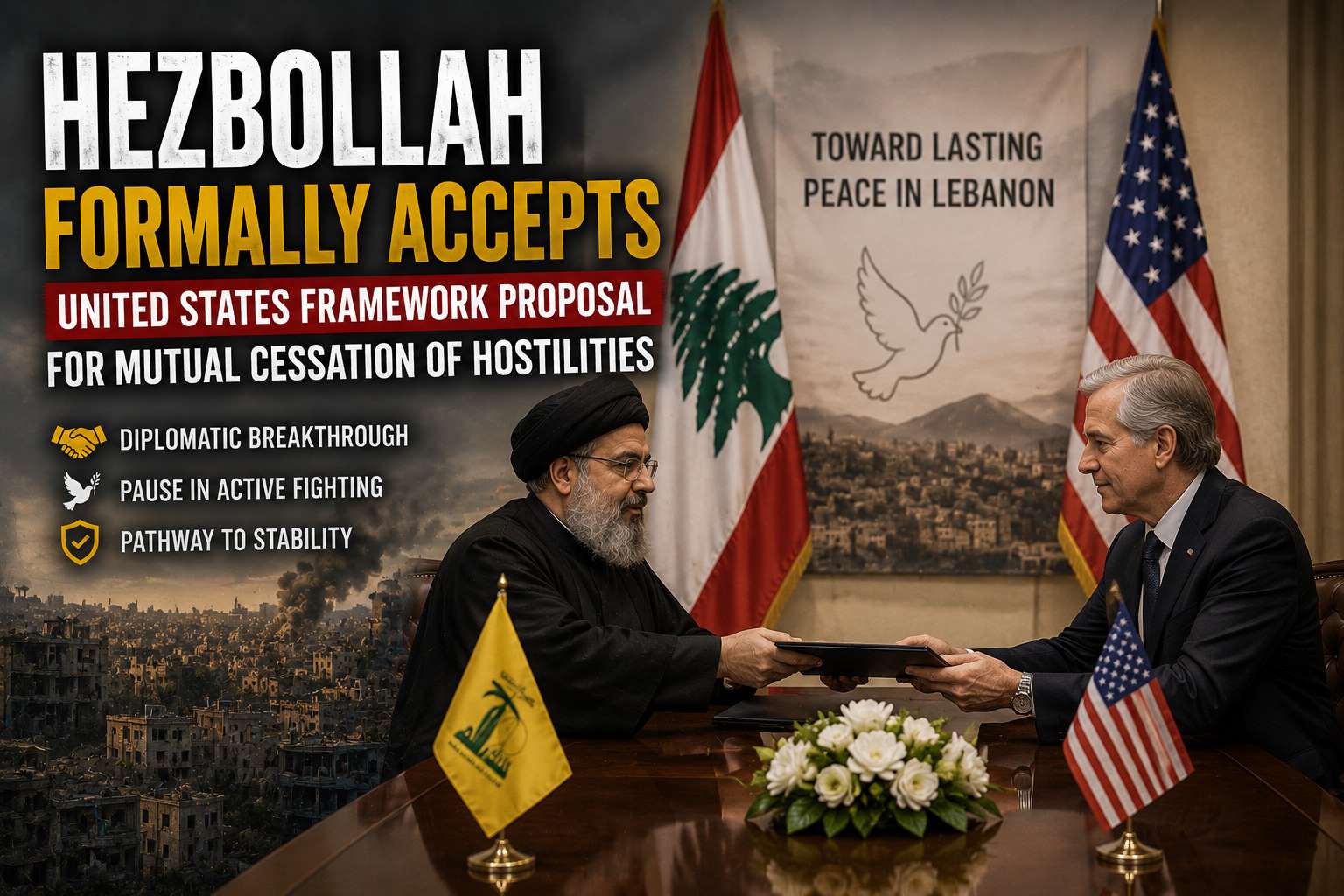
De-escalation proposal emerges on eve of Washington diplomatic talks as regional military operations threaten wider economic stability.
Publication Date: June 2, 2026
Last Updated: June 2, 2026
Byline: Global War News Editorial
The Core Agreement
Official channels in Beirut have confirmed that Lebanese authorities received formal verification of Hezbollah’s willingness to engage with a United States-brokered diplomatic framework. According to an official statement released by Lebanese President Joseph Aoun’s office via the country’s embassy in Washington, the proposed arrangement outlines a mutual cessation of military attacks between the non-state armed group and Israeli forces.
The immediate terms specify that Israeli military operations targeting Dahiyeh—Beirut’s southern suburbs—would pause. In return, Hezbollah would commit to halting cross-border missile, rocket, and drone strikes against Israeli territory. The ultimate goal stated in the diplomatic communication is to expand this localized understanding into a comprehensive ceasefire covering all sovereign Lebanese territory.
The development followed direct high-level telephone consultations on June 1, 2026. The Lebanese presidency indicated that the confirmation was advanced following an official discussion between President Aoun and US Secretary of State Marco Rubio. Concurrently, US President Donald Trump announced via social media that he had engaged in productive discussions with Israeli Prime Minister Benjamin Netanyahu and separate, highly placed representatives of Hezbollah, stating that both parties had conceptually agreed to halt offensive operations.
Current Operational Reality and Tactical Escalation
Despite the significant diplomatic movement reported by official channels, the operational reality on the ground remains highly volatile. The diplomatic breakthrough emerged directly on the heels of intense military posturing and widespread displacement.
The Threat to Beirut
Hours before the de-escalation framework was publicized, Israeli Defense Minister Israel Katz and Prime Minister Netanyahu announced they had ordered renewed planning for targeted strikes on Dahiyeh. The Israeli command justified the measures by citing what it termed repeated violations by Hezbollah of the temporary truce originally outlined in mid-April.
Forced Evacuations
The Israeli military issued urgent evacuation orders for residents of Beirut’s southern suburbs and more than a dozen localities in southern Lebanon. According to Agence France-Presse (AFP) correspondents on the ground, the warnings sparked immediate panic, causing hundreds of families to flee the densely populated capital suburbs via cars and motorbikes, leaving the streets largely deserted.
Active Engagement
Even as the US Embassy in Beirut broadcasted news of the framework’s acceptance, local media and wire services reported that tactical actions had not fully ceased. Hezbollah’s Al-Manar television network quoted lawmaker Hassan Fadlallah, who maintained that the group’s formal objective remains a comprehensive ceasefire across all Lebanese territory. However, the group simultaneously claimed responsibility for several tactical strikes against Israeli targets positioned in southern Lebanon.
Context and Background: The Path of the 2026 Direct Negotiations
The current framework represents an extension of a diplomatic process that began in the spring of 2026. The conflict intensified significantly after March 2, 2026, when border hostilities escalated alongside wider regional friction linked to the broader US-Iran conflict.
A formal 10-day cessation of hostilities was initially brokered by Washington on April 16, 2026. This landmark initiative opened direct negotiations between delegations representing the state of Israel and the sovereign Lebanese government—marking the first formal bilateral talks of this nature since 1983.
This landmark initiative opened direct negotiations between delegations representing the state of Israel and the sovereign Lebanese government, marking the first formal bilateral talks of this nature between the two nations since 1983.
- April 16, 2026: Landmark 10-day truce brokered by the US; direct bilateral talks open.
- April 23, 2026: Second round of negotiations held in Washington under US chairmanship.
- May 15, 2026: Third round concludes; initial truce extended for an additional 45 days.
- May 29, 2026: Pentagon military coordination meeting plans Southern Lebanon transition frameworks.
- June 1, 2026: US Embassy and Lebanese presidency announce Hezbollah acceptance of mutual cessation framework.
While these diplomatic rounds advanced in Washington, executing a durable peace has proven structurally complex. Hezbollah was not a direct, formal signatory to the state-to-state talks, leading to a precarious security environment where both the Israeli military and Hezbollah field commanders frequently accused each other of micro-violations to justify retaliatory actions. According to data released by the Lebanese Health Ministry, the cumulative conflict has resulted in more than 3,400 fatalities in Lebanon since early March.
Analysis: The “Move Versus Move” Dilemma
The primary structural hurdle facing mediators is the establishment of a verifiable verification sequence. Observers note that the current breakthrough is highly conditional and functions primarily as an emergency mechanism to prevent a deeper ground invasion of Lebanon and the urban destruction of Beirut.
A core friction point remains the presence of the Israel Defense Forces (IDF) within southern Lebanese border towns, such as Bint Jbeil and Khiam. Independent analysts suggest that Hezbollah’s acceptance of a pause is explicitly tied to halting strikes on its capital strongholds, yet the group maintains its ideological stance of armed resistance against foreign forces inside Lebanese territory. Conversely, Israeli defense officials have repeatedly stated that a permanent cessation is impossible without the enforcement of a demilitarized zone up to the Litani River and the complete disarmament of non-state actors, as loosely outlined under historical UN Security Council Resolution 1701.
The fourth round of formal negotiations scheduled for June 2 and 3, 2026, in Washington is expected to center on a “move versus move” mechanism. This proposed operational sequence requires the Lebanese Armed Forces (LAF) to actively deploy south with international financial support to assume sole sovereign control, providing a buffer that allows the IDF to withdraw while ensuring Hezbollah assets are moved away from the border.
What to Watch
Moving forward, the durability of this US-led framework depends on three immediate indicators:
- The Washington Plenary Sessions: Whether the Lebanese state delegation, led by Simon Karam, and the Israeli delegation, led by Yechiel Leiter, can formalize the “move versus move” security timeline during this week’s talks.
- Adherence to the Suburban Pause: Whether Israel entirely refrains from conducting airstrikes inside the administrative boundaries of Beirut, and whether Hezbollah completely suppresses rocket launches into northern Israel.
- The Iranian Diplomatic Position: Whether Tehran maintains its public position that a durable Lebanon ceasefire is an absolute pre-condition for wider regional settlement, or if independent actions by the Revolutionary Guards complicate the local truce.
Source Disclosure Note: This report relies on official public communiques issued by the Lebanese Presidency and the United States Embassy in Beirut. Operational details, evacuation reporting, and field statements were compiled from real-time dispatches by Agence France-Presse (AFP), Reuters, The Hindu, and Al-Monitor. Statistical data regarding casualties originates from the Lebanese Health Ministry.
This article is based on publicly available reporting from named international news agencies and attributed official statements. All claims about ongoing events are attributed to their original sources. Analysis sections represent the editorial interpretation of reported facts and do not constitute advocacy for any party to the described conflict. AI tools may be utilized for image generation to assist in explaining complex concepts, as well as for refining grammar, spelling, and other linguistic enhancements. However, all original content is produced, fact-checked, and revised by the editorial team. This publication does not take political positions on active military conflicts.