
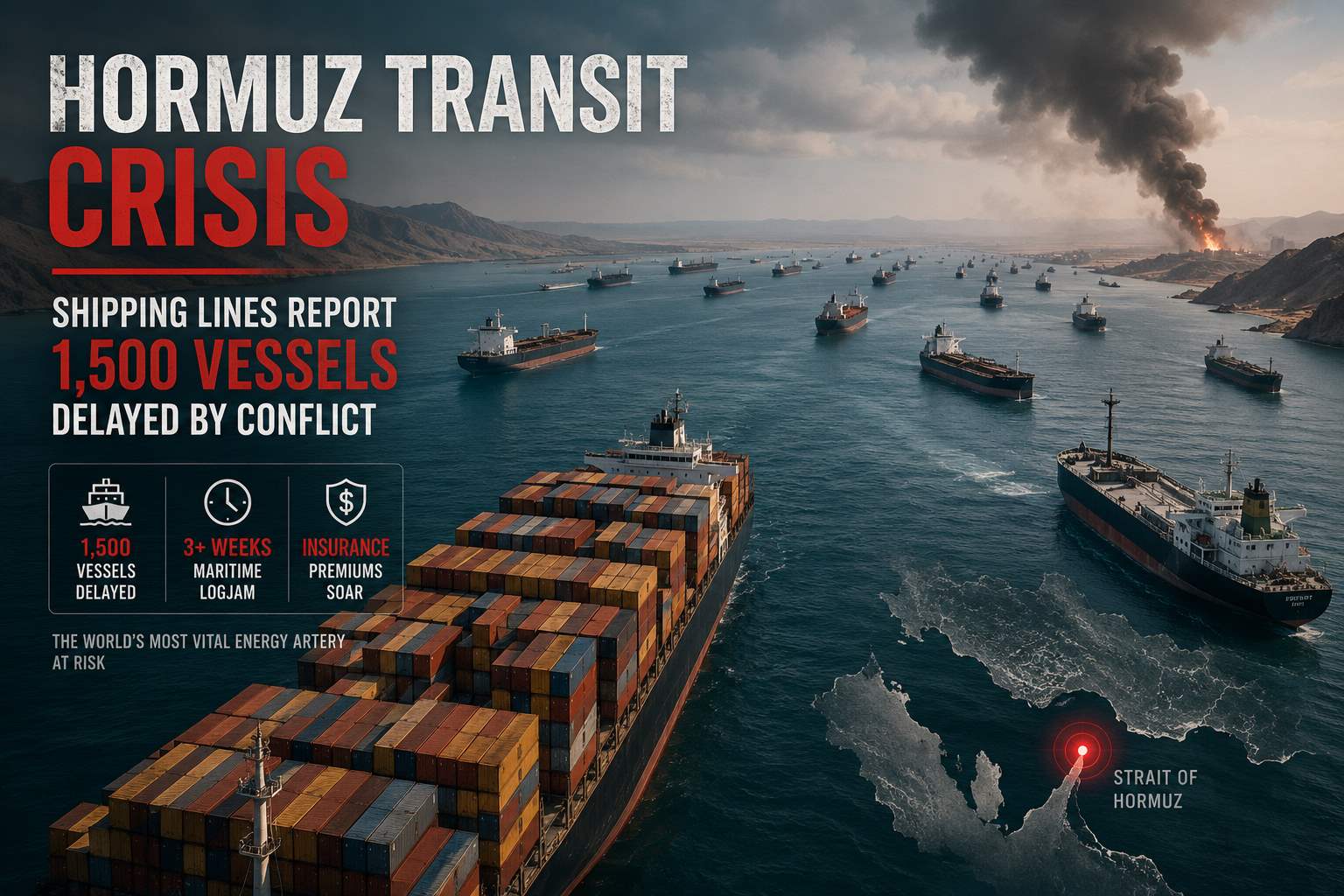
Maritime logjam at the world’s most vital energy artery enters its third week, threatening global supply chains and driving up insurance premiums for commercial vessels.
Monday, May 11, 2026
Last updated: 10:55 AM GMT
Global War News Editorial
More than 1,500 commercial vessels, including oil tankers and liquefied natural gas (LNG) carriers, are currently delayed or anchored awaiting passage through the Strait of Hormuz, according to data released by major shipping associations and maritime tracking services. The backlog is a direct result of the ongoing naval blockade and kinetic exchanges between United States and Iranian forces that have intensified since late April.
Industry groups, including the International Chamber of Shipping (ICS), reported on Sunday that the “bottleneck” has effectively halted the predictable flow of goods from the Persian Gulf. Approximately 20% of the world’s daily petroleum liquid consumption passes through this narrow waterway, making the current transit crisis a significant threat to global energy security.
The delay follows a series of maritime incidents, including the disabling of two Iranian tankers by U.S. forces last Friday and retaliatory drone strikes reported near regional ports. While a mediated ceasefire technically remains in place, the maritime sector has largely treated the strait as a “high-risk zone,” with many insurers suspending coverage for vessels attempting the passage.
The Scope of the Logjam
According to maritime analytics firm Lloyd’s List, the 1,500 delayed vessels include 420 crude oil tankers and roughly 150 LNG carriers. The remainder consists of bulk carriers and container ships carrying consumer goods and industrial raw materials. Many of these vessels are currently anchored off the coast of the United Arab Emirates and Oman, waiting for “security corridors” that have yet to be guaranteed by regional naval powers.
Shipping giant Maersk stated in a customer advisory on Saturday that it has diverted several vessels around the Cape of Good Hope, a route that adds approximately 10 to 14 days to a journey from the Middle East to Europe. “The lack of clear transit protocols in the Strait of Hormuz has made scheduled operations impossible,” the statement noted.
Economic Impact and Insurance Surge
The transit crisis has triggered a sharp rise in “war risk” insurance premiums. Analysts at Bloomberg reported that the cost to insure a standard Very Large Crude Carrier (VLCC) for a single trip through the Persian Gulf has increased fivefold since the start of May.
These costs are already beginning to trickle down to national economies. Fuel prices in South Asia and parts of East Asia, which are heavily dependent on Gulf oil, saw a 4% increase in wholesale markets over the weekend. The International Monetary Fund (IMF) has warned that a prolonged closure or significant slowing of Hormuz transit could shave 0.5% off global GDP growth if it persists through the second quarter of 2026.
Context: Why the Strait is Stalled
The Strait of Hormuz is a narrow chokepoint, only 21 miles wide at its narrowest point, with shipping lanes just two miles wide in each direction. Since the outbreak of the regional conflict on February 28, 2026, the waterway has become a primary tactical objective.
Iran has asserted its right to “monitor and regulate” all traffic in the strait, citing national security concerns. In response, the United States and its allies launched “Operation Sentinel II” to provide naval escorts for commercial shipping. However, the exchange of fire last week has made these escorts increasingly difficult to manage without triggering broader combat engagements.
Analysis: The Risk of a “Permanent” Disruption
Observers note that the longer the 1,500 vessels remain idle, the greater the risk to the global “just-in-time” supply chain. This is not merely an energy crisis; it is a logistics crisis. If the backlog continues to grow, it could lead to port congestion in Europe and Asia as hundreds of ships eventually arrive simultaneously once the strait reopens.
Furthermore, analysts suggest that the maritime industry is losing confidence in the Pakistani-mediated ceasefire. The fact that commercial shipping is choosing to anchor rather than transit indicates that the private sector views the truce as effectively broken on the water, regardless of the diplomatic statements coming from Washington or Tehran.
Source Disclosure: This report is based on data and statements from the International Chamber of Shipping (ICS), Lloyd’s List, Bloomberg, and the International Monetary Fund (IMF). Information regarding vessel diversions was sourced from official Maersk advisories and Reuters.
This article is based on publicly available reporting from named international news agencies and attributed official statements. All claims about ongoing events are attributed to their original sources. Analysis sections represent the editorial interpretation of reported facts and do not constitute advocacy for any party to the described conflict. AI tools may be utilized for image generation to assist in explaining complex concepts, as well as for refining grammar, spelling, and other linguistic enhancements. However, all original content is produced, fact-checked, and revised by the editorial team. This publication does not take political positions on active military conflicts.