
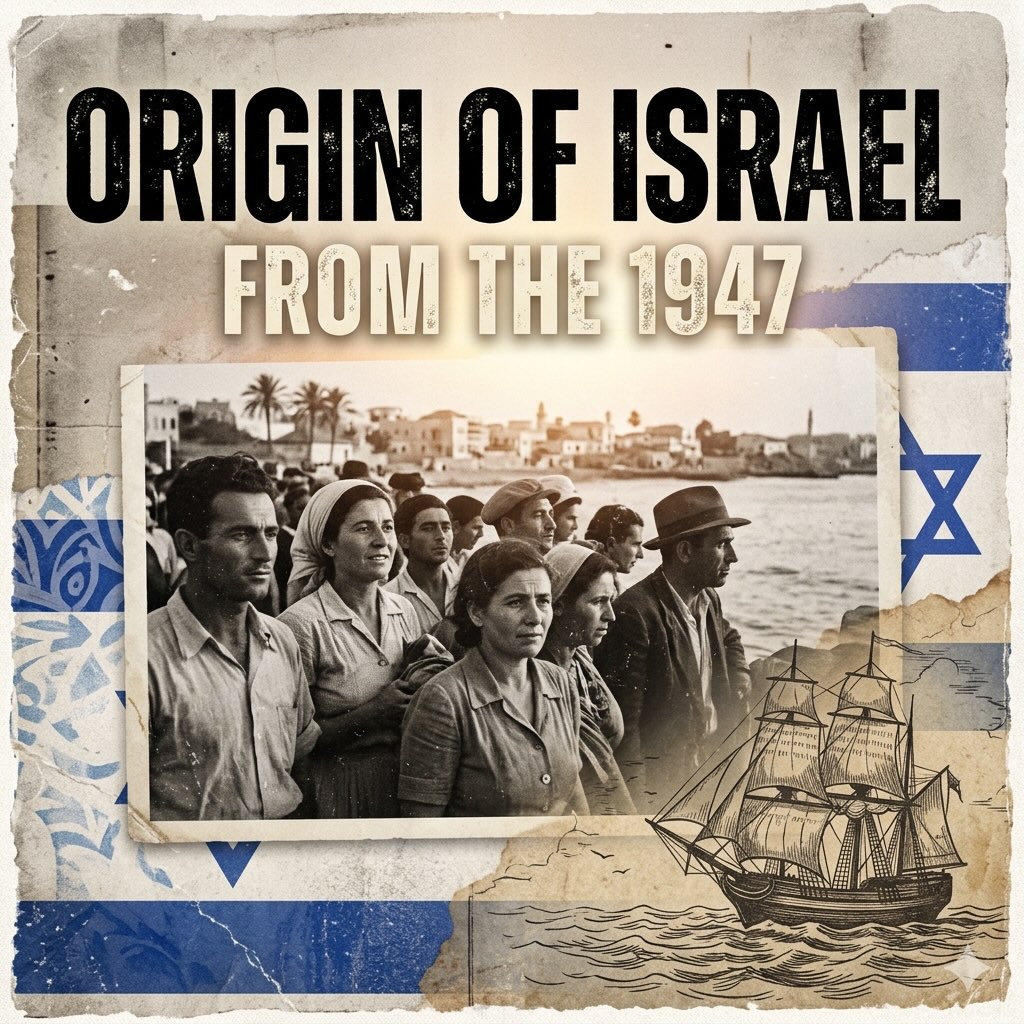
The decision to divide British-controlled Palestine set in motion a conflict that has shaped the Middle East for nearly eight decades. This is the documented history of how a state was created, what it displaced, and what remains unresolved.
Published: April 11, 2026 Last Updated: April 11, 2026 Byline: Global War News Editorial
What This Article Covers
This is an explainer. It documents the political, legal, and diplomatic history of Israel’s establishment and the decades of conflict that followed. It presents the historical record as documented by named international institutions, official archives, and established international news sources. It does not take a position on the legitimacy of any party’s claims.
Where historical events are described differently by different parties, this article notes that difference and presents both accounts with attribution.
The World Before 1947
To understand what happened in 1947, you need to understand what existed before it.
Palestine, as a defined political territory, came under British administration after the First World War. Britain had been awarded a League of Nations mandate over the territory in 1920, formally tasked with administering the land while, according to the mandate’s text, facilitating the establishment of a national home for the Jewish people without prejudicing the civil and religious rights of the existing non-Jewish communities.
That dual obligation was, from the beginning, a source of structural tension. Palestine in 1920 had a large Arab majority and a Jewish minority. Jewish immigration to the territory accelerated significantly through the 1920s and 1930s, driven in large part by persecution in Europe and, later, by the systematic murder of Jews across Nazi-occupied Europe during the Second World War.
By the mid-1940s, according to British Mandate census records, the population of Palestine was approximately 1.8 million people. Roughly two thirds were Arab and approximately one third were Jewish. Both communities had organised political and paramilitary structures. Both had articulated claims to the land. And both were in increasingly violent conflict with each other and with the British administration.
Britain, exhausted by the Second World War and facing an ungovernable situation, announced in 1947 that it would hand the problem to the newly formed United Nations.
The 1947 UN Partition Plan
On November 29, 1947, the United Nations General Assembly passed Resolution 181, known as the Partition Plan for Palestine.
The resolution proposed dividing the territory into two independent states. One would be a Jewish state covering approximately 56 percent of the land. The other would be an Arab state covering approximately 43 percent. Jerusalem and Bethlehem would be placed under international administration, governed by the UN as a separate corpus separatum, or international body.
The plan was accepted by the Jewish Agency, which represented the Jewish community in Palestine and served as a proto-governmental body. It was rejected by the Arab Higher Committee, which represented the Arab Palestinian population, and by the Arab League, the regional body representing the surrounding Arab states.
The reasons for the rejection were documented at the time. Arab leaders argued that the UN had no legal authority to partition a territory against the wishes of the majority of its inhabitants. They also argued that the proposed Jewish state would contain a very large Arab minority and that the land allocation favoured the Jewish community disproportionately relative to the existing population balance.
Jewish leaders argued that the plan represented the minimum viable basis for a secure Jewish state following the Holocaust and that they accepted it as a compromise, not as their preferred outcome.
The General Assembly vote was 33 in favour, 13 against, and 10 abstentions. The United States and the Soviet Union both voted in favour. The United Kingdom abstained.
The Civil War and the End of the Mandate
The passage of Resolution 181 did not produce an orderly transition. It produced a war.
Within days of the UN vote, armed conflict broke out between Jewish and Arab communities across Palestine. The period between November 1947 and May 1948 is documented by historians as a civil war between the two communities, fought before British authority had formally ended.
The British Mandate expired on May 14, 1948. On the same day, David Ben-Gurion, the head of the Jewish Agency, declared the establishment of the State of Israel in a ceremony in Tel Aviv. The declaration cited Resolution 181 as the international legal basis for the new state and appealed to the Arab inhabitants of Israel to maintain peace.
The United States recognised Israel within eleven minutes of the declaration, according to records from the US State Department. The Soviet Union followed with recognition three days later.
The following day, May 15, 1948, the armies of Egypt, Transjordan, Syria, Iraq, and Lebanon entered the territory. The conflict expanded from a civil war into a regional war involving multiple state actors.
The 1948 War and Its Consequences
The 1948 war lasted approximately ten months, ending with a series of armistice agreements signed between Israel and the neighbouring Arab states in 1949. No comprehensive peace treaty was signed. The armistice lines, commonly referred to as the Green Line, became the de facto borders of the new state.
Israel emerged from the war controlling approximately 78 percent of the territory of the former British Mandate, significantly more than had been allocated under Resolution 181.
The consequences for the Arab Palestinian population were severe and are documented by the United Nations Relief and Works Agency, known as UNRWA, and by Israeli, Palestinian, and international historians.
Approximately 700,000 Palestinian Arabs fled or were expelled from their homes during the war, according to UNRWA records. They and their descendants became refugees. The majority settled in the West Bank, the Gaza Strip, Jordan, Lebanon, and Syria. Many remain in refugee camps to this day. Their right to return to their original homes has been a central point of dispute in every subsequent peace negotiation.
The causes of the displacement remain contested. Israeli historians, Palestinian historians, and international scholars have produced diverging accounts of the degree to which the flight was voluntary, the result of war conditions, or the result of deliberate expulsion by Israeli forces. The historical record contains documented examples of all three.
The Arab states did not recognise Israel. The war ended not with peace but with a frozen conflict.
The Establishment of Borders That Were Never Formally Agreed
One of the most important facts about Israel’s borders is that they have never been formally recognised by treaty.
The 1949 armistice lines defined where fighting stopped. They did not define permanent borders. The state of Israel has never had its final borders set by a binding international agreement. This is not a contested political claim. It is a documented feature of every peace negotiation that has taken place since 1948.
The West Bank and the Gaza Strip, the territories allocated to the Arab Palestinian state under Resolution 181 that were never established as such, came under Jordanian and Egyptian administration respectively following the 1948 war.
In 1967, in the conflict known as the Six-Day War, Israel captured the West Bank from Jordan, the Gaza Strip and the Sinai Peninsula from Egypt, and the Golan Heights from Syria. The Sinai was later returned to Egypt under the Camp David Accords of 1978, the first peace treaty between Israel and an Arab state, brokered by the United States under President Jimmy Carter.
The West Bank and Gaza remained under Israeli military occupation. The Golan Heights were annexed by Israel in 1981, a move that was not recognised by the international community at the time, though the United States recognised Israeli sovereignty over the Golan in 2019 under President Donald Trump.
The Palestine Liberation Organisation and the Question of Statehood
The Palestine Liberation Organisation, known as the PLO, was founded in 1964 with the stated aim of establishing a Palestinian state. For the first two decades of its existence, it pursued that goal through armed operations, including attacks on Israeli and international targets that were widely designated as terrorism by Western governments.
In 1988, the PLO formally recognised Israel’s right to exist and declared an independent Palestinian state based on the 1967 borders, meaning the West Bank and Gaza Strip. The declaration was recognised by over 100 countries, though not by Israel or the United States at the time.
The Oslo Accords, signed in 1993 between Israel and the PLO under US mediation, represented the closest the two sides came to a negotiated framework. The accords established the Palestinian Authority as a governing body for parts of the West Bank and Gaza, recognised the PLO as the legitimate representative of the Palestinian people, and outlined a process intended to lead to a final status agreement.
That final status agreement was never reached. Negotiations collapsed at Camp David in 2000 and again at Taba in 2001. The core issues that remained unresolved were the status of Jerusalem, the right of return for Palestinian refugees, the final borders of a Palestinian state, and the status of Israeli settlements built in the West Bank since 1967.
Settlements, International Law, and a Growing Point of Dispute
Since 1967, Israel has constructed civilian settlements in the West Bank, including East Jerusalem. According to the United Nations Office for the Coordination of Humanitarian Affairs, there are now more than 700,000 Israeli settlers living in the West Bank and East Jerusalem.
The legal status of these settlements is a matter of sustained international dispute. The International Committee of the Red Cross, the United Nations, and the vast majority of the international community regard the settlements as illegal under international law, specifically under Article 49 of the Fourth Geneva Convention, which prohibits the transfer of a civilian population into occupied territory.
Israel disputes this legal interpretation. Israeli governments have argued that the West Bank is not occupied territory in the legal sense because it was never part of a sovereign state before 1967, and that the Geneva Convention provision does not apply.
The settlements have been a central obstacle in every round of peace negotiations since Oslo. Palestinian negotiators have argued that continued settlement construction renders a viable Palestinian state increasingly unachievable. Israeli settlement advocates have argued that the West Bank, which they refer to by the biblical names Judea and Samaria, is part of the historic Jewish homeland and is not subject to negotiation.
The United States, under successive administrations, described the settlements as an obstacle to peace while stopping short of declaring them illegal under international law. In 2019, the Trump administration reversed this position, stating that it no longer considered the settlements to be inconsistent with international law. The Biden administration did not formally reverse that position.
Hamas, Gaza, and the Division of Palestinian Leadership
In 2006, Hamas, an Islamist militant organisation designated as a terrorist organisation by the United States, the European Union, and the United Kingdom, won Palestinian legislative elections. The following year, after a period of violent internal conflict with Fatah, the political party that dominates the Palestinian Authority, Hamas took full control of the Gaza Strip.
Since 2007, Gaza has been under an Israeli and Egyptian blockade. Israel and Egypt have both described the blockade as a security measure to prevent the importation of weapons. Human rights organisations including Amnesty International and Human Rights Watch have described the blockade’s effects on the civilian population as constituting collective punishment.
Gaza has been the site of multiple rounds of armed conflict between Israel and Hamas since 2008. Each conflict produced significant civilian casualties and infrastructure destruction in Gaza. Each ended with a ceasefire rather than a political resolution.
The Palestinian political situation since 2007 has effectively been split between the Palestinian Authority, which governs parts of the West Bank and is led by President Mahmoud Abbas, and Hamas, which governs Gaza. The two bodies have not been reconciled. There has been no Palestinian election since 2006.
October 7, 2023, and the War in Gaza
On October 7, 2023, Hamas and other armed groups based in Gaza carried out an assault on communities in southern Israel. According to Israeli government figures, approximately 1,200 people were killed, the majority of them civilians, and approximately 250 people were taken hostage into Gaza.
Israel declared war in response. The Israeli military launched an air and ground campaign in Gaza that, according to the Gaza Health Ministry, has resulted in more than 50,000 Palestinian deaths as of early 2026. The United Nations and multiple humanitarian organisations have described the scale of civilian casualties and the destruction of civilian infrastructure as catastrophic. The Israeli government has stated that its military operations target Hamas infrastructure and personnel and that civilian casualties result from Hamas’s use of civilian areas for military purposes.
The accuracy of casualty figures from Gaza has been a matter of ongoing dispute between Israeli officials and international organisations. The UN, the World Health Organisation, and multiple humanitarian bodies have consistently cited the Gaza Health Ministry figures while noting the difficulty of independent verification in an active conflict zone.
A ceasefire agreement was reached in January 2025, pausing the fighting in phases. The terms and the durability of that agreement have been subject to ongoing negotiation. The full terms of any permanent resolution remain unresolved as of the date of publication.
The International Court of Justice Proceedings
In December 2023, South Africa filed a case against Israel at the International Court of Justice, the principal judicial organ of the United Nations, alleging that Israel’s military campaign in Gaza constituted acts of genocide under the 1948 Convention on the Prevention and Punishment of the Crime of Genocide.
In January 2024, the ICJ issued provisional measures ordering Israel to take all measures within its power to prevent acts that could fall under the Genocide Convention and to ensure that its military does not commit acts prohibited by the convention. The court did not order a ceasefire at that stage. The substantive case, which will determine whether genocide has occurred, is a lengthy legal process that remains ongoing.
Israel rejected the characterisation of its actions as genocide. The Israeli government described the case as legally unfounded and argued that its military operations constitute legitimate self-defence under international law following the October 7 attacks.
More than 30 countries subsequently filed declarations of intervention in the case or otherwise associated themselves with South Africa’s application, according to ICJ records. The United States, the United Kingdom, and Germany initially opposed or distanced themselves from the case, though Germany later shifted its position.
The ICJ proceedings represent the first time a formal genocide allegation against Israel has been brought before an international court. The legal process is expected to take years to conclude.
Analysis: What Remains Unresolved
The following section represents editorial analysis of the documented facts above. It is not advocacy for any party.
Nearly eight decades after the UN Partition Plan, the core questions it was meant to resolve remain open.
There is no agreed border between Israel and a Palestinian state. There is no Palestinian state recognised by Israel or the United States in any final status framework. There are more than 700,000 Israeli settlers in the West Bank, a fact that every independent assessment identifies as a structural obstacle to the two-state solution that successive US, European, and Arab governments have publicly supported as the preferred outcome.
The Palestinian political leadership is divided, with no unified body capable of negotiating or implementing an agreement even if one were reached. The humanitarian situation in Gaza, as documented by the UN and international aid organisations, represents one of the most severe civilian crises of the current era.
The international legal framework that was invoked to create Israel in 1947 is now being invoked at the ICJ to scrutinise Israel’s conduct in Gaza. That is not an irony the article needs to dramatise. It is simply part of the documented record.
What is clear from the historical evidence is that every attempt to resolve the conflict through negotiation has failed to produce a final agreement. What is not clear, and what no credible analyst can assert with confidence, is what path, if any, leads to a durable resolution.
Where Things Stand
As of April 2026, the ceasefire reached in January 2025 remains the most recent significant diplomatic development. Hostage negotiations and discussions over the governance of Gaza have continued in various forms, mediated primarily by Qatar, Egypt, and the United States, according to reporting by Reuters and the Associated Press.
The ICJ case continues. The political status of the West Bank and Gaza remains unresolved. The Palestinian Authority has not held elections. Israeli settlement construction in the West Bank has continued. Recognition of Palestinian statehood has grown internationally, with several European countries formally recognising a Palestinian state in 2024, but that recognition has not translated into any change in conditions on the ground.
The history documented in this article did not begin in 2023, or in 2007, or in 1967. It began, in its modern form, with a vote in a General Assembly hall in New York in November 1947. Understanding that starting point is the minimum requirement for understanding anything that has followed.
Sources
United Nations General Assembly Resolution 181 (II), November 1947. Official UN archive.
United Nations Relief and Works Agency for Palestine Refugees (UNRWA). Documented refugee figures and historical records.
British Mandate for Palestine census records, 1945. UK National Archives.
David Ben-Gurion, Declaration of the Establishment of the State of Israel, May 14, 1948. Israeli Government archives.
Camp David Accords, 1978. US National Archives.
Oslo Accords I and II, 1993 and 1995. United Nations Treaty Collection.
United Nations Office for the Coordination of Humanitarian Affairs. West Bank settlement figures, 2024.
International Committee of the Red Cross. Commentary on the Fourth Geneva Convention, Article 49.
Gaza Health Ministry casualty figures, cited by the United Nations and World Health Organisation, 2023 to 2026.
International Court of Justice. Application of the Convention on the Prevention and Punishment of the Crime of Genocide in the Gaza Strip (South Africa v. Israel), filed December 2023.
Reuters and Associated Press. Ongoing coverage of ceasefire negotiations and ICJ proceedings, 2024 to 2026.
US State Department historical records on recognition of Israel, 1948.
This article is based on publicly available reporting from named international news agencies and attributed official statements. All claims about ongoing events are attributed to their original sources. Analysis sections represent the editorial interpretation of reported facts and do not constitute advocacy for any party to the described conflict. This publication does not take political positions on active military conflicts.