
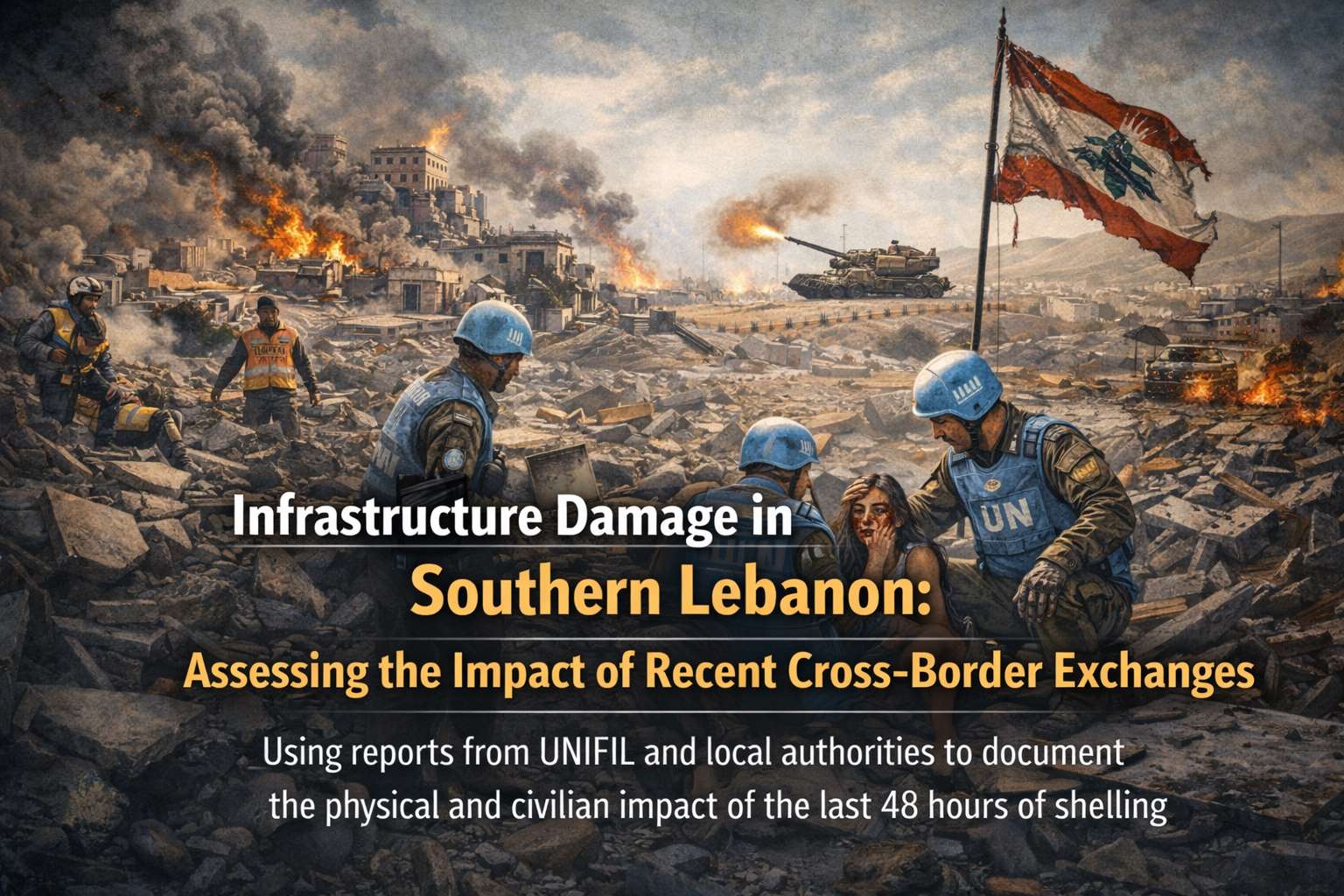
Using reports from UNIFIL and local authorities to document the physical and civilian impact of the last 48 hours of shelling.
Publication date: April 17, 2026
Last updated: April 17, 2026
Byline: Staff Writer, Global War News
The border regions of southern Lebanon have experienced a significant intensification of cross-border shelling and aerial strikes over the last 48 hours, resulting in widespread damage to civilian and international infrastructure. While the Blue Line—the 120-kilometer boundary between Lebanon and Israel—has seen persistent instability for years, the recent surge in kinetic activity has shifted focus toward the systematic degradation of essential service networks and the obstruction of international monitoring missions.
According to reports from the United Nations Interim Force in Lebanon (UNIFIL) and the Lebanese Ministry of Public Health, the escalation has paralyzed movement across the Litani River and further isolated communities in the South of the Litani River (SLR) area.
Damage to Civil and Essential Infrastructure
Local authorities and international humanitarian partners have documented a series of strikes targeting critical transit and utility points. According to the UN Office for the Coordination of Humanitarian Affairs (OCHA), the bombing of the Qasmieh Bridge near Tyre on April 8 had already severed a vital link to the rest of the country. Recent shelling over the last 48 hours has reportedly expanded this damage to smaller, secondary routes.
The physical impact on the ground includes:
- Healthcare Facilities: According to the Lebanese Ministry of Public Health, at least 14 hospitals and 7 primary healthcare centers in the south have sustained direct or indirect damage. As of mid-April, 6 hospitals have been forced to cease operations entirely due to structural risks and proximity to active combat.
- Water and Power: Reports from the Tahrir Institute for Middle East Policy indicate that water pumping stations and electricity networks in the Bint Jbeil and Marjayoun sectors have been repeatedly hit, leaving thousands without consistent access to potable water.
- Residential Destruction: Amnesty International and local monitors report that tens of thousands of structures in the south have been damaged or destroyed since late 2024, with recent “controlled detonations” and artillery fire leveled at entire residential blocks in border villages.
Impact on International Monitoring Missions (UNIFIL)
The security environment for international peacekeepers has also deteriorated. On April 15, 2026, UNIFIL issued a formal statement describing the “obstruction of logistical movements.” The mission reported that a routine convoy transporting peacekeepers and essential contractors was halted by Israel Defense Forces (IDF) personnel just kilometers from its headquarters in Naqoura.
Furthermore, UNIFIL reported on April 12 that an Israeli Merkava tank rammed its vehicles in the Bayada area on two separate occasions, causing “heavy damage.” The mission also documented the destruction of force protection cameras at its headquarters and five other positions along the Blue Line. UNIFIL stated that these actions “hinder peacekeepers’ ability to report violations by both sides on the ground.”
Analysis: The Tactical Impact of Infrastructure Attrition
Analysts suggest that the targeting of bridges and transit corridors indicates a strategy aimed at isolating the southern border region from the rest of Lebanon. By severing the Litani River crossings, military planners can effectively limit the mobility of armed groups while simultaneously creating a humanitarian vacuum that forces civilian displacement.
According to the Tahrir Institute, the framing of Southern Lebanon as an “abstract militarized zone” often leads to the systematic destruction of the economic and social systems that sustain civilian life, such as agricultural orchards and local workshops. This “anatomy of destruction” complicates future reconstruction, as the World Bank now estimates the total damage to the southern region at approximately $4.76 billion.
Context and Background: The Blue Line and Resolution 1701
The current situation is governed—in principle—by UN Security Council Resolution 1701, which was intended to end the 2006 conflict by establishing a zone between the Blue Line and the Litani River free of any armed personnel other than those of the Lebanese Government and UNIFIL.
However, the reality on the ground in 2026 is one of near-total erosion of these mandates. The escalation in April follows a collapse of earlier ceasefire efforts between regional powers. As displacement figures cross the one-million mark in Lebanon, the border region has been effectively transformed into a high-intensity combat zone where civilian infrastructure is increasingly treated as a secondary concern to tactical positioning.
Looking Ahead
Humanitarian organizations warn that if the current pace of infrastructure destruction continues, the “pre-war economic and social life” of South Lebanon may be permanently extinguished. With the last operational bridges over the Litani under constant threat, the ability of aid convoys to reach the thousands of civilians remaining in the south is becoming nearly impossible. International monitors will be watching for any shift in engagement rules that might provide a “humanitarian window” for the repair of water and power systems, though recent strikes suggest that de-escalation is not imminent.
Sources: This article is based on official statements from the United Nations Interim Force in Lebanon (UNIFIL), the Lebanese Ministry of Public Health, the UN Office for the Coordination of Humanitarian Affairs (OCHA), and reports from the Tahrir Institute for Middle East Policy and Amnesty International.
This article is based on publicly available reporting from named international news agencies and attributed official statements. All claims about ongoing events are attributed to their original sources. Analysis sections represent the editorial interpretation of reported facts and do not constitute advocacy for any party to the described conflict. AI tools may be utilized for image generation to assist in explaining complex concepts, as well as for refining grammar, spelling, and other linguistic enhancements. However, all original content is produced, fact-checked, and revised by the editorial team. This publication does not take political positions on active military conflicts.