
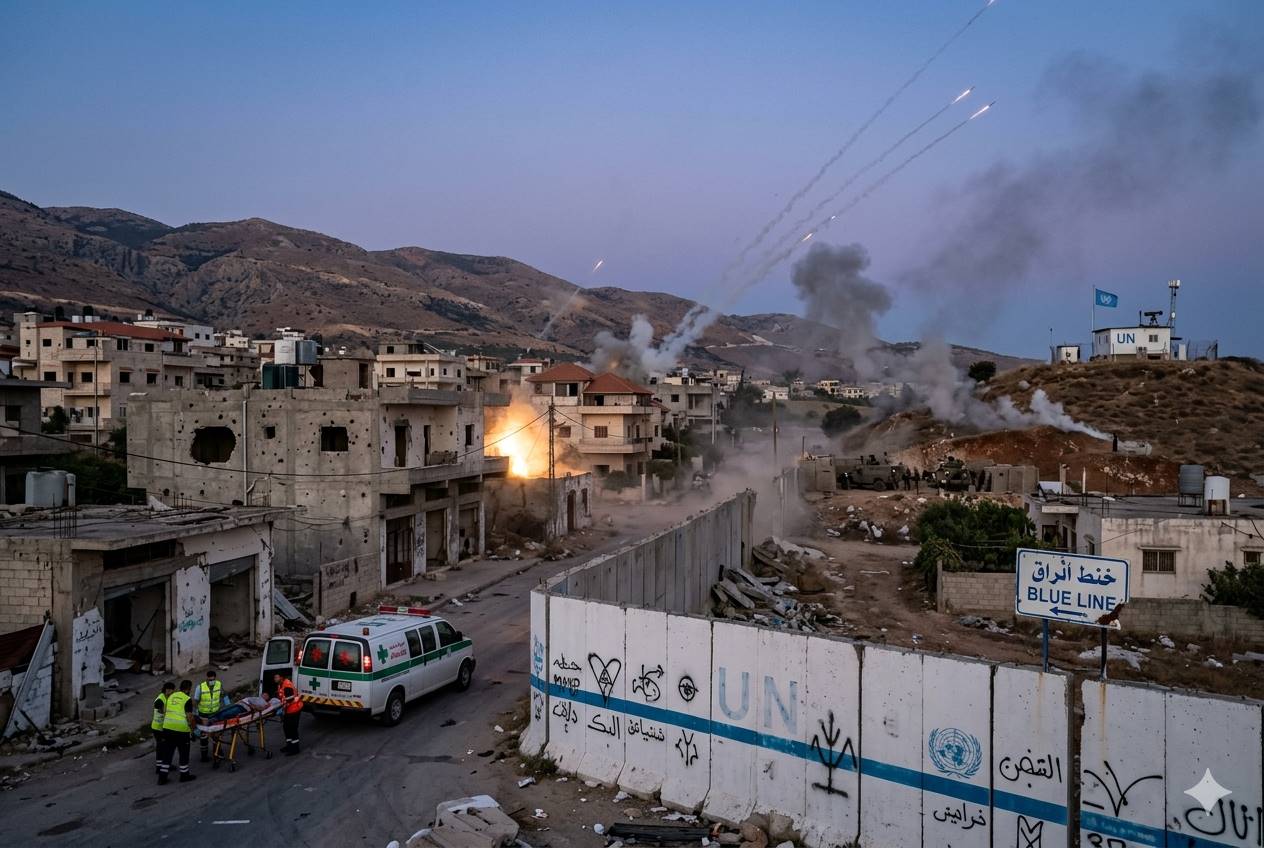
Cross-border aerial strikes continue as Lebanon reports paramedic casualties and Israel cites ongoing rocket barrages from the north.
April 16, 2026
Last Updated: 12:45 PM
By Staff Writer, Global War News
The border region between Israel and Lebanon has seen a marked escalation in aerial activity over the last 24 hours. According to statements from the Israel Defense Forces (IDF) and the Lebanese National News Agency (NNA), dozens of projectiles were exchanged as frontline operations continue to expand despite parallel diplomatic efforts in Washington.
The most significant developments occurred in the Nabatieh District and along the coastal highway south of Beirut. While military officials in Tel Aviv state that their operations are localized and targeted at dismantling Hezbollah infrastructure, Lebanese health authorities have reported multiple strikes on civilian and first-responder personnel. These reports emerge as the regional death toll in Lebanon has reportedly surpassed 2,100 since the expansion of hostilities in early March.
Targeted Strikes in Southern Lebanon
According to a report from the Lebanese Ministry of Public Health, at least three paramedics were killed and six others injured on Wednesday following consecutive strikes in the town of Mayfadoun. The ministry stated that the rescue workers were targeted in “three consecutive, targeted strikes” while attempting to respond to an earlier incident. As reported by the Associated Press, the IDF did not comment directly on the Mayfadoun incident but stated it was investigating the reports.
In a separate update, the NNA reported that Israeli aircraft targeted two vehicles on the coastal highway approximately 20 kilometers south of Beirut. AFP photographers at the scene documented the remains of a charred van, though official casualty figures for this specific incident remain unverified. These strikes represent an expansion of aerial activity outside of the traditional southern conflict zones and the Dahieh suburbs.
Rocket Fire and Defensive Operations in Northern Israel
From the Israeli side, the IDF reported that Hezbollah launched approximately 30 rockets toward northern Israel throughout Wednesday. According to a statement released by the military, several projectiles were intercepted by the Iron Dome defense system, while others landed in open areas or near the settlements of Metula and Misgav Am.
Local Israeli media reported structural damage to at least one building in the Galilee region, though no fatalities were confirmed from the Wednesday morning barrages. The IDF’s Chief of Staff, Lt. Gen. Eyal Zamir, emphasized during a visit to frontline troops that the military has been ordered to maintain a “terrorist kill zone” up to the Litani River line. Zamir stated that the objective remains the permanent degradation of the Radwan Force’s ability to launch cross-border incursions.
Analysis: Escalation Amidst Negotiation
The timing of these strikes is particularly significant, occurring just as high-level talks between Israeli and Lebanese envoys were hosted by US Secretary of State Marco Rubio. While mediators described the talks as a “positive opening,” the reality on the ground reflects a different trajectory.
Analysts suggest that both parties are engaging in a “negotiation under fire” strategy. By maintaining or increasing the tempo of operations, each side aims to improve its leverage at the bargaining table. However, the reported targeting of medical personnel and the use of precision strikes in central Lebanon raise concerns that the traditional “red lines” intended to prevent total war have significantly eroded. Observers note that if the IDF continues to target logistics and personnel deep within Lebanese territory, a reciprocal escalation targeting major Israeli urban centers may follow, potentially collapsing the current fragile ceasefire framework between regional powers.
Closing and Humanitarian Outlook
The humanitarian situation in southern Lebanon remains critical. The UN reports that 1.2 million people are now displaced, with 140,000 residing in overcrowded collective shelters. The targeting of essential infrastructure, including bridges over the Litani River, has severely restricted the movement of aid.
In northern Israel, thousands remains displaced from their homes, and the constant sound of air raid sirens has become a permanent feature of life in the Galilee. As of mid-April, both sides appear prepared for a prolonged conflict of attrition unless a formal ceasefire agreement can be reached in the coming weeks.
Sources: This article is based on reporting and official statements from the IDF, the Lebanese National News Agency (NNA), the Lebanese Ministry of Public Health, Reuters, Agence France-Presse (AFP), and the Associated Press (AP).
This article is based on publicly available reporting from named international news agencies and attributed official statements. All claims about ongoing events are attributed to their original sources. Analysis sections represent the editorial interpretation of reported facts and do not constitute advocacy for any party to the described conflict. AI tools may be utilized for image generation to assist in explaining complex concepts, as well as for refining grammar, spelling, and other linguistic enhancements. However, all otherwise original content is produced, fact-checked, and revised by the editorial team. This publication does not take political positions on active military conflicts.