
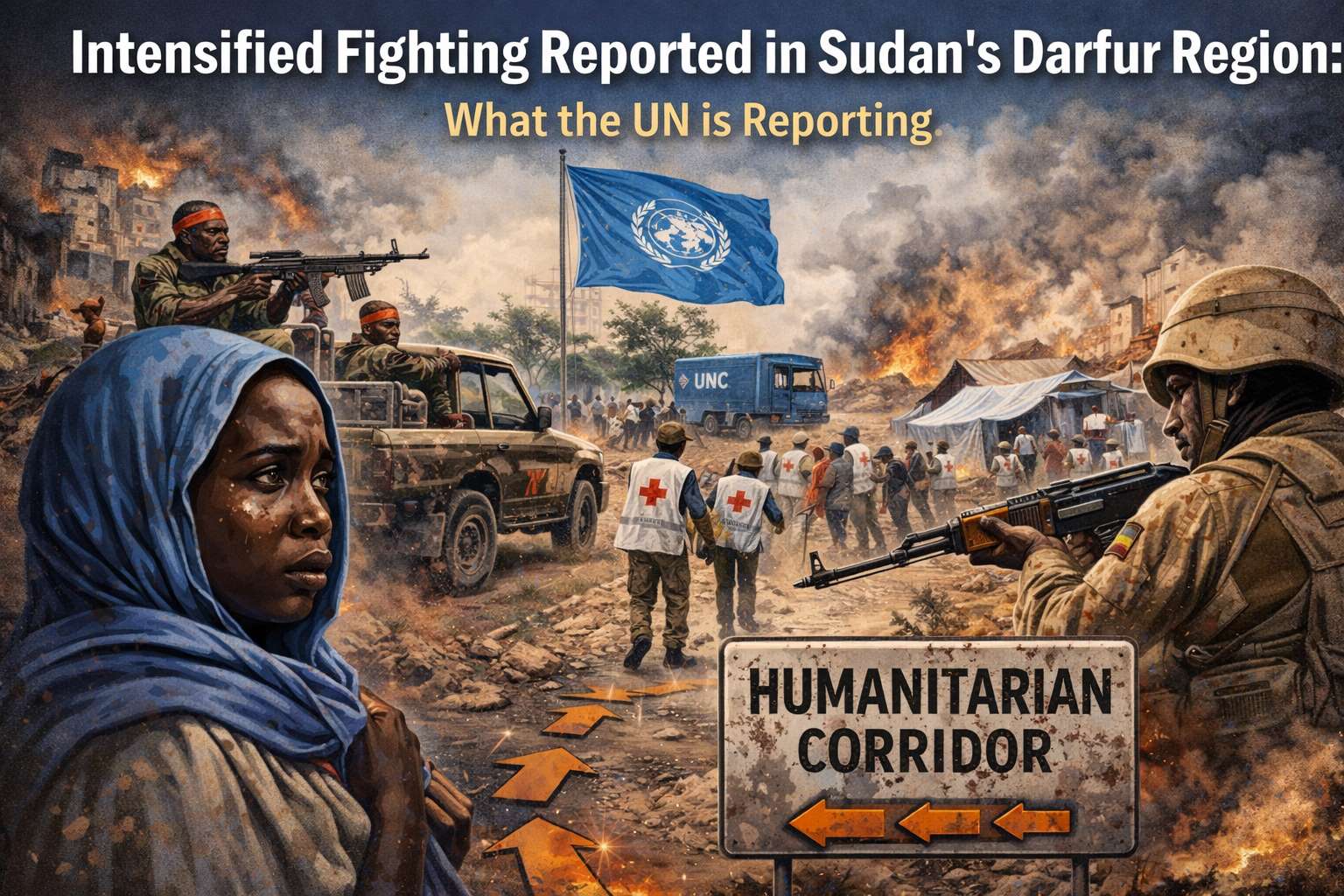
A summary of reports regarding renewed clashes between the RSF and SAF, focusing on humanitarian corridors.
Publication date: April 17, 2026
Last updated: April 17, 2026
Byline: Staff Writer, Global War News
The conflict in Sudan, now entering its fourth year, has seen a significant escalation in the Darfur region over the past week. Reports from United Nations monitors and international humanitarian agencies indicate that the city of El Fasher, the provincial capital of North Darfur, is once again a central flashpoint for intense kinetic activity between the Sudanese Armed Forces (SAF) and the paramilitary Rapid Support Forces (RSF).
According to the UN Independent International Fact-Finding Mission for Sudan, the current wave of violence is severely restricting the movement of civilians and the delivery of life-saving aid. This escalation follows months of siege-like conditions that have already triggered famine in several displacement camps.
Central to the current crisis is the systematic obstruction of “humanitarian corridors”—designated routes meant to ensure the safe passage of aid and civilians. Both warring parties have been accused of using these corridors as tactical leverage, directly contributing to what the UN describes as the world’s largest displacement crisis.
Renewed Clashes and Strategic Stalemate
The most recent reporting from the UN Human Rights Council (UNHRC) highlights large-scale RSF attacks on settlements near El Fasher. These maneuvers are reportedly aimed at consolidating control over the last major urban stronghold in Darfur not fully held by the paramilitary group. Conversely, the SAF has responded with intensified airstrikes. According to Human Rights Watch, these strikes have frequently impacted residential areas and commercial markets, leading to high civilian casualties.
The Institute for the Study of War (ISW) notes that the battle for El Fasher is strategically critical for both sides. For the RSF, full control of North Darfur would secure a vast territorial bloc. For the SAF, maintaining a presence in the city represents their last significant foothold in the west of the country.
The Collapse of Humanitarian Corridors
The primary concern for international monitors is the status of supply routes from the Chadian border. According to the International Organization for Migration (IOM), over 15 million people are now displaced across Sudan, with many in Darfur trapped without access to food or medical supplies.
The UN Fact-Finding Mission reported in mid-April 2026 that humanitarian convoys are being repeatedly hindered. According to their documentation:
- Administrative Hurdles: Both the SAF and RSF have implemented bureaucratic restrictions, including the withholding of travel permits for aid workers.
- Physical Obstructions: Armed groups have reportedly damaged water facilities and supply lines, particularly near the Zamzam displacement camp.
- Direct Attacks: Convoy drivers have reported being stopped at checkpoints where food and fuel are seized by soldiers from both sides.
As reported by Al Jazeera, the inability to secure these corridors has led to Global Acute Malnutrition rates exceeding 50% in parts of North Darfur, a level far beyond the emergency threshold.
Analysis: The Weaponization of Aid
Analysts from the European Union Institute for Security Studies (EUISS) suggest that the obstruction of humanitarian corridors has moved beyond a byproduct of war and is now being used as a deliberate military tactic. By controlling the flow of food and medicine, warring factions can effectively exert pressure on local populations to align with their control.
This raises significant legal concerns. The UN Fact-Finding Mission recently stated that the RSF’s actions in Darfur, including the deprivation of food and humanitarian assistance, hold the “hallmarks of genocide” and may amount to crimes against humanity. The SAF, while positioned as the national military, faces similar scrutiny for indiscriminate shelling that has dismantled the very infrastructure required to facilitate aid.
Context and Background: The Legacy of Conflict in Darfur
The current violence in Darfur is deeply rooted in historical grievances and ethnic tensions that predated the 2023 fallout between General Abdel Fattah al-Burhan (SAF) and Mohamed Hamdan “Hemedti” Dagalo (RSF). Darfur was the site of a brutal conflict in the early 2000s that led to charges of genocide against the previous regime.
Many of the current RSF fighters originated from the Janjaweed militias used during that earlier conflict. The current war has reignited these old fault lines, with the UN reporting that non-Arab communities, particularly the Masalit people, are being systematically targeted.
Looking Ahead
The international community remains divided on how to intervene. While aid summits in Paris and Berlin have sought to raise billions in assistance, current funding levels remain at approximately 16% of what is required, according to the UN Development Programme (UNDP).
Without a verified ceasefire and the establishment of independently monitored humanitarian corridors, the residents of El Fasher and the wider Darfur region remain at risk of total isolation. International observers will be closely watching for signs of any diplomatic breakthrough that could force the warring parties to prioritize civilian survival over territorial gain.
Sources: This report is based on data and statements from the UN Independent International Fact-Finding Mission for Sudan, the UN Human Rights Council (UNHRC), the International Organization for Migration (IOM), the World Health Organization (WHO), Human Rights Watch, and the International Rescue Committee (IRC).
This article is based on publicly available reporting from named international news agencies and attributed official statements. All claims about ongoing events are attributed to their original sources. Analysis sections represent the editorial interpretation of reported facts and do not constitute advocacy for any party to the described conflict. AI tools may be utilized for image generation to assist in explaining complex concepts, as well as for refining grammar, spelling, and other linguistic enhancements. However, all original content is produced, fact-checked, and revised by the editorial team. This publication does not take political positions on active military conflicts.