
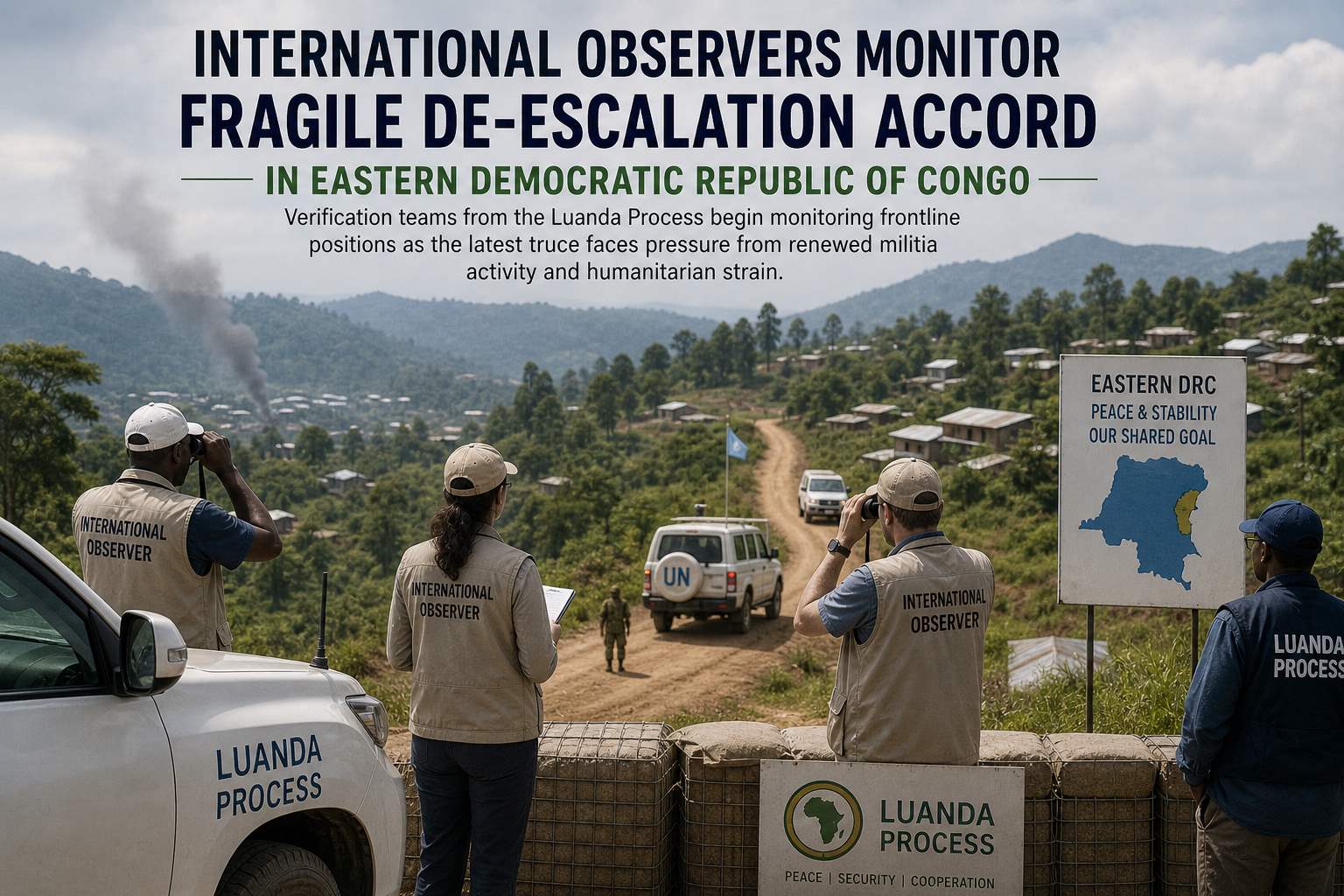
Verification teams from the Luanda Process begin monitoring frontline positions as the latest truce faces pressure from renewed militia activity and humanitarian strain.
May 4, 2026
Last Updated: May 4, 2026
By Staff Writer, Global War News
International monitoring teams have reportedly begun deploying to key areas in North Kivu this week to oversee a fragile de-escalation accord in the eastern Democratic Republic of Congo (DRC). According to official statements from the African Union and the Luanda Process mediators, the verification mechanism aims to ensure the separation of forces between the Congolese national army (FARDC) and the M23 insurgent group.
The deployment follows a renewed commitment to a ceasefire signed in late April, intended to provide a “humanitarian window” for aid deliveries to displaced populations. In a statement released on May 2, the United Nations Organization Stabilization Mission in the DRC (MONUSCO) confirmed it is providing logistical support to the regional observers, though it noted that sporadic skirmishes involving “non-signatory” armed groups continue to threaten the stability of the agreement.
While the primary combatants have largely maintained their current positions, local civil society organizations in Goma report that the situation remains tense. According to the Associated Press, residents have observed increased drone surveillance over the “buffer zones,” and several vital supply routes between Goma and the northern territories remain under the control of armed factions.
The Luanda Process and Regional Mediation
The current de-escalation effort is the latest iteration of the Luanda Process, a mediation framework led by Angolan President João Lourenço. The accord requires the withdrawal of M23 forces from seized territories and the cessation of all external support for armed groups operating in the DRC.
According to reports from Reuters, the success of the accord is heavily dependent on the cooperation of neighboring Rwanda, which the DRC government and several UN expert reports have alleged provides support to the M23. Rwanda has consistently denied these claims. The presence of international observers is designed to provide an objective record of movements on the ground to prevent “tit-for-tat” escalations based on unverified reports.
Economic Paralysis and the Mineral Trade
The protracted conflict in the eastern DRC is inextricably linked to the region’s vast mineral wealth, particularly tantalum, tin, and tungsten—minerals essential for global electronics. According to data from the International Peace Information Service (IPIS), over 50% of artisanal mining sites in North Kivu are currently subject to illegal “taxation” or direct control by various armed groups.
- Trade Disruption: The closure of the primary road link between Goma and the Rwandan border has increased the cost of imported consumer goods by approximately 25% in local markets.
- Agricultural Decline: The FAO reported in April 2026 that over 600,000 hectares of fertile land in the Rutshuru territory are inaccessible to farmers due to landmines and active patrols, leading to a localized food price surge of nearly 40%.
- Global Supply Chains: While the conflict has not yet halted industrial-scale mining in the south, analysts from the World Bank suggest that the persistent instability in the north is driving up “compliance and security costs” for international firms operating across the country.
Analysis: The Challenge of “Non-Signatory” Groups
Analysts have suggested that the greatest threat to the Luanda Process is the fragmentation of the conflict. While the FARDC and M23 are the primary actors, the eastern DRC is home to over 100 active armed groups, including the ADF and various “Wazalendo” (patriot) militias. These groups are not formal parties to the ceasefire and often operate with their own local agendas.
Observers note that as long as these “third-party” groups continue to engage in combat, the primary forces are likely to remain in a state of high alert, making a full withdrawal difficult to achieve. This creates a “security vacuum” where political agreements made in Luanda or Nairobi often fail to translate into peace on the hills of Masisi and Rutshuru.
Current Standing
As of May 4, 2026, the ceasefire holds in name, but the humanitarian situation is critical. The UN Refugee Agency (UNHCR) reports that the number of internally displaced persons (IDPs) in the DRC has reached a record 7.2 million. The international observers now on the ground represent a thin line between a potential path to peace and a return to full-scale regional war. Their reports over the next fortnight will likely determine if the regional mediators can move the process from a fragile truce to a durable political settlement.
Source Disclosure: Factual reporting on the observer deployment and the Luanda Process is based on official statements from the African Union, MONUSCO, and the Angolan government. Economic data and mining site information were sourced from the International Peace Information Service (IPIS) and the World Bank. Humanitarian figures were provided by the UNHCR and the FAO. Secondary reporting was sourced from Reuters and the Associated Press (AP).
This article is based on publicly available reporting from named international news agencies and attributed official statements. All claims about ongoing events are attributed to their original sources. Analysis sections represent the editorial interpretation of reported facts and do not constitute advocacy for any party to the described conflict. AI tools may be utilized for image generation to assist in explaining complex concepts, as well as for refining grammar, spelling, and other linguistic enhancements. However, all original content is produced, fact-checked, and revised by the editorial team. This publication does not take political positions on active military conflicts.