
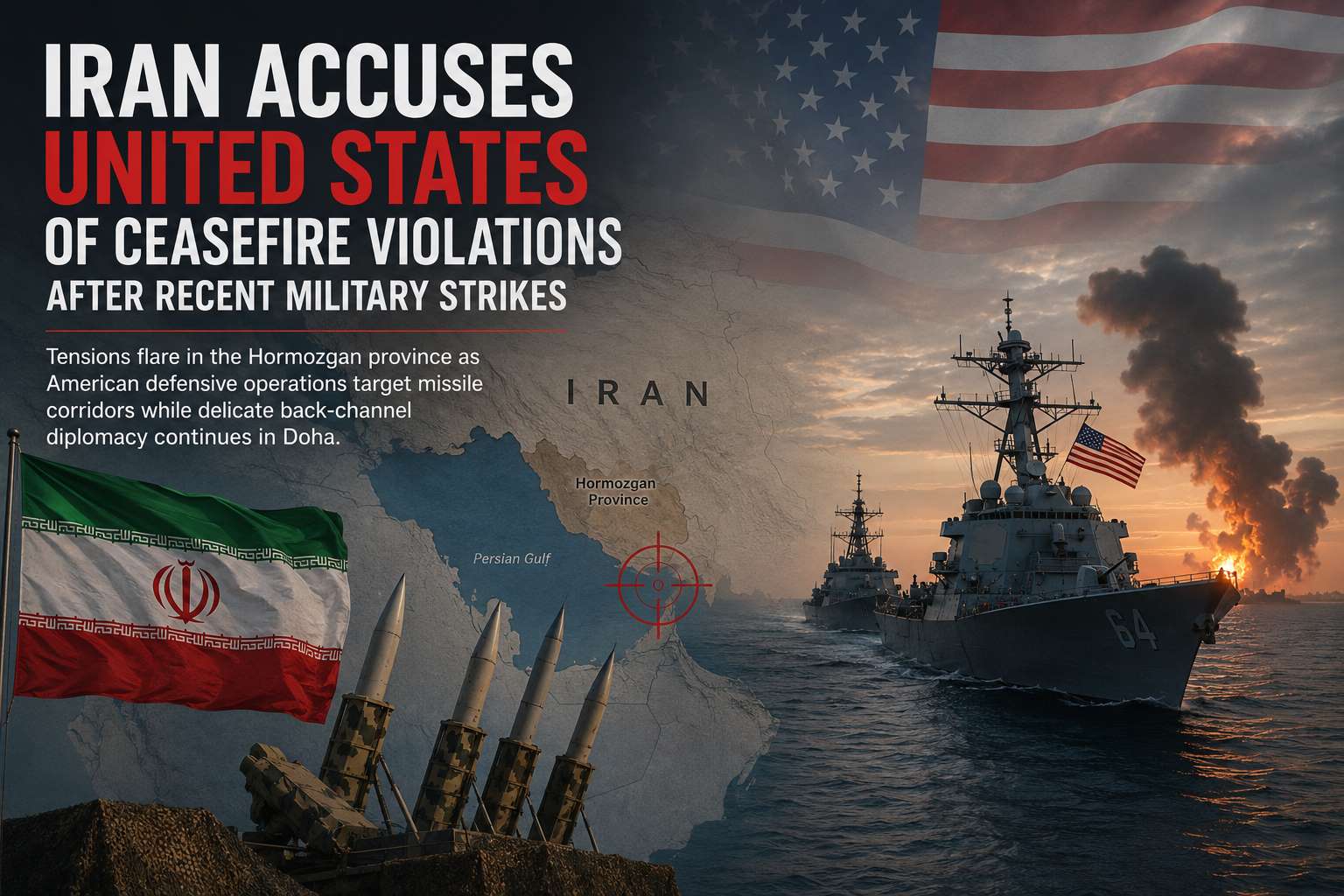
Tensions flare in the Hormozgan province as American defensive operations target missile corridors while delicate back-channel diplomacy continues in Doha.
Published: May 27, 2026
Last Updated: May 27, 2026
By Global War News Editorial
The fragile regional truce established on April 8 faced its most severe challenge on Tuesday as the Iranian government formally accused the United States of committing a gross violation of their standing ceasefire agreement. The diplomatic friction follows a series of intense American military strikes conducted along Iran’s southern coastline, threatening to disrupt complex negotiations intended to permanently resolve the multi-month conflict.
The confrontation comes at a critical moment for international mediators. High-level Iranian envoys returned to Tehran on Tuesday evening following two days of intensive, back-channel diplomacy in Qatar. While political leaders from both Washington and Tehran maintain that a final peace framework remains within technical reach, the latest kinetic exchanges around the strategic Strait of Hormuz emphasize how vulnerable the temporary security architecture remains to tactical field developments.
Escalation in the Hormozgan Province
The diplomatic dispute erupted after the United States Central Command confirmed it had executed targeted military actions inside southern Iran’s Hormozgan region. According to a public statement issued by U.S. Central Command spokesman Captain Tim Hawkins, American naval and air forces conducted defensive strikes against operational missile launch sites and specialized military vessels. The Pentagon asserted that the targeted units were attempting to emplace naval mines within regional transit lanes.
The Iranian Foreign Ministry issued a sharp condemnation via state media channels, characterizing the operations as an illegal and unjustified breach of the seven-week-old truce.
Iranian state broadcaster IRIB reported that multiple loud explosions were monitored around the port city of Bandar Abbas, which hosts a major naval installation and a dual-use domestic airport. While the semi-official Mehr news agency later reported that local conditions had stabilized, the Islamic Revolutionary Guard Corps confirmed that four of its personnel were killed during the American strikes targeting coastal transport craft. Iranian defense units also asserted they had engaged an F-35 fighter jet and downed an unmanned aerial vehicle that had allegedly entered sovereign Iranian airspace during the engagement.
The Diplomatic Track in Doha
Despite the visible increase in front-line hostilities, parallel diplomatic efforts mediated by Qatari officials continue in Doha. A senior Iranian delegation led by parliamentary speaker Mohammad Bagher Ghalibaf, Foreign Minister Abbas Araghchi, and Central Bank Governor Abdolnaser Hemmati concluded a intensive round of discussions aimed at expanding the initial truce into a comprehensive 60-day regional settlement.
According to reporting published by the semi-official Tasnim news agency, a core sticking point remains the sequencing of sanctions relief and the liberation of state funds. Iranian negotiators are currently seeking the structured release of approximately $24 billion in frozen international assets, demanding that at least half of the total amount be disbursed during the initial execution phase of any final memorandum of understanding.
U.S. Secretary of State Marco Rubio acknowledged the ongoing friction during a diplomatic visit to India on Tuesday, noting that negotiators are working through specific terminology adjustments. On social media, U.S. President Donald Trump indicated that the discussions were moving forward but emphasized that the administration would not rush the process, reiterating that the United States would only sign a highly favorable agreement.
Analysis: The Strait of Hormuz Blockade and Regional Friction
The strategic calculus driving the current conflict revolves entirely around maritime access. Following the initial outbreak of hostilities on February 28, the effective closure of the Strait of Hormuz, through which roughly 20 percent of global petroleum supplies normally transit—has severely impacted global energy markets and raised shipping costs across international supply lines.
Economic Insight: The partial or complete closure of the Strait of Hormuz directly influences global energy indices, rendering the status of the waterway the central pivot of international negotiations.
The proposed 60-day peace framework seeks to address this economic paralysis by requiring Iran to systematically remove naval mines and permit unhindered commercial shipping without imposing transit tariffs. In return, Washington would offer phased economic concessions. However, the operational execution of these terms remains deeply complicated by two distinct factors:
- Mine Accountability: Operational tracking indicates that some maritime units have encountered difficulties locating previously deployed naval mines, complicating efforts to fully open verified shipping lanes safely.
- The Lebanese Theater: Tehran continues to demand that any permanent peace accord explicitly incorporate a cessation of hostilities in Lebanon, where the Israeli military has simultaneously intensified its ground actions against Hezbollah units along the Litani River.
Because the United States and Israel have largely resisted linking the Iranian maritime track directly to the ongoing ground conflict in Lebanon, tactical friction points are likely to persist even as diplomats finalize technical drafts in Doha.
Current Status and Outlook
By Wednesday morning, international monitors reported a cautious calm returning to the waters of the Gulf of Oman, though both militaries remain on high alert. In a public statement marking the Eid al-Adha holiday, Iran’s Supreme Leader Ayatollah Mojtaba Khamenei warned regional states against permitting foreign forces to utilize local military installations for operations against Iranian territory, suggesting that regional power dynamics are permanently shifting away from traditional frameworks.
While global energy markets reacted with minor volatility to the Bandar Abbas strikes, international powers have urged restraint. Chinese Foreign Ministry spokeswoman Mao Ning called on all involved parties to strictly adhere to their existing ceasefire commitments and resolve emerging disputes through established diplomatic channels to prevent a broader escalation.
Source Disclosure Note: This report compiles official military notifications from the United States Central Command (CENTCOM), state media dispatches from the Iranian Islamic Republic News Agency (IRNA), regional tracking by the Tasnim and Mehr news agencies, statements from the U.S. Department of State, and independent operational reporting from Reuters, the Financial Times, and The Guardian.
This article is based on publicly available reporting from named international news agencies and attributed official statements. All claims about ongoing events are attributed to their original sources. Analysis sections represent the editorial interpretation of reported facts and do not constitute advocacy for any party to the described conflict. AI tools may be utilized for image generation to assist in explaining complex concepts, as well as for refining grammar, spelling, and other linguistic enhancements. However, all original content is produced, fact-checked, and revised by the editorial team. This publication does not take political positions on active military conflicts.