
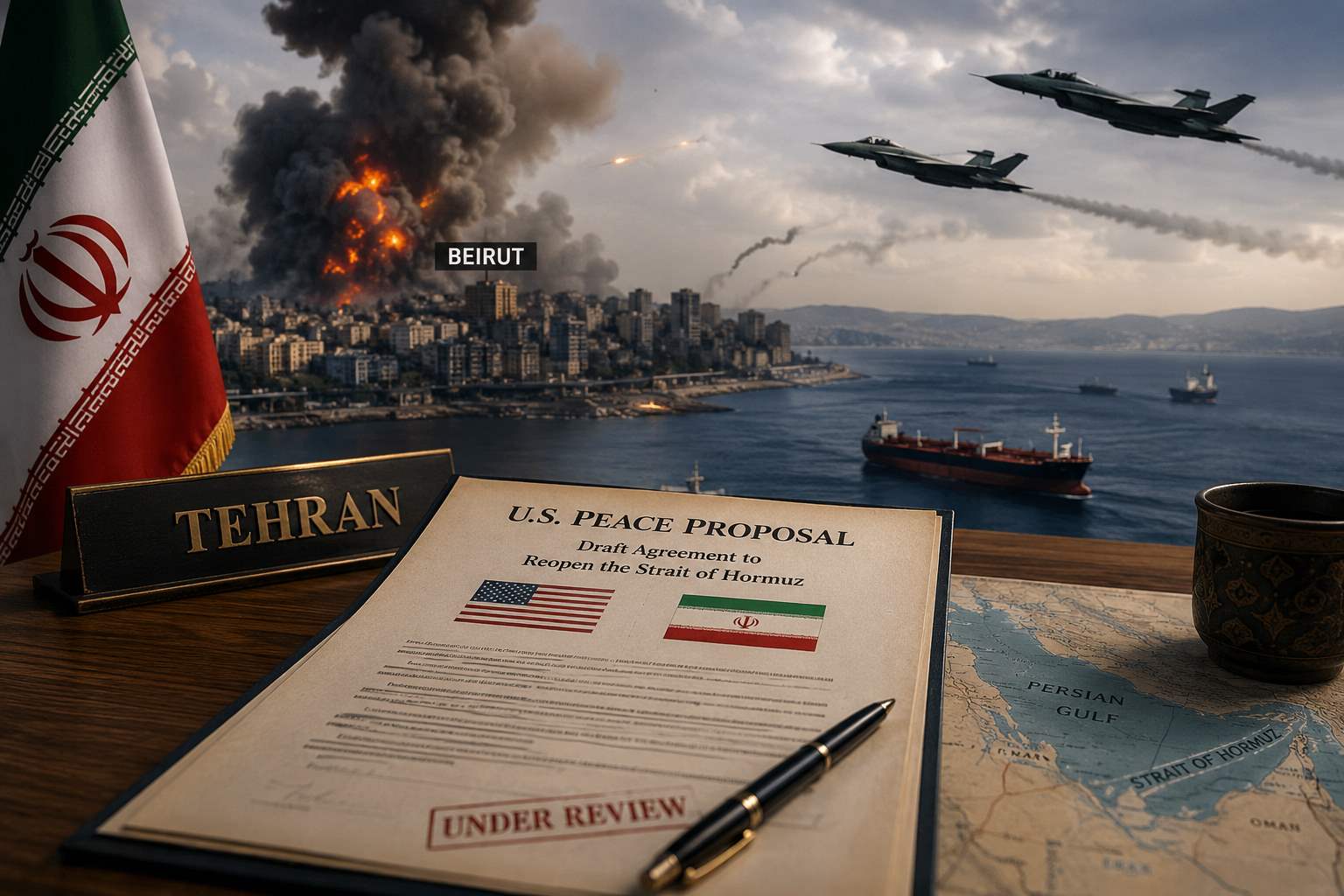
Tehran evaluates a draft agreement to reopen the Strait of Hormuz as regional kinetic activity persists.
May 8, 2026
Global War News Editorial
Tehran is currently assessing a formal United States proposal aimed at ending the 69-day conflict, according to official statements from the Iranian Foreign Ministry. The diplomatic movement comes as the Trump administration intensifies pressure on the Islamic Republic to accept terms that include the reopening of the Strait of Hormuz, a critical global energy artery that has remained largely restricted since the outbreak of hostilities in late February.
Iranian Foreign Ministry spokesperson Esmaeil Baghaei told the state-run Islamic Republic News Agency (IRNA) on Thursday that while the document is under review, Tehran has not yet reached a final conclusion. The proposed framework reportedly involves a temporary memorandum intended to stabilize regional shipping and establish a 30-day window for broader negotiations regarding nuclear and sanctions issues.
Escalation in Lebanon
The diplomatic track remains shadowed by a sharp increase in military activity in Lebanon. According to reporting from the Associated Press and Reuters, Israel conducted its first airstrike on Beirut’s southern suburbs since an April ceasefire agreement on Wednesday and Thursday. The Israel Defense Forces (IDF) stated that the strike successfully targeted Ahmed Balout, identified by the military as a commander in Hezbollah’s elite Radwan Force.
Hezbollah has not publicly commented on the loss of the commander but responded on Friday by launching a salvo of rockets toward northern Israel. Lebanese health officials reported that subsequent Israeli strikes on southern villages near Tyre killed at least five people, including a paramedic. These exchanges underscore the fragility of the regional security environment even as high-level mediators in Pakistan express cautious optimism about a diplomatic breakthrough.
The “Wait and See” in Tehran
Analysts note that the Iranian leadership appears to be balancing internal pressure with the external threat of renewed large-scale bombing. U.S. President Donald Trump stated publicly this week that talks have been “very good,” yet he simultaneously issued warnings on social media that military operations would resume if a deal regarding the Strait of Hormuz is not finalized quickly.
The Iranian mission to the United Nations has maintained that a permanent end to the U.S. naval blockade is the only “viable solution” to the shipping crisis. This position reflects a central tension in the current negotiations: Washington is seeking an interim deal to restore global oil flow, while Tehran is pushing for comprehensive sanctions relief and a formal cessation of the war.
Analysis: The Strategic Dilemma
The current situation presents a complex strategic calculation for all parties. For Tehran, accepting the U.S. proposal could provide much-needed economic breathing room but might be viewed domestically as a concession under duress. For Washington, the priority remains the stabilization of global energy markets.
Observers note that the inclusion of the Lebanon front in the draft U.S.-Iran agreement, as reported by Israel’s Channel 12, suggests that mediators are attempting to de-escalate the entire “northern arc” of the conflict simultaneously. However, the recent strikes in Beirut demonstrate that military commanders on the ground are continuing to pursue tactical objectives, which could inadvertently collapse the diplomatic window before a formal response is delivered from Tehran.
Outlook
The coming days are expected to be critical as Pakistan, acting as a key mediator, facilitates the exchange of messages between the warring parties. Pakistani Foreign Ministry spokesperson Tahir Andrabi stated that an agreement is expected “sooner rather than later,” though he declined to provide a specific timeline. Market participants and regional governments remain focused on whether Tehran’s “review” of the proposal will result in a signature or a return to active escalation.
Sources: Associated Press, Reuters, IRNA (Iran State Media), Council on Foreign Relations, The Wall Street Journal, and official statements from the Pakistani Foreign Ministry.
This article is based on publicly available reporting from named international news agencies and attributed official statements. All claims about ongoing events are attributed to their original sources. Analysis sections represent the editorial interpretation of reported facts and do not constitute advocacy for any party to the described conflict. AI tools may be utilized for image generation to assist in explaining complex concepts, as well as for refining grammar, spelling, and other linguistic enhancements. However, all original content is produced, fact-checked, and revised by the editorial team. This publication does not take political positions on active military conflicts.