
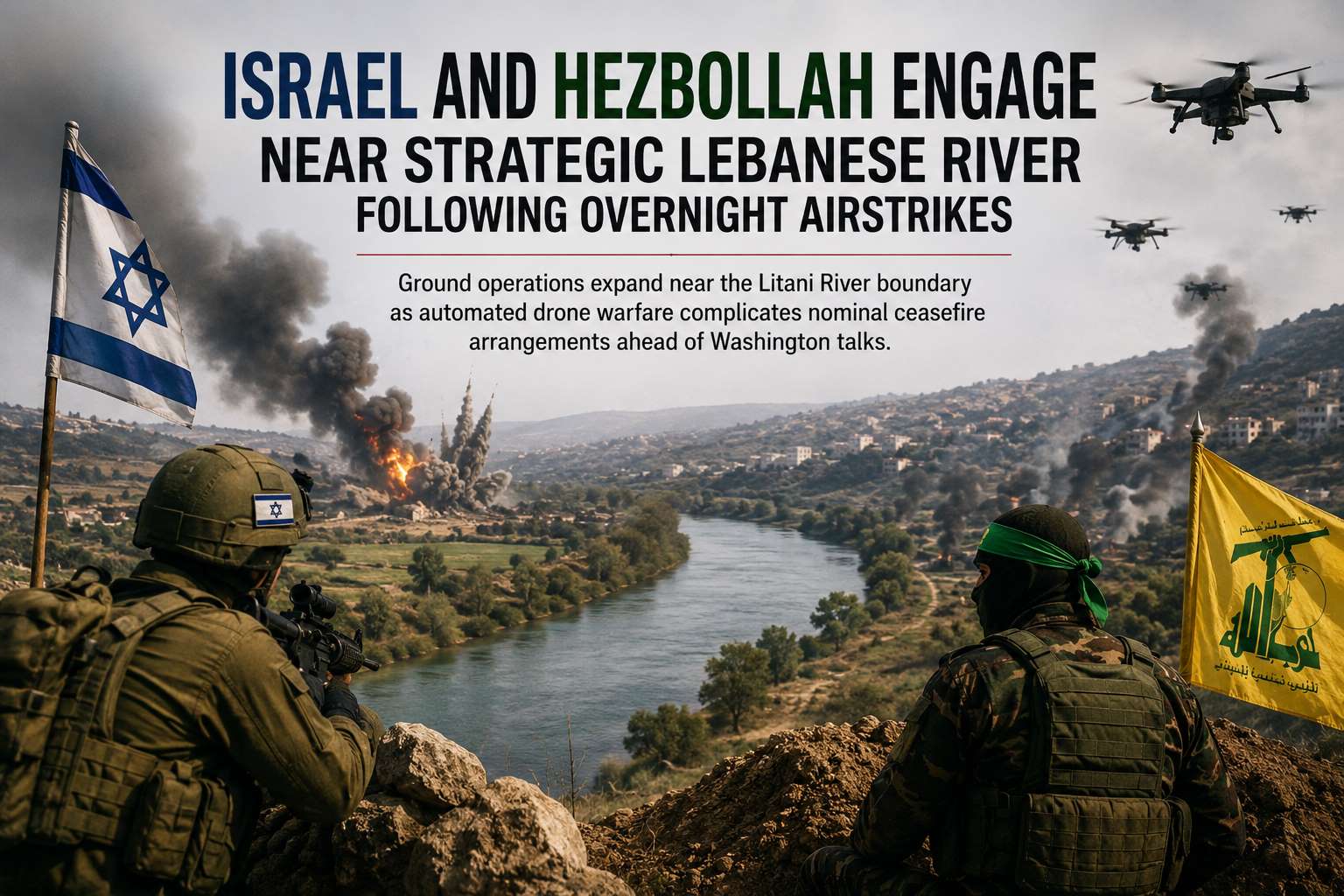
Ground operations expand near the Litani River boundary as automated drone warfare complicates nominal ceasefire arrangements ahead of Washington talks.
Published: May 27, 2026
Last Updated: May 27, 2026
By Global War News Editorial
The U.S.-brokered ceasefire between Israel and Hezbollah appeared increasingly nominal on Tuesday as heavy ground fighting and airstrikes intensified along Lebanon’s strategic Litani River. Armed clashes erupted on the banks of the waterway as Israeli forces pushed further north, marking an expansion of the ground offensive that began following the regional outbreak of hostilities on March 2.
The escalation comes just days before military delegations from Israel and the reform-minded Lebanese government are scheduled to convene in Washington for direct talks. The Lebanese administration hopes to secure a permanent truce and full Israeli withdrawal. However, Israeli Prime Minister Benjamin Netanyahu announced on Tuesday that he has authorized “deepening operations” to permanently neutralise Hezbollah infrastructure near the border, signaling that a broader geopolitical settlement with Iran may not automatically halt the conflict in Lebanon.
Escalation Along the Litani Frontier
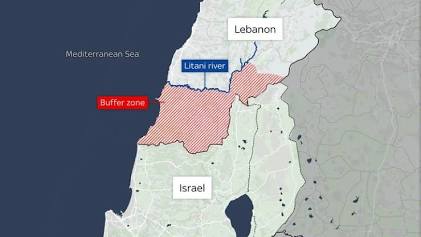
The Litani River has served as a critical geographic boundary throughout decades of border instability. Large sectors south of the river have fallen under active Israeli military control since the initial offensive in early March. According to statements released by the Israel Defense Forces, Israeli troops are operating with substantial ground formations to secure heights along the riverbank, asserting that these positions are vital to shield border communities in northern Israel from recurring cross-border attacks.
Source: Hidropolitik Akademi
In response to the advancing ground units, Hezbollah forces carried out a series of rocket, artillery, and exploding drone strikes. According to updates broadcast by Hezbollah’s Al-Manar television network, the group engaged mobilizing Israeli vehicles and personnel heading toward the Nabatieh province villages of Yohmor al-Shaqif and Zawtar al-Sharqieh, claiming to have repelled infantry advances directly along the riverbank.
Overnight Airstrikes and Civilian Toll
The ground engagements followed a wave of over 100 overnight airstrikes conducted by the Israeli Air Force across southern Lebanon and the eastern Bekaa Valley. The Israeli military stated that the operation successfully hit command centers, observation posts, and storage sites utilized by Hezbollah networks.
The strikes resulted in severe casualties within residential zones. Lebanon’s state-run National News Agency reported that an airstrike in the eastern village of Mashghara killed 12 people, including several members of a single family. Concurrently, the Israeli military issued immediate evacuation orders for the major southern city of Nabatieh, located just north of the Litani River, causing thousands of residents to flee toward central Lebanon. The United Nations reported that an Israeli strike also destroyed a major Civil Defense facility in Nabatieh, heavily limiting regional emergency and rescue capabilities.
Analysis: The Strategic Hydropolitical Divide
The current battle for control of the Litani River highlights its unique status as both a military and economic lifeline. Running entirely within Lebanon’s borders, the river serves as the primary source of irrigation and hydroelectric power for the country’s southern regions.
Strategic Context: Control of the Litani effectively dictates the terms of security for northern Israel and economic survival for southern Lebanon.
By advancing directly to the river’s edge, the Israeli military aims to establish a permanent geographic buffer zone. This moves Hezbollah out of direct line-of-sight anti-tank missile range from Israeli border towns. However, the fighting has moved dangerously close to critical civilian infrastructure. On Tuesday, an airstrike hit near the Qaraoun Dam, Lebanon’s largest reservoir on the Litani. While the Litani River Authority confirmed the dam sustained no structural damage, observers note that prolonged combat around these nodes risks crippling Lebanon’s already fragile national power grid.
The tactical nature of the conflict is also shifting. In recent weeks, Hezbollah has deployed new fiber-optic guided drones. These systems are immune to standard radio-frequency jamming and have proven difficult for Israeli air defenses to intercept. According to official Israeli data, drone strikes have caused the majority of Israeli military casualties since the nominal April ceasefire took effect, prompting warnings against troop gatherings on the front lines.
Diplomatic Deadlock Ahead of Washington Talks
The fighting complicates the diplomatic track in Washington. The Lebanese government enters negotiations seeking a strict enforcement of international border lines. However, Beirut remains politically unable and unwilling to deploy its national army to forcibly disarm Hezbollah, which opposes the direct talks.
Compounding the deadlock, U.S. and Israeli officials have rejected attempts by Tehran to link an end to the fighting in Lebanon with a wider U.S.-Iran diplomatic settlement. With Hezbollah vowing to fight until a total Israeli withdrawal occurs, and Israel refusing to leave without a dismantled insurgent infrastructure, the Litani River remains a highly volatile front line.
Source Disclosure Note: This report relies on official statements from the Israel Defense Forces (IDF), field dispatches from Lebanon’s state-run National News Agency (NNA), independent operational tracking by the United Nations Interim Force in Lebanon (UNIFIL), and wire reports from Reuters and The Associated Press.
This article is based on publicly available reporting from named international news agencies and attributed official statements. All claims about ongoing events are attributed to their original sources. Analysis sections represent the editorial interpretation of reported facts and do not constitute advocacy for any party to the described conflict. AI tools may be utilized for image generation to assist in explaining complex concepts, as well as for refining grammar, spelling, and other linguistic enhancements. However, all original content is produced, fact-checked, and revised by the editorial team. This publication does not take political positions on active military conflicts.