
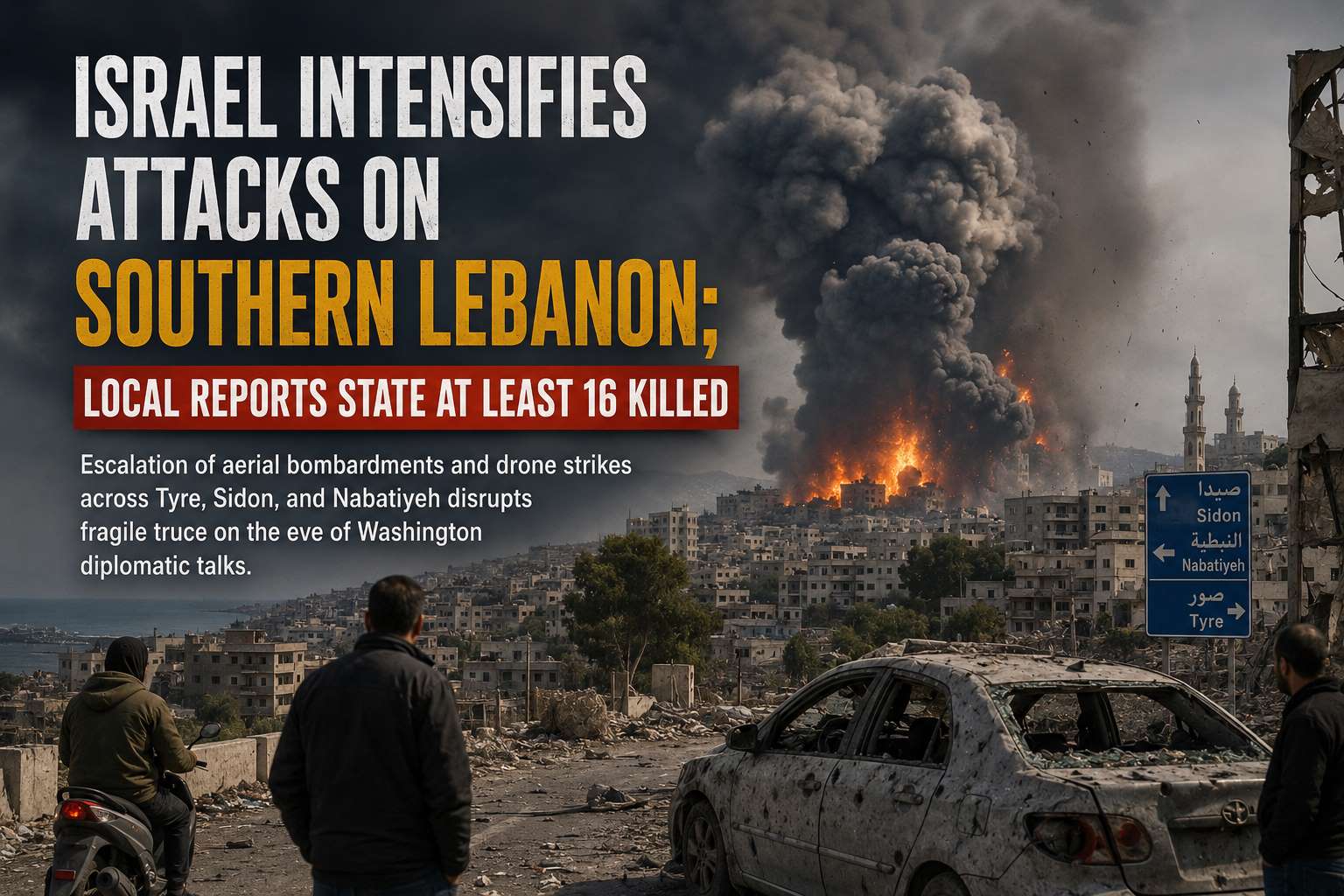
Escalation of aerial bombardments and drone strikes across Tyre, Sidon, and Nabatiyeh disrupts fragile truce on the eve of Washington diplomatic talks.
Publication Date: May 29, 2026
Last Updated: May 29, 2026
Byline: Global War News Editorial
The Israeli military has significantly expanded its aerial campaign and artillery operations across southern Lebanon. The intensified actions have caused substantial casualties and forced thousands of civilians to flee northern areas, according to reports from local health officials and international monitoring agencies.
Lebanese health authorities stated on Thursday that at least 16 people were killed and 58 others wounded within a 24-hour window as Israeli airstrikes and drone operations targeted residential neighborhoods, transit corridors, and civilian infrastructure. The sharp increase in violence comes despite a United States-brokered ceasefire framework originally agreed upon in mid-April.
The timing of the military surge has drawn criticism from regional observers, occurring immediately before scheduled security talks between Lebanese and Israeli military officials in Washington. Lebanese Prime Minister Nawaf Salam condemned the widespread bombardments across Tyre and Nabatiyeh, describing them as sustained onslaughts that amount to collective punishment through mass forced displacement.
Frontline Incidents and Civil Flight
According to reports published by the state-run National News Agency (NNA), a significant portion of the casualties resulted from targeted strikes on vehicles and residential structures. On the Adloun Highway, a primary coastal route connecting the cities of Sidon and Tyre, an Israeli drone strike hit a vehicle carrying a family attempting to flee the combat zone. The Lebanese Health Ministry confirmed that six people belonging to the same family, including two children and their parents, were killed in the blast.
Further north in Sidon, an Israeli drone targeted an apartment building housing displaced families in the Qiyaa neighborhood. Local rescue teams reported that the strike killed five people, including two women, and injured 21 others. Among the dead was Hossan Zeidan, a media worker who previously served as a correspondent for Iran’s Arabic-language al-Aalam television network.
In the Tyre district, Israeli aircraft conducted over a dozen consecutive strikes overnight, hitting a cafe and residential complexes on Hiram Street. The bombardment followed specific evacuation orders issued on social media by the Israeli military’s Arabic-language spokesperson, Avichay Adraee, who warned residents to immediately clear eight designated building clusters along the Mediterranean coast and move north of the Zahrani River, approximately 40 kilometers from the border.
Direct Military Engagements and Ceasefire Fractures
The violence has extended beyond non-state targets. The Lebanese military announced that one of its regular soldiers was killed and another injured when an Israeli drone strike targeted his motorcycle in the Nabatiyeh district. This marks the latest in a series of incidents impacting Lebanese state forces, who are not active participants in the primary cross-border hostilities. Separately, an strike on the Zefta-Deir al-Zahrani road claimed the lives of two additional soldiers.
For its part, the Israeli military reported that a soldier was killed and two reservists were wounded in northern Israel following a drone attack launched by Hezbollah. According to Prime Minister Benjamin Netanyahu’s office, at least 23 Israeli personnel and one defense contractor have been killed near southern Lebanon since the current phase of the conflict intensified in early March, with the majority of casualties attributed to unmanned aerial systems.
Hezbollah, which did not formally sign the April diplomatic agreement, has continued to launch drone and rocket salvos targeting Israeli troop concentrations. The group issued a statement claiming several close-range attacks on Israeli tanks and infantry units that had crossed the strategic Litani River near the town of Zawtar al-Sharqieh.
Context and Diplomatic Deadlocks
The renewed conflict between Israel and Hezbollah erupted on March 2, 2026, when the Shia militant group commenced rocket barrages into northern Israel. Since then, Lebanese health officials state that the fighting has killed at least 2,715 people, wounded more than 8,300, and displaced approximately 1.6 million individuals, representing roughly one-fifth of Lebanon’s total population.
A Washington-brokered ceasefire instituted on April 17 brought a brief reduction in large-scale operations, but international monitors indicate it has failed to halt daily friction. The United Nations Interim Force in Lebanon (UNIFIL) reported detecting 91 airspace violations by Israeli aircraft in a single day, the highest number recorded since the truce began, alongside nearly 400 separate firing incidents.
Geopolitical analysts note that the current surge reflects an explicit political decision by the Israeli leadership to strengthen its leverage. Netanyahu stated during a security briefing that the military is systematically “deepening its operation” to dismantle Hezbollah infrastructure before entering technical negotiations. Conversely, Hezbollah leaders have dismissed the diplomatic framework as meaningless while Israeli ground units maintain physical control over a 10-kilometer buffer zone inside the southern Lebanese border.
Analysis: Escalation Pressures and Technical Dilemmas
The latest wave of strikes points to a strategic shift toward cutting off the internal mechanics of southwestern Lebanon. By systematically targeting main roads like the Adloun Highway and issuing broad evacuation demands for major urban nodes like Tyre, the Israeli military appears intent on creating a completely depopulated operations zone south of the Litani River. This approach aims to isolate remaining Hezbollah cells from local logistical support.
However, the high volume of civilian casualties and the direct targeting of Lebanese state soldiers place significant strain on the diplomatic leverage held by Western mediators. The primary indicator to watch in the coming days will be the opening session of the military-to-military talks in Washington. If the Lebanese government delegation refuses to participate in technical boundary discussions while active bombardments hit civilian infrastructure, the ceasefire framework will likely collapse entirely, potentially leading to a broader conventional ground offensive into the Bekaa Valley and central Lebanon.
Source Disclosure Note: This article compiles operational data, casualty tracking, and official press releases from the Lebanese Ministry of Public Health and the state-run National News Agency (NNA). Military claims and casualty figures regarding Israeli forces were sourced via official communiqués from the Israeli Defense Forces (IDF) and the Israeli Prime Minister’s Office. Operational monitoring data was obtained from situation briefings published by the United Nations Interim Force in Lebanon (UNIFIL) and field dispatches from Agence France-Presse (AFP), the Associated Press (AP), and Al Jazeera.
This article is based on publicly available reporting from named international news agencies and attributed official statements. All claims about ongoing events are attributed to their original sources. Analysis sections represent the editorial interpretation of reported facts and do not constitute advocacy for any party to the described conflict. AI tools may be utilized for image generation to assist in explaining complex concepts, as well as for refining grammar, spelling, and other linguistic enhancements. However, all original content is produced, fact-checked, and revised by the editorial team. This publication does not take political positions on active military conflicts.