
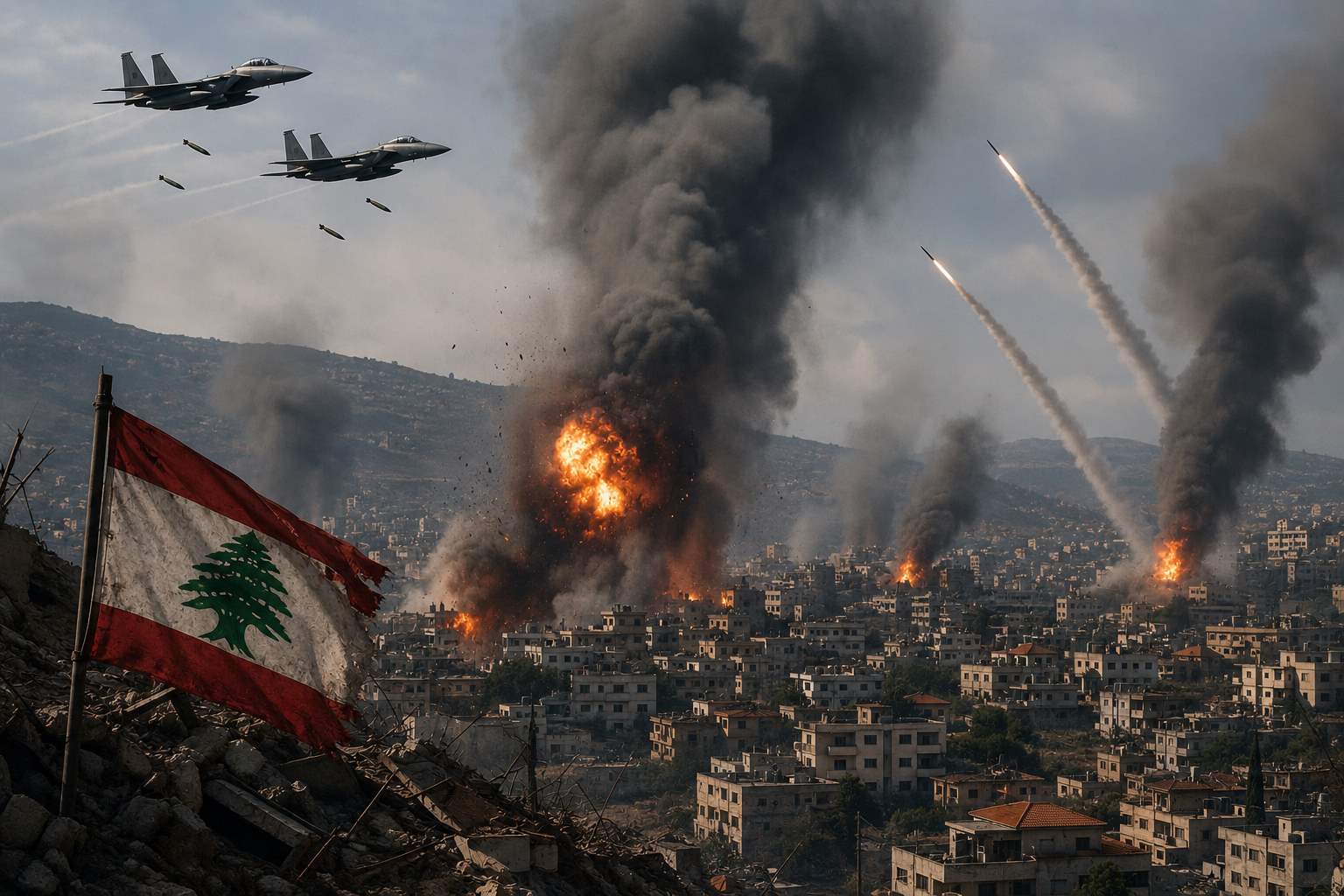
A series of strikes targeting southern Lebanon threatens a fragile, month-old ceasefire as Hezbollah retaliates with drone and rocket fire.
Monday, May 11, 2026
Last updated: 09:15 AM GMT
Global War News Editorial
At least 24 people were killed in a series of Israeli airstrikes across southern Lebanon late last week, according to reports from the Lebanese Health Ministry and the National News Agency (NNA). The strikes, which intensified between Thursday and Saturday, targeted multiple villages including Jibchit, Majdelzoun, and Nabatieh. The Lebanese Health Ministry stated that the dead include at least two children and five women, while dozens more have been treated for injuries.
The escalation comes despite a U.S.-brokered ceasefire that took effect on April 17, 2026. While both the Israeli government and Hezbollah leadership have previously signaled a willingness to maintain the truce, the recent spike in violence suggests the agreement is under severe strain. The Lebanese Health Ministry reports that the cumulative death toll since the broader regional conflict began on March 2 has now reached approximately 2,586.
In response to the airstrikes, Hezbollah announced it carried out multiple retaliatory operations, including drone swarms targeting Israeli military vehicles and a missile strike on a tank near Deir Siryan. The Israel Defense Forces (IDF) confirmed that several explosive drones entered Israeli territory, resulting in at least one soldier being seriously injured on Saturday.
Context of the Escalation
The current conflict in Lebanon is closely tied to the broader war between the United States, Israel, and Iran, which began in late February 2026. Hezbollah, an independent Lebanese militia backed by Tehran, began firing rockets into northern Israel on March 1. Following weeks of intense bombardment and a brief ground incursion, a ten-day ceasefire was initially announced by U.S. President Donald Trump in mid-April and subsequently extended.
Under the terms of the fragile truce, Israel agreed to scale back deep strikes into Lebanese territory while Hezbollah was expected to restrain cross-border fire. However, the UN Regional Director for Arab States, Moez Doraid, noted on Friday that the “perceived safety” of the ceasefire has been eroded by “ongoing killing and displacement.” UN officials report that approximately 1.2 million people remain displaced across Lebanon.
Reported Damage and Casualties
According to the NNA, one of the deadliest strikes occurred in the village of Jibchit, where a family of four was killed when their home was hit. In Nabatieh, the Health Ministry reported that an Israeli drone strike targeted a motorcycle, killing a Syrian national and his 12-year-old daughter.
The Israeli military has maintained that its operations are focused on “Hezbollah positions and infrastructure” used to launch attacks into northern Israel. On Saturday, the IDF issued evacuation orders for six villages in Tyre province, warning residents to leave before conducting demolitions. Hezbollah lawmaker Hassan Fadlallah stated that the group remains in a “defensive position” but warned that it would respond to any strikes on Lebanese villages or the suburbs of Beirut.
Analysis: The Ceasefire at a Critical Point
Observers suggest the ceasefire is nearing a point of collapse due to what both sides describe as “retaliatory cycles.” While diplomatic efforts continue in Washington and Islamabad, the lack of a permanent political settlement has left a vacuum filled by tactical skirmishes.
Analysts note that the shift in Hezbollah’s tactics—increasingly relying on high-precision explosive drones rather than unguided rockets—has created a new challenge for Israeli air defenses. Simultaneously, Israel’s use of targeted drone strikes in civilian-populated areas of southern Lebanon has intensified public anger and complicated the humanitarian response. The UN World Food Programme has warned that over 600,000 women and girls in Lebanon are now facing crisis-level hunger as supply chains remain disrupted by the ongoing insecurity.
Source Disclosure: This report is based on verified data and statements from the Lebanese Health Ministry, the National News Agency (NNA), the Associated Press (AP), Reuters, and UN News. Military details were sourced from official briefings by the Israel Defense Forces (IDF) and public statements released by Hezbollah’s media office.
This article is based on publicly available reporting from named international news agencies and attributed official statements. All claims about ongoing events are attributed to their original sources. Analysis sections represent the editorial interpretation of reported facts and do not constitute advocacy for any party to the described conflict. AI tools may be utilized for image generation to assist in explaining complex concepts, as well as for refining grammar, spelling, and other linguistic enhancements. However, all original content is produced, fact-checked, and revised by the editorial team. This publication does not take political positions on active military conflicts.