
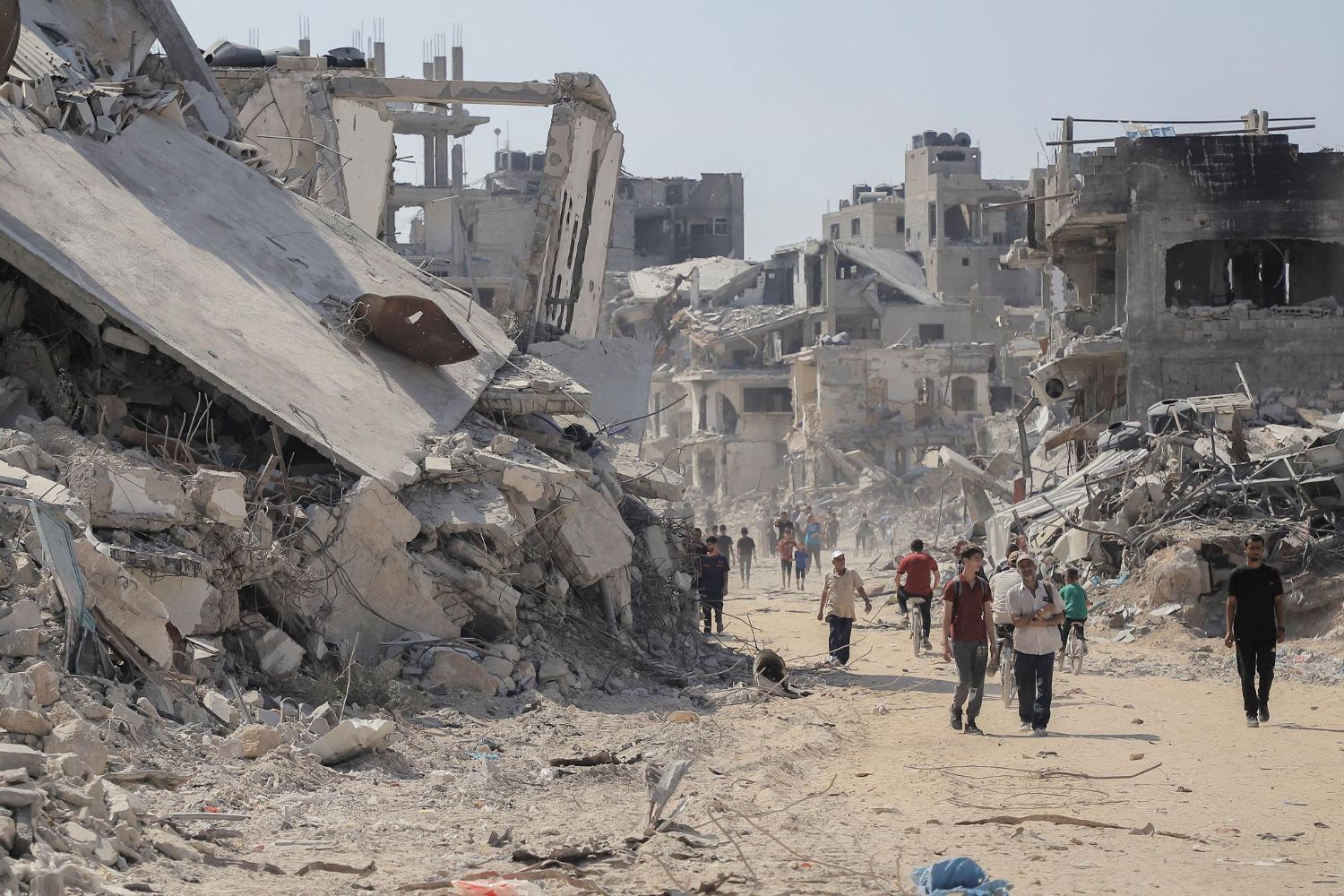
Fatalities reported across central and southern sectors as military targeting near Al-Aqsa Hospital strains post-war diplomatic frameworks.
Publication Date: May 18, 2026
Last Updated: May 18, 2026
Byline: Global War News Editorial
A series of Israeli airstrikes and security incidents across the Gaza Strip has left at least eight Palestinians dead, according to localized health officials and medical responders. The most prominent strike occurred in central Gaza, where local medics reported that an aerial bombardment hit the immediate vicinity of a community kitchen, resulting in the deaths of three humanitarian aid workers.
The targeted strikes took place on May 17, 2026, amid a broader backdrop of faltering indirect diplomatic talks between Israel and Hamas. Observers note that Israeli military operations inside the enclave have visibly intensified in the weeks following the suspension of joint US-Israeli aerial campaigns in Iran, even as international mediators attempt to salvage a comprehensive regional stabilization plan.
The Israel Defense Forces did not immediately issue an official, specific statement regarding the community kitchen incident in Deir al-Balah. However, Israeli military spokesmen confirmed separate pinpoint operations elsewhere in the enclave, maintaining that its forces continue to target armed operatives who pose an active, immediate threat to personnel deployed within the territory.
Sector Breakdown of the Airstrikes and Casualties
According to Gazan medical sources based at the Al-Aqsa Hospital, the strike in Deir al-Balah targeted an area immediately adjacent to the medical compound where a civilian community kitchen was distributing food assistance. The blast instantly killed three individuals identified by local volunteers as kitchen staff members, while wounding several bystanders who were waiting for aid rations.
A secondary strike within central Gaza was reported short distances away near a municipal bakery, resulting in two additional civilian fatalities. In the southern sector of the enclave, the geographic focus shifted toward Khan Younis, where emergency service personnel from the Palestinian Red Crescent Society handled multiple casualty scenes.
Medics in Khan Younis stated that one individual was killed near a local police checkpoint, while another succumbed to shrapnel wounds following an explosion within a civilian tent encampment located in the Al-Mawasi coastal zone. A final fatality was recorded following a shooting incident in a residential district of Khan Younis, bringing the single-day death toll verified by local hospital registries to eight.
Diplomatic Deadlock and Territorial Control Claims
The escalation in kinetic activity comes at a time when Israeli Prime Minister Benjamin Netanyahu has publicly asserted greater administrative and operational authority over the enclave. In a briefing to legislative committees, Netanyahu stated that Israeli ground and security forces currently exert direct operational control over approximately 60 percent of the Gaza Strip’s total land area.
This territorial positioning complicates ongoing indirect negotiations aimed at implementing a long-term post-war stabilization framework introduced by US President Donald Trump. The diplomatic initiative envisions an orderly phased withdrawal of Israeli troops from urban centers paired with the systematic disarmament of Hamas networks.
However, diplomatic dispatches from Cairo indicate that the talks remain frozen. Hamas representatives have reportedly resisted disarmament demands without binding, pre-conditioned guarantees of a permanent ceasefire and the complete cessation of the blockade. Conversely, the Israeli security cabinet has maintained that operations will continue until all remaining operational battalions and command elements are neutralized, point-blank rejecting any framework that compromises its freedom of action.
Context and Background: The Shift from Regional to Local Fronts
The humanitarian operating environment inside Gaza has drastically deteriorated since the geopolitical shifts of February 28, 2026, when brief cross-border escalations between Western coalition forces and Iran temporarily drew away regional military assets. Following the stabilization of those broader borders via Pakistani-mediated truces in April, Israeli command structures redirected their primary offensive capabilities back toward the enclave.
According to a comprehensive operational tracking report published by the United Nations Office for the Coordination of Humanitarian Affairs, civilian reliance on localized community kitchens has reached unprecedented levels due to systemic cooking gas shortages and commercial border constraints. The UN agency noted that nearly half of the displaced population has been forced to rely on rudimentary waste-burning methods to prepare sustenance.
The targeting of aid infrastructure follows a pattern of high-profile command eliminations conducted by the IDF. On May 15, the Israeli military confirmed the assassination of Izz al-Din al-Haddad, the commander of Hamas’s northern wing, alongside operations chief Bahaa Baroud. While Israel characterizes these actions as precision strikes executed via advanced aerial surveillance to minimize civilian exposure, humanitarian organizations maintain that the proximity of strikes to hospitals and feeding centers inflicts unsustainable collateral damage on non-combatants.
Analysis: The Attrition of the Humanitarian Corridor
Observers note that the ongoing targeting of areas adjacent to vital logistics hubs, such as bakeries and community kitchens, accelerates the functional collapse of the remaining internal distribution mechanisms inside Gaza. Even when aid installations are not the intended tactical target of an airstrike, their placement within dense urban conflict zones ensures that any missile deployment carries high risks for humanitarian staff.
For the Israeli political leadership, the current campaign serves a dual purpose: maintaining military pressure on remaining insurgent pockets while establishing a hard territorial status quo ahead of any potential concessions demanded by the Trump administration’s regional peace plans. By asserting control over 60 percent of the territory, Jerusalem strengthens its hand in dictating the terms of any future security corridors.
However, this strategy carries severe diplomatic risks. The steady accumulation of civilian and aid-worker casualties continually strains relations with Western partners and Arab signatories to regional normalization frameworks. As long as the basic infrastructure of survival—such as food production and emergency medical access—remains vulnerable to kinetic disruption, any post-war transition plan will lack the structural stability required to take root.
What to Watch
In the immediate term, international aid watchdogs will look to see if organizations operating the Deir al-Balah community kitchens temporarily suspend their logistics footprints due to heightened security risks, a move that would immediately impact daily food access for thousands of displaced families.
On the diplomatic front, the focus remains on whether US and Egyptian intermediaries can formulate an alternative negotiation text capable of breaking the deadlock over the withdrawal timelines of Israeli forces from the central corridor.
Source Disclosure Note: This report is compiled from verified field updates provided by Gazan medical officials, registries at Al-Aqsa Hospital, and representatives of the Palestinian Red Crescent Society. Official state perspectives are sourced from public briefings delivered by Israeli Prime Minister Benjamin Netanyahu and formal operational statements issued by the Israel Defense Forces. Contextual and data-driven details regarding humanitarian infrastructure are drawn from published situation reports by the United Nations Office for the Coordination of Humanitarian Affairs, Reuters, and Associated Press dispatches.
This article is based on publicly available reporting from named international news agencies and attributed official statements. All claims about ongoing events are attributed to their original sources. Analysis sections represent the editorial interpretation of reported facts and do not constitute advocacy for any party to the described conflict. AI tools may be utilized for image generation to assist in explaining complex concepts, as well as for refining grammar, spelling, and other linguistic enhancements. However, all original content is produced, fact-checked, and revised by the editorial team. This publication does not take political positions on active military conflicts.