
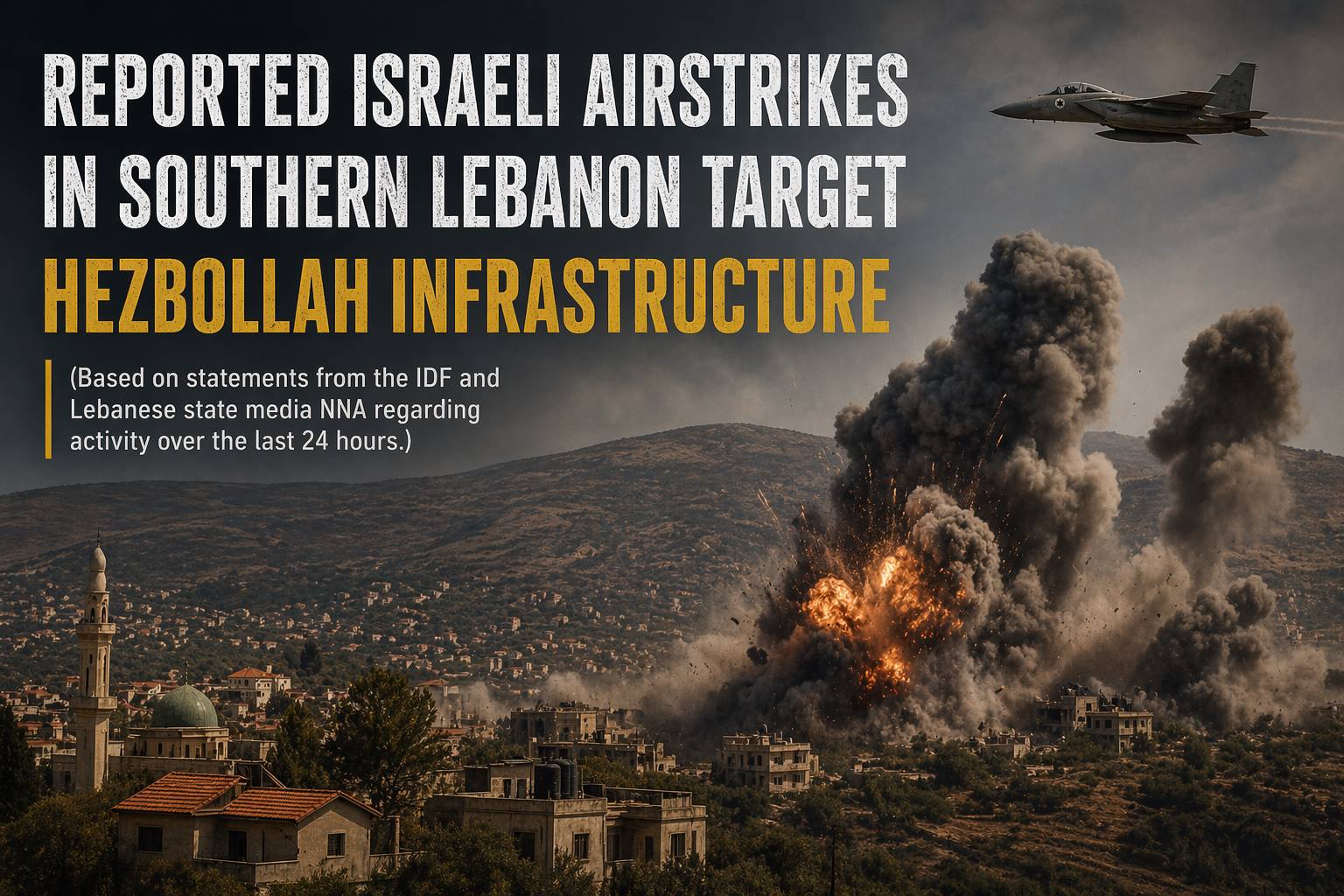
The IDF reports striking several command centers and launch sites following cross-border fire, while Lebanese state media confirms damage to residential outskirts.
April 21, 2026
By Global War News Editorial
The border region between Israel and Lebanon has seen a marked increase in aerial activity over the last 24 hours. According to official statements from the Israel Defense Forces (IDF) and the Lebanese state-run National News Agency (NNA), multiple sites in Southern Lebanon were targeted in a series of airstrikes. These developments follow a period of intensified rocket fire directed toward Northern Israel, signaling a continued lack of stabilization along the “Blue Line.”
The IDF stated that the operations were “precision strikes” aimed at neutralizing military infrastructure used by the Hezbollah group. Conversely, Lebanese officials have raised concerns regarding the proximity of these strikes to civilian municipalities, reporting significant damage to agricultural lands and peripheral housing.
Reported Targets and IDF Statements
In a statement released via official channels, the IDF confirmed that its fighter jets struck what it described as “Hezbollah military compounds” in the areas of Khiam and Ayta ash-Shab. The military claimed that the targets included a weapons storage facility and a command observation post used to coordinate anti-tank missile fire.
According to the IDF, these strikes were a direct response to several projectiles launched from Lebanese territory earlier in the day. The Israeli military maintains that it holds the Lebanese government responsible for actions originating from its soil, though it explicitly identified Hezbollah infrastructure as the primary objective of the mission.
Reports from Lebanese State Media
The National News Agency (NNA) in Lebanon reported that the strikes affected several villages across the south. According to the NNA, an airstrike in the vicinity of Houla caused the destruction of two residential buildings, though no immediate casualty figures were confirmed. Local civil defense teams were reportedly deployed to the sites to clear debris and monitor for fires in the surrounding olive groves.
Lebanese Prime Minister’s office, in a brief statement, characterized the escalations as a “violation of national sovereignty” and called for international intervention to prevent a full-scale regional expansion. The NNA also noted that Israeli reconnaissance drones remained a persistent presence in the airspace above Tyre and Sidon throughout the afternoon.
Context: The “Blue Line” and Rules of Engagement
The current hostilities are centered around the Blue Line, the border demarcation established by the United Nations in 2000. While not an official international border, it serves as the reference point for the cessation of hostilities under UN Security Council Resolution 1701.
Since late 2023, this region has been defined by a “tit-for-tat” cycle of violence. Analysts note that while both sides have largely avoided a declared total war, the depth and frequency of the strikes have gradually increased. The IDF has expanded its target bank to include logistics hubs further north of the Litani River, while Hezbollah has utilized more sophisticated drone technology to penetrate Israeli air defenses.
Economic Impact: Agriculture and Tourism
The economic consequences of the persistent strikes are becoming increasingly severe for Southern Lebanon’s agrarian economy. According to a report by the Lebanese Ministry of Agriculture, cited by regional news outlets, thousands of hectares of olive trees and tobacco crops—the primary source of income for border communities—have been lost to fires caused by white phosphorus or high-explosive munitions.
On the Israeli side, the displacement of approximately 80,000 residents from Northern Galilee has created a significant fiscal burden. The Bank of Israel has previously noted that the cost of housing displaced citizens and the loss of agricultural productivity in the north are contributing factors to the nation’s revised 2026 budget deficits.
Analysis: Escalation or Deterrence?
Military observers are currently debating whether these strikes are intended to deter Hezbollah from further escalation or if they are the preamble to a larger ground operation. The IDF’s focus on command-and-control infrastructure suggests a strategy of “degrading” Hezbollah’s immediate capability to launch an invasion.
However, observers also note that Hezbollah’s retaliatory patterns remain consistent. For every strike on a command center, the group typically responds with localized rocket barrages on military outposts in the Golan Heights or Galilee. It remains unclear if diplomatic channels, led by US and French mediators, can decouple this front from other regional tensions before the localized friction leads to a miscalculation.
Closing Summary
As of the evening of April 21, the situation remains extremely tense. The IDF has indicated that its northern command remains on high alert, while Lebanese authorities continue to document the damage to civilian infrastructure. With neither side showing a willingness to retreat from their current positions, the focus remains on the UNIFIL peacekeeping forces and their ability to facilitate communication between the two parties.
Sources: This report is based on official statements from the Israel Defense Forces (IDF), reporting from the Lebanese National News Agency (NNA), and coverage by Reuters and Al Jazeera. Economic data and context were drawn from official Lebanese ministry reports and Bank of Israel bulletins.
This article is based on publicly available reporting from named international news agencies and attributed official statements. All claims about ongoing events are attributed to their original sources. Analysis sections represent the editorial interpretation of reported facts and do not constitute advocacy for any party to the described conflict. AI tools may be utilized for image generation to assist in explaining complex concepts, as well as for refining grammar, spelling, and other linguistic enhancements. However, all original content is produced, fact-checked, and revised by the editorial team. This publication does not take political positions on active military conflicts.