
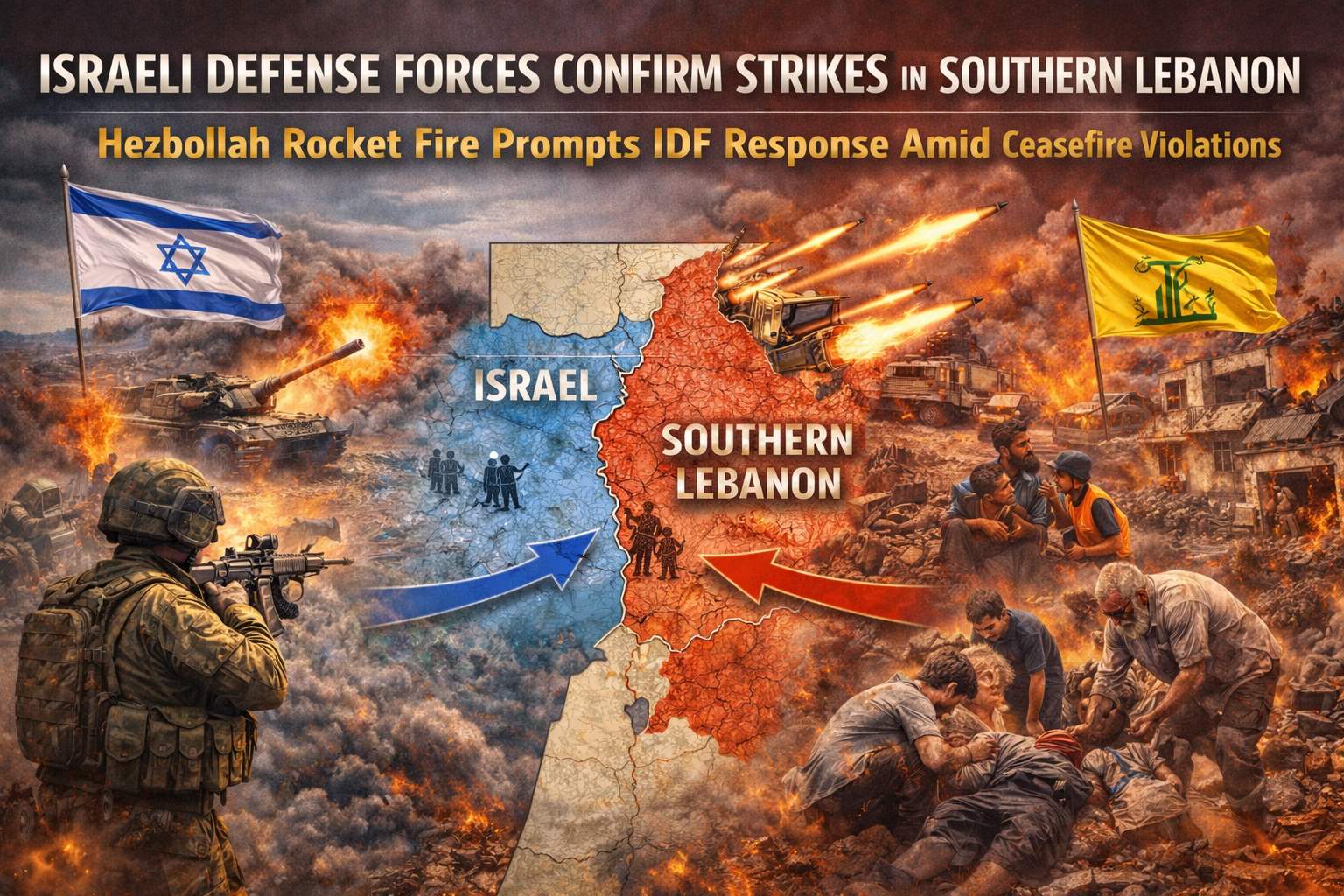
IDF reporting indicates “blatant violation” of tenuous ceasefire as Lebanese state media reports civilian and municipal casualties in response.
Publication date: May 6, 2026
Last updated: May 6, 2026
By Staff Writer, Global War News
The Israeli Defense Forces (IDF) have confirmed a significant wave of airstrikes targeting Hezbollah infrastructure across southern Lebanon. The military operations, described by Israeli officials as a response to recent rocket and drone fire, come amid a fragile, US-mediated ceasefire that has been in place since mid-April but remains under severe strain.
According to a series of statements released by the IDF on May 5 and 6, the Israeli Air Force targeted “Hezbollah infrastructure sites” in multiple sectors of southern Lebanon. The military stated that these strikes were a direct reaction to incidents in which rockets were launched at Israeli troops operating south of the Forward Defense Line. In one specific briefing, the IDF reported that rockets struck near soldiers in two separate incidents, though no injuries were sustained.
“The Hezbollah terrorist organization continues to violate the ceasefire agreement,” an IDF spokesperson stated. “In response, we are striking the sources of fire and the organizational infrastructure used to launch these attacks.”
Reports from Lebanon: Casualties and Displacement
Lebanese state media, via the National News Agency (NNA), has reported that the Israeli response has resulted in significant damage and loss of life. On May 3 and 4, NNA reported that Israeli strikes near Tyre and in the Bint Jbeil district killed at least eight individuals. Among the dead were two municipal council members in the town of Breqa.
Reports from Lebanese security sources indicate that the strikes have hit residential houses and motorcycles, with civilian casualties including both Lebanese nationals and foreign workers. The Lebanese government has characterized these actions as a continuation of “expanded strikes” that have displaced over 1.6 million people since the escalation began earlier this year.
The Breakdown of the Ceasefire
The 10-day US-mediated ceasefire that took effect on April 17, 2026, was intended to stabilize the border following a period of high-intensity conflict. However, both sides have accused the other of “blatant violations” in the weeks since its extension.
Hezbollah has reportedly shifted its tactical patterns, increasingly utilizing unmanned aerial vehicles (UAVs) and precision drones alongside traditional rocket fire. Analysts from regional research institutions suggest this shift is an operational adaptation to the presence of IDF forces remaining at five border posts—territory the Lebanese government asserts should have been vacated under the initial truce terms.
Analysis: A Fragile Status Quo
The current exchange highlights the precarious nature of the “security zone” currently maintained by the IDF inside southern Lebanon. While Israeli officials claim their presence is a temporary security necessity to prevent Hezbollah from returning to border villages, Beirut views the continued presence as an occupation that justifies “resistance” operations.
Observers note that the intensity of the strikes on municipal infrastructure and non-military vehicles suggests a broadening of the IDF’s target bank, potentially aimed at dismantling the social and administrative presence of Hezbollah in the south. This “controlled friction” carries the risk of descending into full-scale hostilities once more, as the mid-May deadline for the current ceasefire extension looms.
Source Disclosure: This report is based on official military briefings from the Israeli Defense Forces (IDF), reporting from the Lebanese state news agency (NNA), and situational updates from international news outlets including Reuters and The Times of Israel.
This article is based on publicly available reporting from named international news agencies and attributed official statements. All claims about ongoing events are attributed to their original sources. Analysis sections represent the editorial interpretation of reported facts and do not constitute advocacy for any party to the described conflict. AI tools may be utilized for image generation to assist in explaining complex concepts, as well as for refining grammar, spelling, and other linguistic enhancements. However, all original content is produced, fact-checked, and revised by the editorial team. This publication does not take political positions on active military conflicts.