
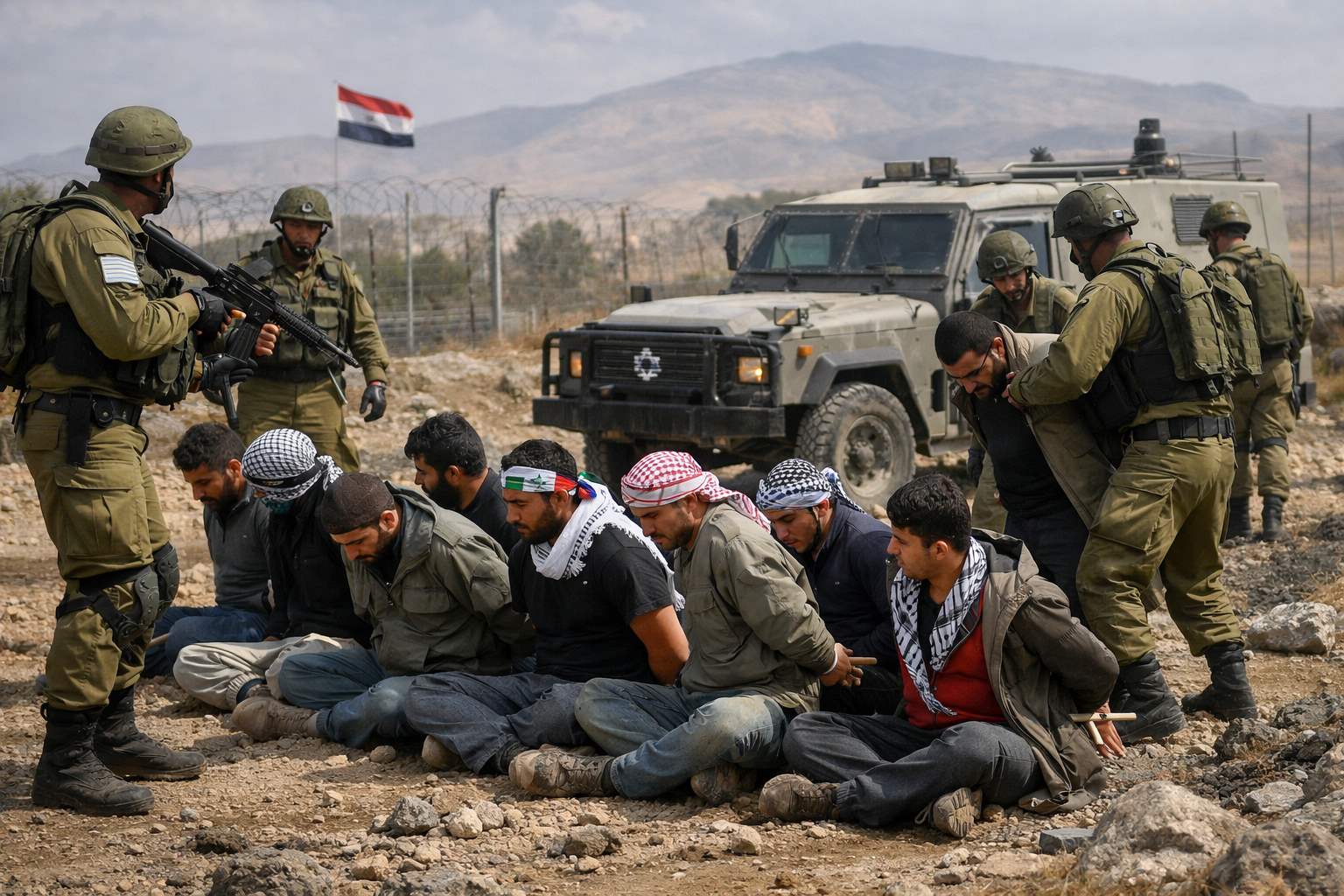
Military forces intercept ideological activist group in the Golan Heights sector, condemning unauthorized incursions that complicate regional frontier security.
Publication Date: May 18, 2026
Last Updated: May 18, 2026
Byline: Global War News Editorial
The Israel Defense Forces detained ten Israeli civilians on May 17, 2026, after the group successfully breached the border fence and crossed into Syrian territory. The operational interception, which occurred in the highly sensitive Golan Heights frontier sector, highlights growing domestic security friction between the Israeli military apparatus and ideological activist organizations operating along the country’s northern boundaries.
According to an official statement released by the IDF Spokesperson’s Unit on the night of May 17, military personnel deployed to the border region quickly identified the unauthorized crossing. Inbound field units moved to intercept the individuals several hundred meters inside Syrian jurisdiction, returned the entire group back into Israeli territory without further incident, and subsequently transferred all ten suspects to the custody of the Israel Police for formal criminal processing.
The military command issued a sharp public rebuke following the security breach. In its official briefing, the IDF stated that it strongly condemns the incident and emphasizes its severity, characterizing the unauthorized border crossing as a criminal offense that directly endangers both civilian lives and active IDF soldiers stationed along the demarcation line.
The Bashan Pioneers and the Escalation of Border Breaches
The individuals involved in the border crossing have been identified by regional media as members of the “Bashan Pioneers” (Haluzey HaBashan), a fringe ideological organization dedicated to promoting Jewish civilian resettlement within parts of southern Syria. According to reporting by Srugim, a news network catering to Israel’s religious Zionist community, the group timed its incursion to coincide with the Hebrew-calendar anniversary of the capture of the Golan Heights during the 1967 Six-Day War.
The group’s leadership openly acknowledged the illegal entry via their official media channels, posting updates that confirmed their intent to scale the foothills near Mount Hermon. In a public statement issued following the arrests, the Bashan Pioneers declared that they will not stop their actions until the government allows families to enter and establish communities in the territory. The group’s literature frequently references historical and biblical ties to the region to justify their presence.
Data compiled by independent tracking monitors underscores that this incursion represents a systemic challenge rather than an isolated security breakdown. The Jerusalem Post reported that Kan News and internal military logs identified the May 17 breach as the fourth distinct attempt by the same group to cross into Syria within a 24-hour window. Since the organization’s inception, activists have attempted or completed 14 separate unauthorized frontier crossings, illustrating a persistent operational strain on local border defense units.
Context and Background: The Golan Frontier After the Damascus Transition
The strategic realities governing the 80-kilometer Israel-Syria border have shifted significantly over the past 18 months. Following the collapse of the central Ba’athist administration in Damascus in December 2024, the IDF expanded its defensive parameters, establishing localized buffer positions inside Syrian territory—particularly within the Quneitra governorate—to prevent radical non-state actors from occupying vacuum zones near the armistice line.
While the military justification for these forward positions rests on absolute defensive necessity, the presence of Israeli troops across the frontier has inadvertently created a permissive environment for civilian activist groups. Organizations like the Bashan Pioneers have interpreted the military’s forward presence as an opportunity to push past the historical international border.
This trend mirrors previous internal security challenges. On April 22, 2026, a significantly larger contingent of approximately 40 Israeli civilians successfully bypassed the border fence in a similar sector, moving deep into Syrian territory before being apprehended by an IDF patrol. Under existing Israeli emergency regulations, Syria remains legally classified as an enemy state. Civilian entry without explicit defense ministry authorization is strictly prohibited, with statutory guidelines allowing for criminal penalties of up to four years of imprisonment for violators.
Analysis: The Operational Risk of Ideological Incursions
From a military perspective, unauthorized civilian movements through an active theater of conflict present severe tactical complications. The border zone between the Golan Heights and southern Syria remains heavily contaminated with legacy landmines, unexploded ordnance, and unpredictable local security dynamics where remnants of various Syrian factions continue to operate.
Observers note that when civilian groups cross the border fence, they force the IDF to redirect assets from essential counter-reconnaissance duties toward domestic search-and-retrieval operations. If an activist group were to be captured by local Syrian armed factions or hostile remnants, it would instantly trigger an international hostage crisis, potentially forcing a significant military escalation that could destabilize the current regional truce frameworks managed via international intermediaries.
Furthermore, these actions expose a widening ideological divide between senior IDF commanders and the political fringes. While the military prioritizes strict adherence to international borders and operational stability, the activists view the fluid geopolitical situation as a window to alter long-term demographic realities. The repetitive nature of the breaches suggests that standard police handovers have yet to establish a sufficient legal deterrent against the core members of the group.
What to Watch
The primary factor to monitor moving forward is the legal response from the Israeli state prosecution. Observers will watch whether the Israel Police and the Ministry of Justice opt to seek formal indictments carrying prison sentences, or if the detained individuals continue to be released shortly after questioning.
Additionally, international observers will monitor whether these civilian actions prompt a defensive realignment by local Syrian security committees or international monitoring forces on the eastern side of the Golan line. Any signs of coordinated pushback from local populations in the Quneitra sector could lead to direct kinetic friction if future activist incursions are not successfully contained by the IDF at the fence line.
Source Disclosure Note: This report is compiled from official public statements distributed by the Israel Defense Forces Spokesperson’s Unit and supplementary arrest documentation from the Israel Police. Ideological claims and organizational context are drawn directly from published manifestos and digital media updates issued by the Bashan Pioneers movement, alongside reporting from the regional outlets Kan News, Srugim, The Jerusalem Post, and The Times of Israel. Historical background concerning border shifts relies on published reports from Amnesty International and the United Nations Disengagement Observer Force (UNDOF).
This article is based on publicly available reporting from named international news agencies and attributed official statements. All claims about ongoing events are attributed to their original sources. Analysis sections represent the editorial interpretation of reported facts and do not constitute advocacy for any party to the described conflict. AI tools may be utilized for image generation to assist in explaining complex concepts, as well as for refining grammar, spelling, and other linguistic enhancements. However, all original content is produced, fact-checked, and revised by the editorial team. This publication does not take political positions on active military conflicts.