
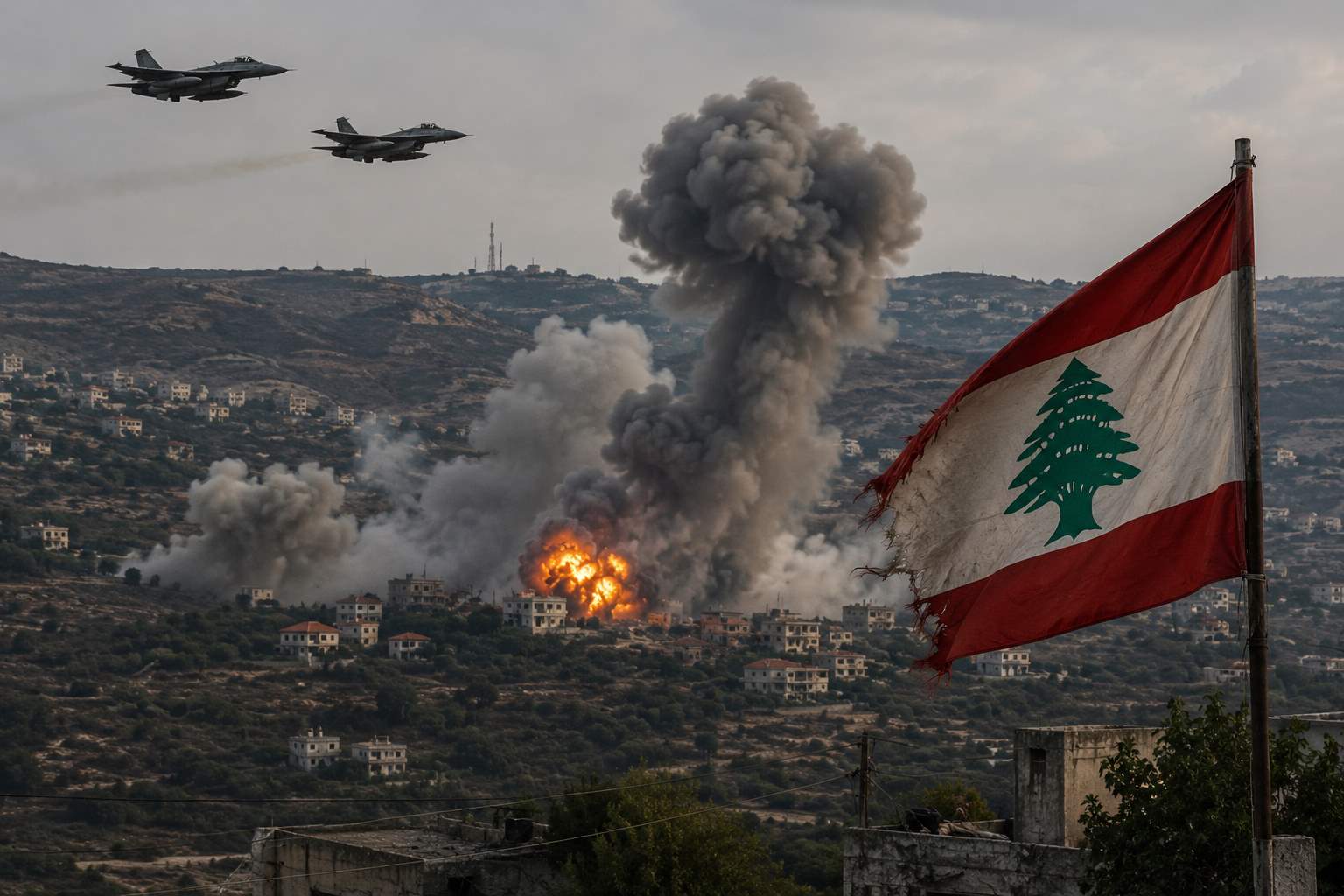
Massive aerial wave hits over 70 positions in southern districts and Bekaa Valley, placing severe strain on the current ceasefire.
Publication Date: May 26, 2026
Byline: Global War News Editorial
The Israeli military executed a concentrated wave of airstrikes across Lebanon on Monday, targeting dozens of locations associated with the Shia militant group Hezbollah. The sudden escalation occurred despite an active, United States-brokered ceasefire agreement, prompting fears of a return to full-scale territorial warfare.
According to official briefings from the Israel Defense Forces (IDF) issued on Monday, May 25, 2026, the operation targeted more than 70 infrastructure nodes, including command positions, weapon storage facilities, and mobile teams. The development follows a public declaration by Israeli Prime Minister Benjamin Netanyahu, who announced he had ordered the military to accelerate operations to suppress the group’s tactical capabilities.
Detailed Scope of the Aerial Engagement
The military campaign involved simultaneous strikes across multiple geographical regions in Lebanon, representing one of the most intense daily tallies since the implementation of the spring truce.
According to reports from Lebanon’s state-run National News Agency (NNA), Israeli warplanes and drones focused heavily on southern border villages, the coastal environs near the ancient city of Tyre, and the eastern Bekaa Valley. Successive airstrikes targeted the town of Mashghara in the Bekaa region late Monday evening. Local reporters also observed a fresh exodus of residents from Beirut’s southern suburbs following the circulation of the escalating military statements.
The IDF reported that its strikes successfully neutralized 10 specialized command centers and eliminated several operational units moving on motorcycles in southern territories. Israeli military spokesperson Colonel Avichay Adraee published localized evacuation notices for 10 distinct southern Lebanese villages, stating that the army was compelled to act with force because of repeated adversary actions.
The human toll of Monday’s actions included at least seven fatalities, according to Lebanese authorities. An airstrike on a vehicle near the municipality of Kfar Rumman killed four people, while subsequent drone strikes along southern transit paths killed three others. On the opposing side, the Israeli military confirmed that one IDF soldier was killed during ground friction in southern Lebanon on Sunday, raising the total number of Israeli military fatalities in the theater to 23 since March.
Technical Friction and the Fiber-Optic Drone Threat
The immediate trigger for the intensified Israeli response appears to be a shift in tactical technology along the frontline. In a video statement published to his official Telegram channel on Monday, Prime Minister Netanyahu explicitly cited the deployment of advanced explosive drones by Hezbollah as the rationale for the expanded campaign.
“It is true that they are shooting drones at us, fiber-optic drones,” Netanyahu stated, referencing a remote-controlled weapon system that has seen extensive deployment in contemporary eastern European theaters.
Military analysts from independent research institutions note that fiber-optic drones present unique operational challenges for advanced militaries:
- Signal Immunity: Unlike traditional radio-controlled unmanned aerial vehicles (UAVs), fiber-optic systems unspool a physical micro-cable during flight. This direct physical link makes the guidance system entirely immune to standard electronic warfare jamming, spoofing, or frequency disruption.
- Targeting Precision: The physical link allows a continuous, uncompressed high-definition video stream to reach the operator without signal degradation, increasing terminal targeting accuracy against personnel and armored vehicles.
Hezbollah claimed responsibility for eight separate operational responses on Monday. The group confirmed it targeted three military barracks and an army outpost near Misgav Am in northern Israel, framing the drone launches as a direct response to continuous Israeli violations of the existing armistice lines.
The Imperilled Peace Process and Geopolitical Impasse
The ongoing exchanges occur under a highly fragile diplomatic framework. Israel and Lebanon originally agreed to a temporary cessation of hostilities on April 16, 2026, which was subsequently extended for an additional 45 days during multilateral sessions. Under the terms brokered by the United States, Israel preserves the right to execute defensive maneuvers against imminent threats, while the Lebanese government is expected to assume administrative sovereignty along its southern border.
However, the political foundations of the truce face deep systemic strains. A senior United States State Department official speaking on Monday indicated that Hezbollah has fired hundreds of rockets and drones since April in a deliberate attempt to derail expanding structural negotiations. For the first time in over three decades, direct bilateral defense talks opened between Israeli and Lebanese state officials, with a high-level meeting scheduled at the Pentagon to discuss a phased Israeli withdrawal and the deployment of the Lebanese Armed Forces (LAF) south of the Litani River.
The State Department source noted that a successful, state-led ceasefire presents an existential threat to Hezbollah because it strips the militia of its domestic political narrative as the sole defender of Lebanese territory. Consequently, the group’s leadership has publicly denounced the direct talks as a capitulation by Beirut. The diplomatic situation is further complicated by stalling parallel negotiations between the United States and Iran in Pakistan, where Tehran has demanded a complete cessation of hostilities in Lebanon as a prerequisite for lifting maritime blockades in the Persian Gulf.
Secondary Global Economic Volatility
The persistent threat of an expanded conflict in West Asia continues to generate structural economic pressures that extend far beyond the immediate Mediterranean basin, hitting developing economies through global commodity and supply chain disruptions.
The impact of prolonged instability on maritime trade pathways has kept shipping insurance premiums elevated, creating imported inflation concerns for central banks worldwide. Highlighting this trend, the Central Bank of Sri Lanka enacted an unexpected 100-basis-point increase to its benchmark policy interest rate. In an official briefing, Sri Lankan monetary authorities stated that the preemptive tightening was directly necessitated by persistent currency pressures and commodity market volatility tied closely to the unresolved West Asian security crisis.
Source Disclosure Note: This explainer relies on official statements published by the Israel Defense Forces, video briefings from Prime Minister Benjamin Netanyahu, and updates from Lebanon’s state-run National News Agency (NNA). Strategic background, operational data, and diplomatic accounts were compiled from tracking by the Associated Press (AP), Reuters, Agence France-Presse (AFP), the BBC, and The Guardian, alongside economic policy releases from the Central Bank of Sri Lanka.
This article is based on publicly available reporting from named international news agencies and attributed official statements. All claims about ongoing events are attributed to their original sources. Analysis sections represent the editorial interpretation of reported facts and do not constitute advocacy for any party to the described conflict. AI tools may be utilized for image generation to assist in explaining complex concepts, as well as for refining grammar, spelling, and other linguistic enhancements. However, all original content is produced, fact-checked, and revised by the editorial team. This publication does not take political positions on active military conflicts.