
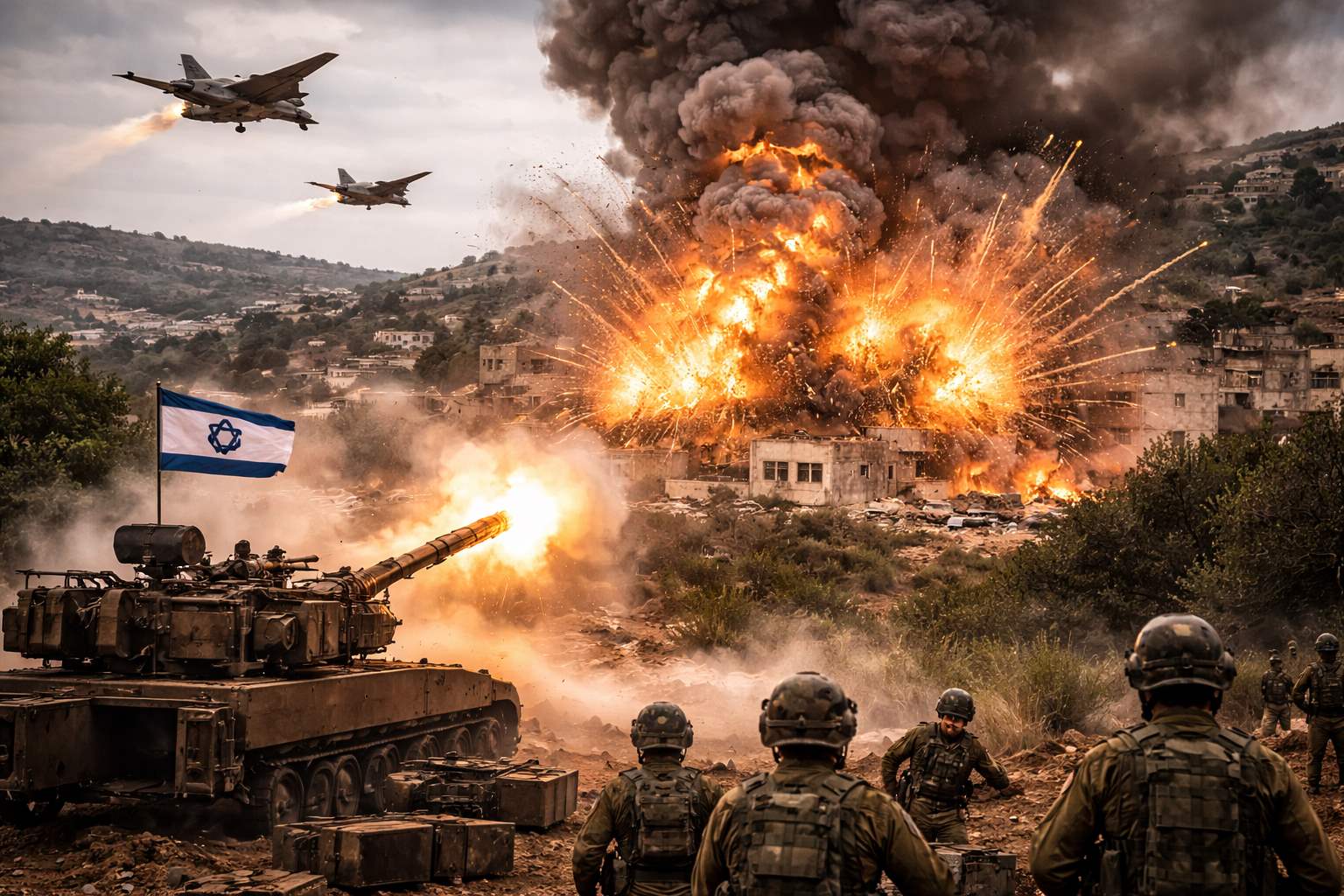
Massive explosions reported following an Israeli operation aimed at neutralizing underground infrastructure near the border.
April 30, 2024
Updated: April 30, 2026
By Global War News Editorial
The Israel Defense Forces (IDF) conducted a series of large-scale controlled demolitions in southern Lebanon on Tuesday, targeting what it described as a strategic tunnel network belonging to Hezbollah. Residents in northern Israel and southern Lebanon reported feeling significant tremors, with some monitoring stations initially recording the seismic activity as a minor earthquake.
According to a statement released by the IDF, the operation focused on a multi-layered subterranean complex located beneath civilian areas in the vicinity of the Lebanese border. The military stated that the tunnels were equipped with living quarters, weapon storage facilities, and advanced communication systems, designed to facilitate a large-scale ground incursion into Israeli territory.
Lebanese state media, NNA, reported that the explosions caused structural damage to several residential buildings in nearby border villages. While the IDF maintains the sites were military in nature, Lebanese officials have condemned the operation as an infringement on national sovereignty and a threat to civilian safety in the region.
The Strategic Role of Subterranean Warfare
The use of tunnels has long been a cornerstone of Hezbollah’s defensive and offensive doctrine. These networks allow militants to move personnel and equipment away from the reach of Israeli aerial surveillance and precision airstrikes.
Analysts from the Institute for the Study of War (ISW) note that “tunnel warfare” in southern Lebanon presents a distinct challenge compared to urban environments like Gaza. The rocky terrain of the Galilee and southern Lebanon requires sophisticated engineering for tunnel construction, making these assets highly valuable and difficult to replace once destroyed.
The IDF has prioritized the “neutralization” of these tunnels as a primary objective of its current northern operations. According to military briefings, the goal is to create a buffer zone where Hezbollah cannot maintain a permanent presence close to the Blue Line, the UN-recognized border between the two nations.
Regional Security and Displacement
The ongoing conflict continues to have a profound impact on the civilian populations of both northern Israel and southern Lebanon. The United Nations Interim Force in Lebanon (UNIFIL) reported that the intensity of recent strikes has hampered the ability of humanitarian teams to reach isolated border communities.
According to data from the International Organization for Migration (IOM), over 90,000 Lebanese civilians have been displaced from the south since the current escalation began. In Israel, approximately 60,000 residents from northern communities remain in temporary government-funded housing, with many expressing concern that the destruction of tunnel networks is only one step toward a return to safety.
Analysis: The Scope of “Neutralization”
The scale of the explosions reported on Tuesday suggests that the IDF is no longer merely “sealing” tunnel entrances but is engaged in the systemic destruction of entire underground networks. This shift in tactics indicates a move toward a more permanent degradation of Hezbollah’s border infrastructure.
However, it remains unclear whether the destruction of these specific tunnels materially alters the overall strategic balance. Hezbollah is believed to possess a vast network extending deep into the Bekaa Valley and the Lebanese interior. Observers note that while the border tunnels are critical for short-range incursions, the group’s long-range missile and drone capabilities remain largely intact and housed in more distant facilities.
Current Situation and Outlook
As of late Tuesday, the IDF indicated that operations in the border sector are ongoing. Tensions remain at a peak, with international mediators, led by the United States and France, continuing efforts to prevent the border skirmishes from expanding into a full-scale regional war.
What to watch for:
- Retaliatory Strikes: Whether Hezbollah will respond to the loss of this infrastructure with increased rocket fire into central Israel.
- UNIFIL Reports: Potential statements from UN peacekeepers regarding the proximity of these demolitions to civilian infrastructure.
- Diplomatic Movement: Updates on the proposed implementation of UN Resolution 1701, which calls for the removal of Hezbollah forces from the border area.
Source Disclosure: This report relies on official statements from the Israel Defense Forces (IDF), reporting from the Lebanese National News Agency (NNA), data from the IOM and UNIFIL, and analytical assessments from the Institute for the Study of War (ISW).
This article is based on publicly available reporting from named international news agencies and attributed official statements. All claims about ongoing events are attributed to their original sources. Analysis sections represent the editorial interpretation of reported facts and do not constitute advocacy for any party to the described conflict. AI tools may be utilized for image generation to assist in explaining complex concepts, as well as for refining grammar, spelling, and other linguistic enhancements. However, all original content is produced, fact-checked, and revised by the editorial team. This publication does not take political positions on active military conflicts.