
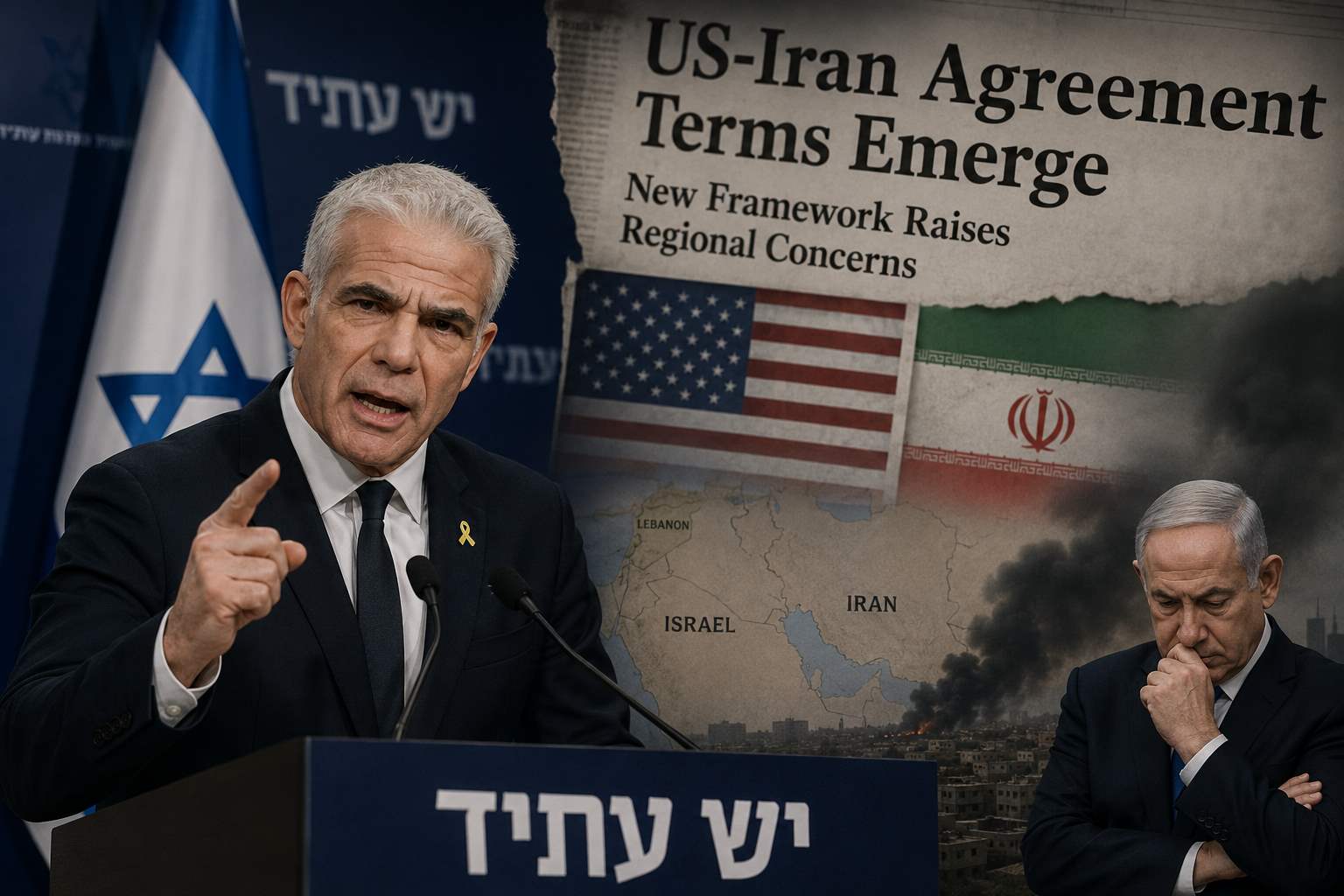
Centrist leader Yair Lapid labels the developing Washington-Tehran agreement a “disaster,” accusing Prime Minister Netanyahu of losing diplomatic leverage and failing to secure Israel’s core wartime objectives.
Published: May 26, 2026
Last Updated: May 26, 2026
By, Global War News
JERUSALEM; The diplomatic framework taking shape between the United States and Iran to bring an end to the current conflict has sparked severe domestic political blowback within Israel. On Monday, Israeli Opposition Leader Yair Lapid sharply criticized the reported parameters of the emerging deal, characterising it as a “disaster” and a “continuous failure of government” by Prime Minister Benjamin Netanyahu.
Speaking to reporters ahead of his Yesh Atid party’s weekly faction meeting in the Knesset, Lapid asserted that the agreement fails to achieve Israel’s core strategic goals. The centrist politician warned that the terms being discussed would leave the Iranian government stronger, rather than degraded, while largely freezing Jerusalem out of the direct decision-making process in Washington.
The public condemnation highlights a widening fracture within Israeli political and military circles as US President Donald Trump signals that an initial agreement with Tehran could be signed in the coming days.
The Criticisms From Jerusalem
According to public remarks delivered by Lapid on May 25, 2026, the diplomatic management of the conflict has left Israel on the sidelines of a critical regional settlement.
“The deal is bad for Israel, bad for the region, bad for the citizens of Iran,” Lapid stated publicly.
Lapid specifically targeted the Prime Minister’s handling of the alliance with Washington, claiming that the current administration has seen its diplomatic leverage diminish significantly. He referenced recent public remarks by President Trump regarding his influence over the Israeli leadership as evidence that Israel’s strategic independence is being compromised.
Furthermore, Lapid argued that the potential agreement fails to establish long-term security because it lacks permanent mechanisms to dismantle Iran’s ballistic missile infrastructure or permanently eliminate its regional proxy funding. The opposition leader insisted that Israel must maintain absolute autonomy, stating that Israel is a sovereign country and not an American protectorate, and must retain its freedom of action to defend its security interests regardless of Washington’s final decision.
Other prominent opposition figures echoed these concerns. National Unity leader Benny Gantz and Yisrael Beytenu chair Avigdor Liberman also issued remarks on Monday, stressing that any acceptable conclusion to the campaign must guarantee the total extraction of Iran’s enriched uranium and a definitive halt to long-range ballistic missile production.
Sourced Parameters of the Emerging Deal
International news agencies and regional officials have recently outlined the core components of the diplomatic framework currently being negotiated in Qatar.
According to reports from the Associated Press and Reuters, the initial phase of the agreement focuses on:
- The Strategic Waterways: A gradual reopening of the strategic Strait of Hormuz to commercial maritime shipping, reversing the chokehold that has stranded global trade supplies since the conflict began.
- The Economic Blockade: The lifting of the US maritime blockade on Iranian ports imposed on April 17, alongside the implementation of specific sanctions waivers to allow Iran to resume oil exports.
- The Nuclear Stockpile: An agreement in principle where Tehran would yield its existing stockpile of highly enriched uranium. International Atomic Energy Agency data indicates Iran possesses approximately 440.9 kilograms of uranium enriched up to 60% purity.
Officials familiar with the talks state that the initial deal would establish a 60-day ceasefire period, during which the highly sensitive technical details regarding Iran’s future enrichment limits and verification protocols would be formally negotiated.
Domestic Political Implications
The public rift comes at a highly sensitive time for the Israeli government, with legislative elections approaching in late October. Lapid’s party is currently working in a renewed political alliance with former Prime Minister Naftali Bennett, aiming to challenge Netanyahu’s Likud party.
Prime Minister Netanyahu has pushed back against domestic critics, stating publicly following a conversation with President Trump that both leaders agree any final settlement must eliminate the nuclear danger by dismantling enrichment sites. Anonymous official sources familiar with the discussions note that Netanyahu has consistently emphasized to Washington that the Israel Defense Forces will preserve freedom of action against imminent threats in any arena, including ongoing operations against Hezbollah in Lebanon.
Analysis: What This Could Mean
The intense political friction inside Israel reveals a fundamental misalignment between Washington’s immediate economic priorities and Jerusalem’s long-term security doctrines. For the United States, reopening the Strait of Hormuz is an urgent economic necessity to stabilize global energy, fertilizer, and logistics markets.
However, for Israeli strategists, a deal that focuses on a 60-day negotiating window without pre-negotiated limits on ballistic missiles or proxy disarmament represents an incomplete victory. By deferring the most contentious issues to future talks, the emerging framework risks leaving Iran’s regional architecture intact, an outcome that opposition leaders are leveraging to frame the current government as diplomatically isolated ahead of the October elections.
Source Disclosure Note: This report relies upon public on-the-record statements delivered by Israeli Opposition Leader Yair Lapid, Benny Gantz, and Avigdor Liberman on May 25, 2026. Details regarding the US-Iran negotiation parameters are sourced from official agency reporting by the Associated Press, Reuters, and PBS Newshour, alongside official data from the International Atomic Energy Agency (IAEA).
This article is based on publicly available reporting from named international news agencies and attributed official statements. All claims about ongoing events are attributed to their original sources. Analysis sections represent the editorial interpretation of reported facts and do not constitute advocacy for any party to the described conflict. AI tools may be utilized for image generation to assist in explaining complex concepts, as well as for refining grammar, spelling, and other linguistic enhancements. However, all original content is produced, fact-checked, and revised by the editorial team. This publication does not take political positions on active military conflicts.