
Protection gaps on Israeli military bases raise safety concerns amid rising missile attacks
As missile attacks intensify across Israel, several soldiers have reported a lack of adequate bomb shelters on military bases, leaving them exposed to potential danger while serving on the front lines.
Troops say damaged shelters, overcrowded safe rooms, and limited protective spaces are forcing some soldiers to seek cover in open areas, raising serious concerns about safety during ongoing missile barrages.
Soldiers Describe Unsafe Shelter Conditions
“Leah,” a reservist combat medic who requested anonymity, recalled a frightening experience on February 28, when sirens warning of incoming missiles forced soldiers on her base near the Gaza border to rush for cover.
When she and several others reached a nearby bomb shelter, they discovered a critical problem – a broken window plate designed to seal the shelter could not be closed, leaving a large opening that compromised its protection.
“We realized it’s not really safe,” Leah said.
The soldiers attempted to move to another shelter on the base but found it already full.
“It was too small – there wasn’t enough room for all of us,” she explained.
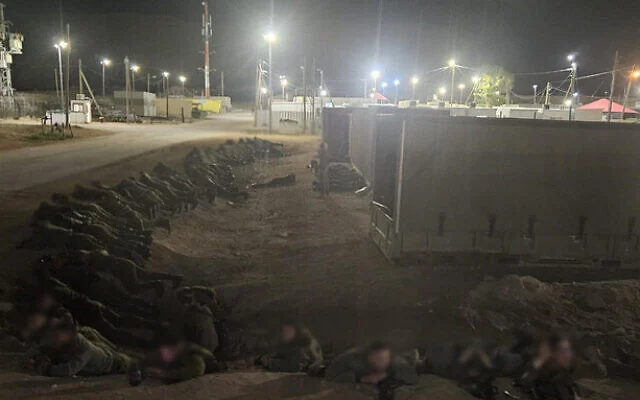
With no safe alternative, several troops were forced to stand outside near the shelter, exposed to potential shrapnel and debris from missile interceptions.
Soldiers Forced to Take Cover in Open Areas
Leah was later transferred to central Israel to join a rapid-response unit tasked with responding to missile impact sites in civilian areas.
Due to the lack of available military accommodations, her unit was temporarily housed in a local school, where classes had been suspended because of the conflict.
For the first time that day, she said she felt secure, as the building had an adequate bomb shelter nearby.
Despite frequent missile alerts in central Israel, Leah said she felt more protected there than at her military base.
However, she is scheduled to return to the same base, leaving her uncertain about safety during future missile sirens.
Complaints Reported Across Multiple Bases
Leah’s experience is not an isolated case. Several soldiers across Israel have raised concerns since the launch of Operation Roaring Lion, Israel’s campaign against Iran, which triggered ballistic missile retaliation from Tehran.
Another reservist stationed near Hebron reported that his battalion of hundreds had access to only one bomb shelter, which also served as a storage room.
According to the soldier, the shelter could fit only about 30 people, forcing many troops to remain outside during alerts.
“We basically don’t even go to the shelter anymore,” the soldier said.
Photos circulating online show groups of soldiers lying in trenches or taking cover in open areas, highlighting the lack of protective infrastructure at some bases.
Protection Issues Reported in Previous Conflicts
Similar complaints emerged during the June 2025 war with Iran, when soldiers reported that several military bases lacked sufficient bomb shelters.
It remains unclear what improvements were implemented after those warnings.
In response to the latest concerns, the Israel Defense Forces (IDF) said it is working to improve protection for troops.
The military stated it is implementing a broad plan to strengthen base protection, including deploying additional protective solutions, although specific details were not disclosed.
Military Infrastructure and Protection Gaps
Protective infrastructure on IDF bases is managed by the military’s Technological and Logistics Directorate, which oversees facilities and infrastructure across the army.
Available protection on military bases typically includes reinforced concrete safe rooms, mobile shelters, and improvised concrete structures. While these shelters are not designed to withstand direct hits from powerful ballistic missiles, they are intended to protect soldiers from falling shrapnel and debris, which remain serious threats even when missile defense systems intercept incoming rockets.
Broader Protection Challenges Across Israel
Protection gaps are not limited to military bases. A recent report by the Knesset Research and Information Center found that more than three million Israelis, nearly one-third of the population, lack adequate access to shelters.
The shortages are particularly severe in Arab communities, where infrastructure for emergency protection is often limited.
The military also noted that soldiers are trained to seek the most protected space available, though some troops must remain at their posts during missile alerts for security reasons.
During Hamas’s October 7, 2023 attack, some soldiers reportedly left their positions to take shelter from rocket sirens, leaving certain bases temporarily vulnerable to infiltration.
As missile threats continue, both military personnel and civilians are calling for stronger protective infrastructure to ensure safety during future attacks.
Source: The Times of Israel