
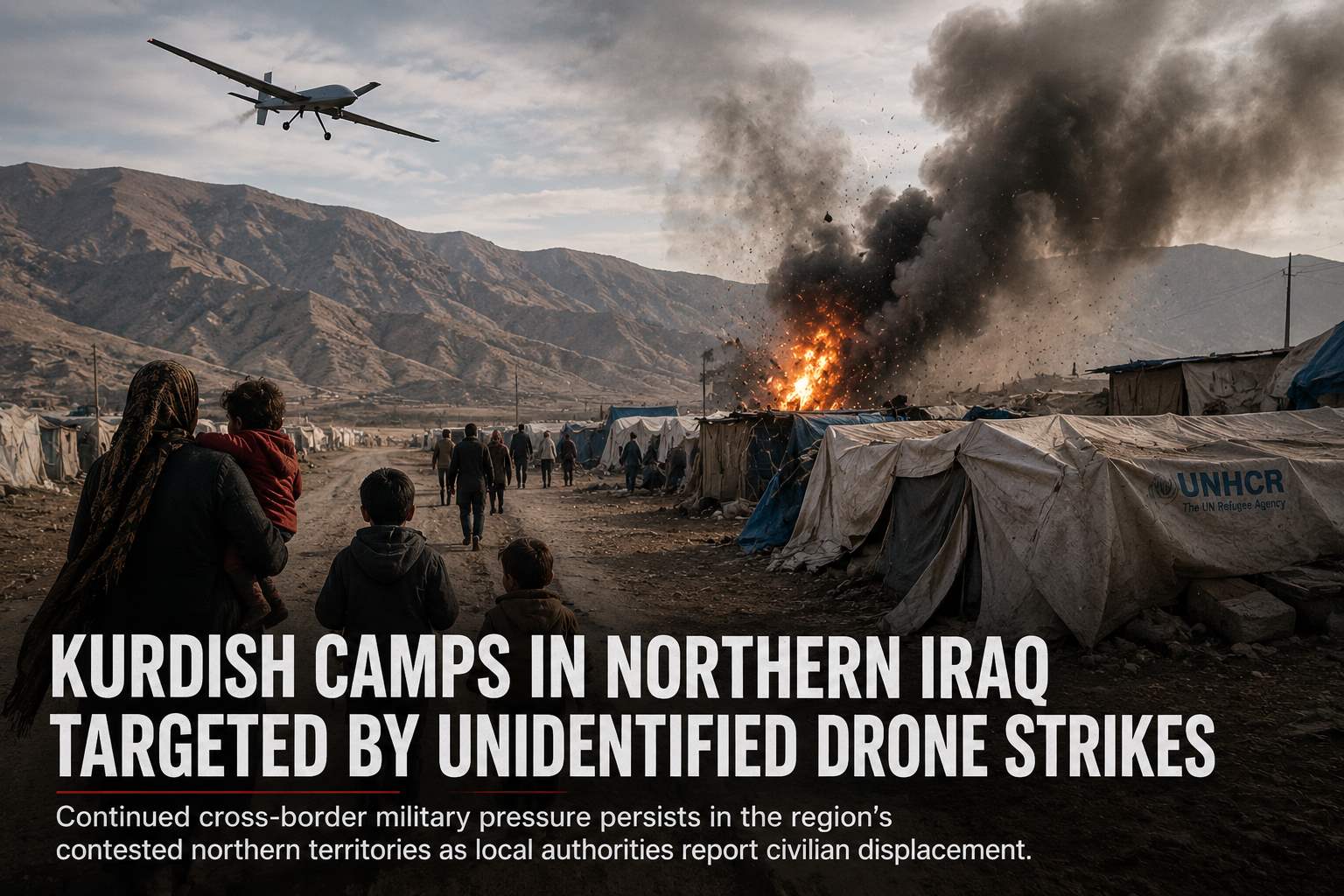
Continued cross-border military pressure persists in the region’s contested northern territories as local authorities report civilian displacement.
May 8, 2026
Global War News Editorial
By Staff Writer, Global War News
Unidentified drone strikes targeted several locations within the semi-autonomous Kurdistan Region of Iraq on Thursday, focusing on areas known to house displaced populations and suspected militant outposts. The strikes mark a continuation of heightened kinetic activity in the northern mountainous corridors, where regional powers have frequently conducted cross-border operations over the last year.
According to local security officials in the Erbil and Sulaymaniyah governorates, the aerial platforms struck positions in the Makhmour and Penjwin districts. While no group has officially claimed responsibility for the late-night raids, the strikes follow a pattern of similar engagements previously attributed to regional neighbors seeking to neutralize insurgent elements operating from within Iraqi territory.
Damage and Casualties
The Kurdistan Regional Government (KRG) health ministry reported that the strikes resulted in at least three injuries, though unverified reports from local residents suggest the casualty count could be higher. According to a report by Reuters, the strikes hit a community center near a camp for displaced persons, causing significant structural damage and sparking fires in the surrounding agricultural land.
The United Nations Assistance Mission for Iraq (UNAMI) issued a brief statement on Friday morning, expressing concern over the “repeated violations of Iraqi sovereignty” and the impact on civilian populations. The statement urged all parties to exercise restraint and prioritize diplomatic channels to resolve security grievances along the border.
Context and Regional Pressure
Northern Iraq has long served as a theater for proxy conflicts and counter-insurgency operations. Turkey and Iran have both conducted periodic drone and artillery strikes in the region, citing the presence of the Kurdistan Workers’ Party (PKK) and various Iranian-Kurdish opposition groups as a direct threat to their national security.
Analysts have suggested that the frequency of these “unidentified” strikes has increased as drone technology becomes more accessible and deniable for regional actors. “The use of unmanned platforms allows for precision strikes while maintaining a degree of diplomatic ambiguity,” noted an observer from the Middle East Institute. This ambiguity often complicates the Iraqi federal government’s efforts to register formal protests with international bodies.
Analysis: Sovereignty and Stability
The inability of Baghdad to secure its northern airspace remains a significant point of tension between the federal government and the KRG in Erbil. While the Iraqi Ministry of Defense has previously condemned such incursions, the lack of a robust integrated air defense system in the north leaves the region vulnerable to external aerial assets.
For the residents of the targeted camps, the strikes represent a recurring trauma. Many in these facilities have already been displaced multiple times by previous rounds of conflict. This raises questions about the long-term viability of humanitarian efforts in contested border zones where military objectives frequently overlap with civilian infrastructure.
Outlook
The Iraqi government is expected to receive a preliminary report from a technical committee dispatched to the strike sites by the end of the week. Observers will be watching for whether Baghdad issues a formal summons to any foreign ambassadors, or if the incident will follow the established pattern of quiet diplomatic protest followed by continued kinetic activity on the ground.
Source Disclosure: Reporting from Reuters, the Associated Press, and Rudaw Media Network. Official statements from the Kurdistan Regional Government (KRG) and the United Nations Assistance Mission for Iraq (UNAMI).
This article is based on publicly available reporting from named international news agencies and attributed official statements. All claims about ongoing events are attributed to their original sources. Analysis sections represent the editorial interpretation of reported facts and do not constitute advocacy for any party to the described conflict. AI tools may be utilized for image generation to assist in explaining complex concepts, as well as for refining grammar, spelling, and other linguistic enhancements. However, all original content is produced, fact-checked, and revised by the editorial team. This publication does not take political positions on active military conflicts.