
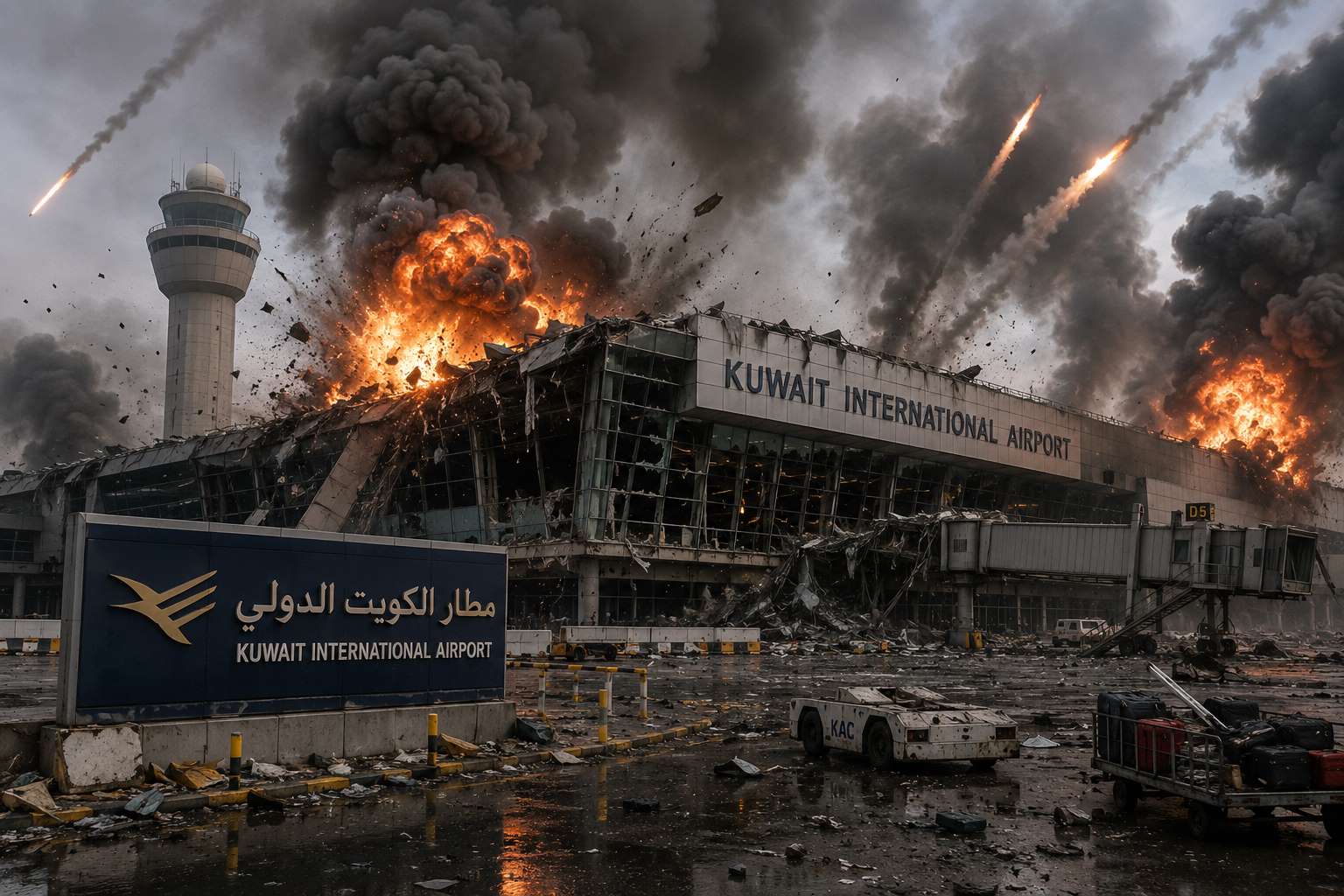
Civilian passenger terminal suffers significant structural damage as regional ceasefire faces its most severe test since April.
Publication Date: June 4, 2026
Last Updated: June 4, 2026
Byline: Global War News Editorial
KUWAIT CITY: A passenger terminal at Kuwait International Airport suffered severe material damage early Wednesday following a wave of missile and drone launches across the Gulf region. The attack marks the first fatal incident in the Gulf since a fragile ceasefire came into effect on April 8, disrupting weeks of relative calm.
Kuwaiti authorities confirmed that one person, identified by India’s ministry of external affairs as an Indian national, was killed in the strike on Terminal 1. According to the Kuwaiti health ministry, 63 other individuals received medical treatment for injuries resulting from the blasts.
The dynamic situation has drawn conflicting accounts from international entities. Kuwait’s defence ministry described the incident as an act of Iranian aggression involving up to 30 ballistic missiles and drones. In contrast, spokespersons for Iran’s Islamic Revolutionary Guard Corps denied targeting the civilian facility, claiming instead that the destruction was caused by a malfunctioning Western interceptor missile.
Current Situation and Damage Assessment
The strike occurred during a broader night of regional military activity. Kuwait’s General Civil Aviation Authority reported that the impact caused severe structural damage to Terminal 1, forcing an immediate suspension of commercial air traffic and the diversion of incoming flights to alternative regional hubs. Operations partially resumed later in the day, with national carriers gradually restarting restricted flight schedules.
Kuwaiti health ministry spokesman Abdullah al-Sanad stated that emergency teams treated dozens of patients for severe injuries, including trauma from flying debris and blast echoes.
In response to the incident, political friction between Kuwait and Tehran escalated rapidly. Kuwait’s deputy foreign minister, Hamad Suleiman al-Mashaan, formally summoned Iran’s chargé d’affaires to lodge a protest. Following the meeting, Kuwait ordered a reduction in Iranian embassy staff and declared two Iranian diplomats persona non grata, ordering them to leave the country within 24 hours.
Context and Sourcing Discrepancies
The escalation follows an incident on Tuesday when US Central Command reported firing a missile to disable the engine of an unladen, Botswana-flagged tanker, the M/T Lexie, inside international waters as it moved toward Iran’s Kharg Island. US officials stated the vessel had ignored repeated warnings to halt.
Accounts of the subsequent strikes differ significantly across regional actors:
- The Kuwaiti and US Position: Kuwaiti military spokesperson Brigadier General Saud Abdulaziz Al-Atwan attributed the airport strike directly to Iranian forces. US Central Command supported this view, stating that Iran launched multiple ballistic missiles and drones at regional targets. US officials added that while several projectiles targeting baseline areas and neighbouring Bahrain were intercepted or fell short, drones successfully struck the civilian terminal in Kuwait.
- The Iranian Position: A statement from Iran’s foreign ministry countered that Kuwait and Bahrain bear responsibility for regional instability due to the use of their territory and infrastructure by US military forces. Concurrently, Islamic Revolutionary Guard Corps spokesman Hossein Mohebi issued a statement on official media channels denying any strikes against the passenger terminal, asserting that its forces had targeted a military facility hosting US helicopters, and alleging that a US-operated Patriot interceptor missile failed and struck Terminal 1.
Analysis: Ceasefire Vulnerabilities and Economic Risks
Analysts note that this sudden increase in hostilities exposes the extreme fragility of the truce brokered in April. The open exchange of fire between US forces and regional actors indicates that tactical miscalculations or uncoordinated maritime enforcement actions can rapidly dissolve diplomatic progress.
The suspension of operations at a major Gulf transit hub highlights the immediate economic vulnerability of the region’s transport corridors. Though air traffic resumed in a limited capacity, prolonged security threats in Kuwaiti airspace raise insurance risks for commercial aviation and commercial shipping near the oil-rich ports of the northern Gulf. Observers emphasize that if negotiations regarding a permanent settlement stall, the risk of a full-scale return to coordinated military action remains a distinct possibility, a scenario explicitly referenced by Israeli Prime Minister Benjamin Netanyahu in public remarks following the strike.
What to Watch
Moving forward, diplomatic observers are monitoring whether communications between international mediators and Tehran will resume. The immediate focus rests on whether US and Iranian authorities seek to isolate this incident as a localized escalation or if it will trigger wider defensive deployments across Gulf state infrastructures. The stabilization of air traffic at Kuwait International Airport will serve as an initial indicator of whether regional security guarantees can hold under stress.
Source Disclosure Note: This report relies on official statements issued by the Kuwaiti Ministry of Defence, the Kuwaiti Ministry of Health, and the General Civil Aviation Authority. Additional details are drawn from statements by the Iranian Foreign Ministry, the Islamic Revolutionary Guard Corps communication channels, US Central Command, India’s Ministry of External Affairs, and verified field reporting from Reuters, the Associated Press, and Agence France-Presse.
This article is based on publicly available reporting from named international news agencies and attributed official statements. All claims about ongoing events are attributed to their original sources. Analysis sections represent the editorial interpretation of reported facts and do not constitute advocacy for any party to the described conflict. AI tools may be utilized for image generation to assist in explaining complex concepts, as well as for refining grammar, spelling, and other linguistic enhancements. However, all original content is produced, fact-checked, and revised by the editorial team. This publication does not take political positions on active military conflicts.