
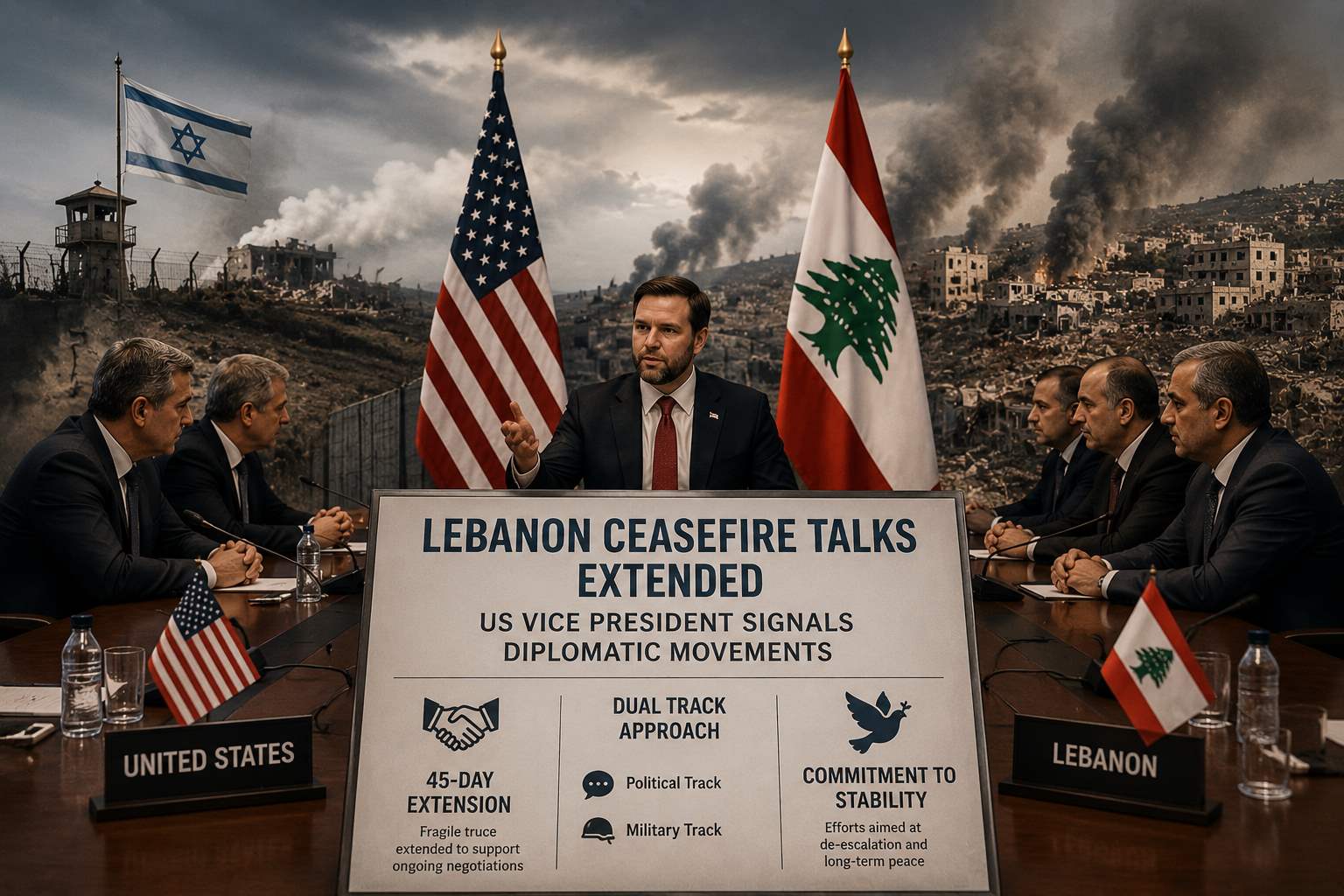
Washington secures a 45-day extension to the fragile truce between Israel and the Lebanese government, establishing dual political and military tracks despite continued regional cross-border hostilities.
Publication Date: May 18, 2026
Last Updated: May 18, 2026
Byline: Global War News Editorial
Direct diplomatic negotiations between the governments of Israel and Lebanon have advanced in Washington following a United States-brokered agreement to extend their current ceasefire for an additional 45 days. The prolongation aims to provide domestic and international negotiators with the necessary baseline stability to transition a highly porous cessation of hostilities into a permanent bilateral security treaty.
The extension was announced by US State Department spokesperson Tommy Pigott late on May 15, 2026, concluding two days of intensive, closed-door deliberations during the third official round of the Washington peace track. US Vice President JD Vance, whom President Donald Trump tasked with coordinating the diplomatic push alongside Secretary of State Marco Rubio and the Joint Chiefs of Staff, indicated that the talks yielded productive movements, particularly in creating distinct, parallel frameworks to handle political sovereignty and frontline military coordination.
While the administrative extension offers a diplomatic window until early July, the situation on the ground remains volatile. Because the Lebanese government delegation in Washington does not represent the Hezbollah militant framework, the Iran-backed Shia group has continued localized kinetic engagements with the Israel Defense Forces along the southern border, highlighting the deep structural disconnect between diplomatic text and frontline realities.
Split-Track Diplomacy: The Pentagon and State Department Mandates
The primary breakthrough of the third round is the formal institutional separation of the security and political disputes into two distinct operational tracks. This structural division is designed to prevent immediate military flashpoints from entirely collapsing the broader political dialogue.
According to a memorandum circulated by the US State Department, the dual-track framework will proceed under the following timeline:
- The Pentagon Security Track (May 29, 2026): Military delegations from both countries will convene at the Pentagon to address highly sensitive operational mechanics. This track will focus on the systematic withdrawal of Israeli ground forces from southern Lebanon, the corresponding deployment of the Lebanese Armed Forces to the frontier, and the enforcement parameters required to clear the border region of independent militant infrastructure.
- The State Department Political Track (June 2-3, 2026): Diplomatic envoys will reconvene to address structural sovereignty concerns. This track involves formal recognition of territorial integrity, the repatriation of displaced populations, civilian reconstruction funding, and the creation of an independent, international verification body to monitor future treaty compliance.
The Lebanese delegation, led by veteran diplomat Simon Karam, welcomed the split-track approach, stating that Beirut remains committed to constructive engagement while prioritizing the complete restoration of its state sovereignty. Conversely, the Israeli delegation, headed by Ambassador to the US Yechiel Leiter, described the Washington sessions as frank and constructive, emphasizing that the long-term safety of northern Israeli communities remains their primary metric for success.
Context and Background: The Path from “Eternal Darkness” to Washington
The current diplomatic track is unfolding against the backdrop of a severely altered strategic landscape in the Levant. Following joint Western actions against Iranian strategic targets on February 28, 2026, regional hostilities rapidly expanded into Lebanon, culminating in an intensive Israeli air campaign on April 8, codenamed Operation Eternal Darkness, and the subsequent deployment of multiple IDF divisions into an 8-to-10-kilometer deep security buffer zone inside southern Lebanese territory.
Recognizing the risk of an unmanageable regional escalation, the White House initiated a direct diplomatic intervention on April 16, bypassing historical proxy channels to facilitate direct communications between Lebanese President Joseph Aoun and Israeli Prime Minister Benjamin Netanyahu. These initial White House efforts secured a baseline 10-day truce, which has now been incrementally extended to prevent a return to full-scale urban bombardment.
However, the structural challenge of these talks lies in the domestic political division within Beirut. Lebanese Prime Minister Nawaf Salam publicly stated that the country has suffered sufficiently from conflicts driven by external interests, signaling an explicit push by the central government to assert sole military authority over its territory. Yet, Hezbollah lawmakers and affiliated media networks have entirely rejected the legitimacy of the Washington talks, declaring that the group will not be bound by any legal parameters negotiated by the state apparatus.
Washington Dual-Track Timeline (2026)
- May 15: The 45-day ceasefire extension is officially ratified.
- May 29: The Pentagon’s military coordination track begins.
- Focus areas include:
- IDF withdrawal mechanisms
- LAF border deployment planning
- Focus areas include:
- June 2–3: The State Department’s political negotiation track reconvenes.
- Main agenda items include:
- Sovereign border recognition
- Refugee return arrangements
- Main agenda items include:
- July 1: The current 45-day truce window is scheduled to expire.
Analysis: The Enforcement Dilemma and State Capability
The fundamental vulnerability of the Washington track is the enforcement dilemma confronting the Lebanese Armed Forces. The central premise of the American and Israeli framework is the total disarmament of non-state actors south of the Litani River, requiring the Lebanese state to assume a monopoly on physical force.
Observers note that while the Lebanese government possesses the political will to reclaim its sovereign borders, the LAF currently lacks the material capability, heavy armor, and logistical infrastructure necessary to forcibly disarm or displace entrenched Hezbollah units. Vice President Vance’s diplomatic push appears predicated on organizing international financial and material aid packages to rapidly build up the Lebanese military’s operational capacity, using Beirut as a localized stabilization zone.
If the upcoming Pentagon sessions fail to establish a realistic, adequately funded enforcement mechanism, the ceasefire extension will likely function merely as a temporary operational pause. Israel has maintained that it retains the right to unilateral self-defense inside Lebanese territory if border threats persist, an operational posture that could trigger a collapse of the political track when diplomats reconvene in June.
What to Watch
In the weeks preceding the May 29 military talks at the Pentagon, the primary indicator of stability will be the frequency and scale of localized ceasefire violations in southern Lebanon. Observers will closely monitor whether the LAF begins preparatory forward deployments toward the edge of the Israeli-occupied buffer zone.
Furthermore, international attention will focus on the political reactions within Beirut’s parliament. Any coordinated push by opposition factions to legally challenge the mandate of the Lebanese negotiating team could severely undermine the credibility of the state’s commitments before the June political sessions begin.
Source Disclosure Note: This report is compiled from official public briefings delivered by US State Department spokesperson Tommy Pigott and statements released via social media by Vice President JD Vance. Israeli diplomatic positions are sourced from official text provided by Ambassador Yechiel Leiter. Lebanese state positions and ministerial remarks are drawn directly from the Lebanese National News Agency and official press releases from the Prime Minister’s office in Beirut. Additional frontline tracking data is derived from wire updates published by the Associated Press, Reuters, and AFP.
This article is based on publicly available reporting from named international news agencies and attributed official statements. All claims about ongoing events are attributed to their original sources. Analysis sections represent the editorial interpretation of reported facts and do not constitute advocacy for any party to the described conflict. AI tools may be utilized for image generation to assist in explaining complex concepts, as well as for refining grammar, spelling, and other linguistic enhancements. However, all original content is produced, fact-checked, and revised by the editorial team. This publication does not take political positions on active military conflicts.