
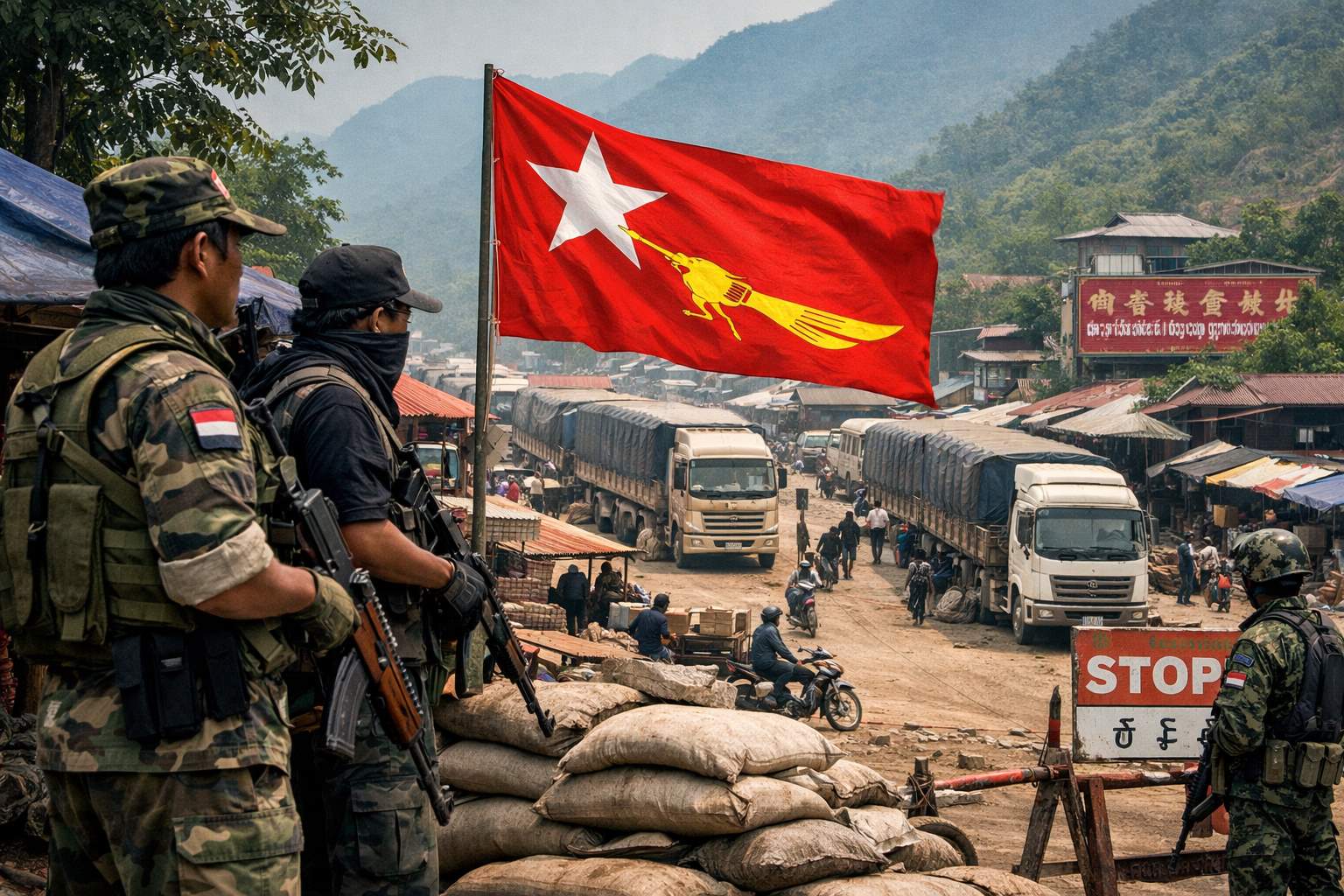
Disruption of vital economic arteries continues as ethnic armed organizations consolidate territory along the Chinese and Thai borders.
May 4, 2026
Last Updated: May 4, 2026
By Staff Writer, Global War News
Reports from Myanmar’s northern and southeastern border states indicate that a coalition of ethnic armed organizations (EAOs) and People’s Defense Forces (PDFs) have maintained firm control over several primary trade hubs, despite intensified aerial campaigns by the military junta. According to local monitors and cross-border trade data, opposition forces currently hold the majority of “economic gateways” linking Myanmar to China and Thailand, creating a de facto blockade of the junta’s primary revenue streams.
In northern Shan State, the Myanmar National Democratic Alliance Army (MNDAA) has reportedly consolidated its grip on the Muse-Lashio corridor. Following a strategic realignment in late March 2026, the MNDAA now dominates the primary artery for trade with China’s Yunnan Province. Local sources confirm that while the Muse border gate has seen a slight resumption in commercial activity, the military junta has effectively blocked the route south of Lashio to prevent opposition forces from financing their operations through cargo taxation.
In the southeast, the situation remains a stalemate. While the junta officially declared the Myawaddy-Kawkareik Asia Highway open on April 29, 2026, cargo trucks remain unable to traverse the route. Negotiating the “taxation deadlock” between the military and the Karen National Union (KNU) has become the primary obstacle to restoring Thai-Myanmar trade, which historically accounts for billions in annual revenue.
The Strategic Siege of Trade Hubs
The opposition’s strategy in 2026 has shifted from rural insurgency to the systematic seizure of urban and economic centers. By controlling the border hubs, EAOs have not only cut off the junta’s access to foreign currency but have also established their own administrative and taxation structures.
- Northern Shan State: The MNDAA and allies control the Kyin San Kyawt and Pangseng gates. Before the 2023–24 offensives, these gates handled an estimated $5 billion in annual trade.
- Rakhine State: The Arakan Army (AA) now controls all but three of the state’s 17 townships, effectively blockading the western coast and stalling major infrastructure projects linked to the China-Myanmar Economic Corridor (CMEC).
- Karen State: The KNU maintains control over the Dawna Range “mountain routes,” forcing traders to pay transit fees to opposition forces even when the junta claims control of the primary highways.
Economic Paralysis and the Informal Economy
The impact on Myanmar’s national economy has been catastrophic. While the junta continues to prioritize security over trade, the civilian population faces a “polycrisis” of currency depreciation and supply chain collapse. The Myanmar Kyat (MMK) has experienced extreme volatility in 2026, driving up the cost of imported fuel and basic commodities.
The agricultural sector, the backbone of the rural economy, has been severely impacted by the closure of land routes. Maize, chili, and onion exporters in Shan and Kayah states have been forced to divert goods through the Yangon-Kawthaung sea route to Thailand, a detour that significantly increases transit times and costs. Consequently, the World Bank and IMF estimate that Myanmar’s GDP remains well below its pre-2021 trajectory, with a projected growth rate of just 3% in 2026, insufficient to offset the cumulative losses of the past five years.
Analysis: The “Two Myanmars” Reality
Analysts suggest that the current map of trade control reflects the emergence of “Two Myanmars”: a junta-controlled central heartland and an opposition-governed periphery. In areas like the Kokang region and parts of Rakhine State, EAOs are no longer just military actors; they are acting as sovereign administrators, issuing trade permits and managing local infrastructure.
This fragmentation poses a significant challenge to regional powers, particularly China. Beijing’s “muted response” to recent territorial shifts, such as the MNDAA’s capture of Kutkai, suggests a pragmatic pivot. Analysts from the Institute for Strategy and Policy, Myanmar (ISP-Myanmar) note that China appears increasingly willing to deal with whoever can guarantee stability along the trade routes, regardless of their standing with the central military government.
Current Standing
As of May 4, 2026, the humanitarian toll of the continued fighting is reaching a breaking point. The UN reports that internal displacement is projected to reach 4 million people this year. While the opposition forces hold the economic high ground at the borders, the junta’s superior airpower ensures that consolidating this control remains a deadly endeavor for civilians trapped in the crossfire. With the military’s planned elections facing widespread rejection and the resistance refusing to yield trade revenue, the “siege of the hubs” is set to remain the defining feature of the conflict through the monsoon season.
Source Disclosure: Factual claims regarding territorial control and trade hub status are based on reports from The Irrawaddy, CNI Myanmar, and ACLED. Humanitarian data and displacement projections are sourced from ReliefWeb and Human Rights Watch. Economic indicators and trade data were provided by the World Bank, IMF, and the UK Trade and Investment Factsheet (2026).
This article is based on publicly available reporting from named international news agencies and attributed official statements. All claims about ongoing events are attributed to their original sources. Analysis sections represent the editorial interpretation of reported facts and do not constitute advocacy for any party to the described conflict. AI tools may be utilized for image generation to assist in explaining complex concepts, as well as for refining grammar, spelling, and other linguistic enhancements. However, all original content is produced, fact-checked, and revised by the editorial team. This publication does not take political positions on active military conflicts.