
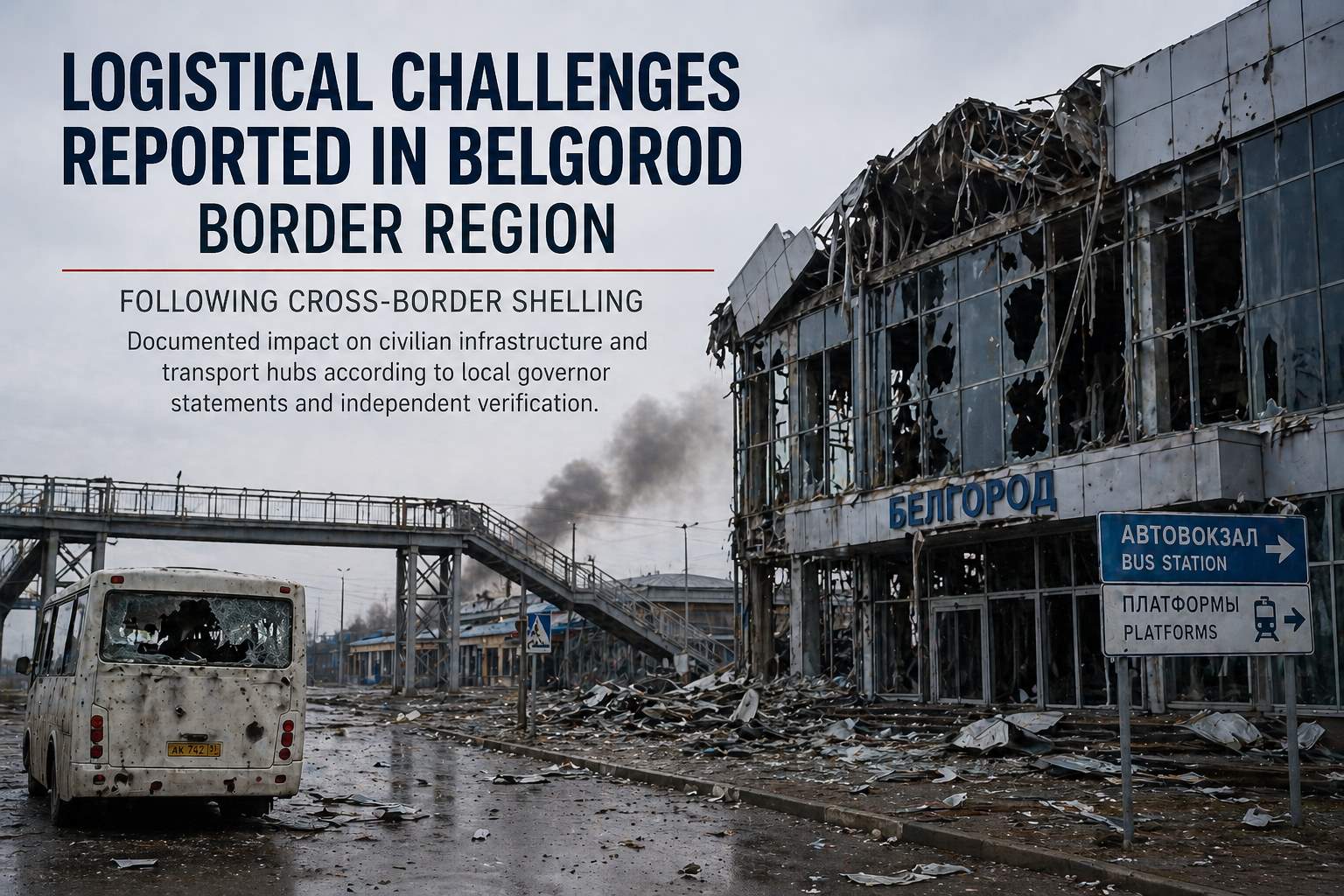
Authorities mandate armored delivery vehicles and specialized electronic warfare systems as persistent drone strikes and shelling disrupt civilian supply chains and utility grids.
April 28, 2026
Last Updated: April 28, 2026
By Global War News Editorial
Persistent cross-border engagements in the Belgorod region have led to a significant restructuring of local logistics and a near-total disruption of conventional civilian transport hubs. According to recent statements from Governor Vyacheslav Gladkov, the intensity of unmanned aerial vehicle (UAV) strikes and artillery shelling has reached a level that prevents standard commercial delivery services from operating within 15 kilometers of the border.
The logistical crisis has forced regional authorities to adopt “military-style” distribution methods for essential goods. As of late April 2026, the delivery of food, water, and mail to frontline settlements is being conducted primarily through armored vehicles equipped with electronic warfare (EW) suites. This shift underscores the growing economic and social toll on Russian border territories as the conflict enters a phase of high-frequency attrition.
Mandated Armored Logistics and Retail Netting
In a regional government meeting held this week, Governor Gladkov issued a formal directive prohibiting the use of unprotected civilian vehicles for deliveries in high-risk zones. The governor noted that commercial firms have largely ceased operations at their own risk due to the frequency of strikes on passenger and freight transport.
“I forbid the use of such equipment without detectors and electronic warfare systems,” Gladkov stated, according to reports from local outlets such as Pepel. The regional administration has also instructed all retail outlets within the 15-kilometer border buffer to reinforce their buildings with anti-drone netting and sandbags.
Independent monitors, including The Moscow Times, have noted that these measures are a response to a sharp increase in civilian casualties occurring during commutes. In early 2026, data suggests that the majority of fatalities in the region have taken place while individuals were traveling in or near private vehicles, highlighting the extreme risk to basic movement.
Infrastructure Damage and Utility Outages
The logistical strain is compounded by systematic damage to the region’s energy and transport infrastructure. Reports from the Russian Ministry of Foreign Affairs and regional power companies indicate that drone assaults on nodal distribution substations have become a daily occurrence.
- Energy Grid: A recent strike on the Yuzhnaya substation reportedly disconnected 61,000 consumers from the power grid. As of April 2026, heating capacity in some border districts remains at approximately 50%, with thousands of residents experiencing intermittent blackouts.
- Water Supply: Logistical challenges extend to sanitation, with power surges caused by airstrikes leading to a total loss of running water for nearly 100,000 customers in February 2026. Restoration efforts are frequently delayed by secondary strikes targeting repair crews.
- Transport Hubs: Independent satellite imagery and local reports have confirmed damage to rail tracks in districts such as Prokhorovsky, where explosive devices have previously derailed locomotives, causing multi-hour suspensions of vital freight lines.
Analysis: The “Gray Zone” Economy of Border Regions
Economic analysts suggest that the Belgorod region is currently operating under a “war economy” model where the state must subsidize the basic costs of civilian survival. The necessity of using armored vehicles for food delivery significantly increases the overhead of local commerce, potentially leading to scarcity and price inflation.
Observers note that:
- Connectivity Barriers: Frequent internet outages, often linked to EW interference or infrastructure damage, have left residents unaware of incoming attacks. Governor Gladkov has described this lack of information as a “serious threat” that has directly contributed to the rising death toll.
- Labor Shortages: Labor shortages are intensifying as commercial drivers and retail staff refuse to work in areas under constant fire. This has forced municipal leaders to take a direct hand in the distribution of correspondence and groceries.
- Social Displacement: The inability to provide modular bomb shelters due to active drone interference has made the “normalization” of life in these districts increasingly untenable, likely driving further internal displacement toward the regional capital.
Closing Summary
As of late Tuesday, April 28, 2026, air defense systems reportedly destroyed 22 drones over the Belgorod region overnight, though three civilians were killed in separate strikes on vehicles. The regional administration continues to seek a balance between maintaining civilian connectivity and implementing the strict security measures required to protect supply chains. We will continue to monitor the impact of these logistical shifts on the broader regional economy.
Sources: This report is based on official Telegram statements from Belgorod Governor Vyacheslav Gladkov, reports from The Moscow Times and Al Arabiya, and weekly data on civilian victims provided by the Russian Ministry of Foreign Affairs. Additional verification provided by the Anadolu Agency and Pepel.
This article is based on publicly available reporting from named international news agencies and attributed official statements. All claims about ongoing events are attributed to their original sources. Analysis sections represent the editorial interpretation of reported facts and do not constitute advocacy for any party to the described conflict. AI tools may be utilized for image generation to assist in explaining complex concepts, as well as for refining grammar, spelling, and other linguistic enhancements. However, all original content is produced, fact-checked, and revised by the editorial team. This publication does not take political positions on active military conflicts.