
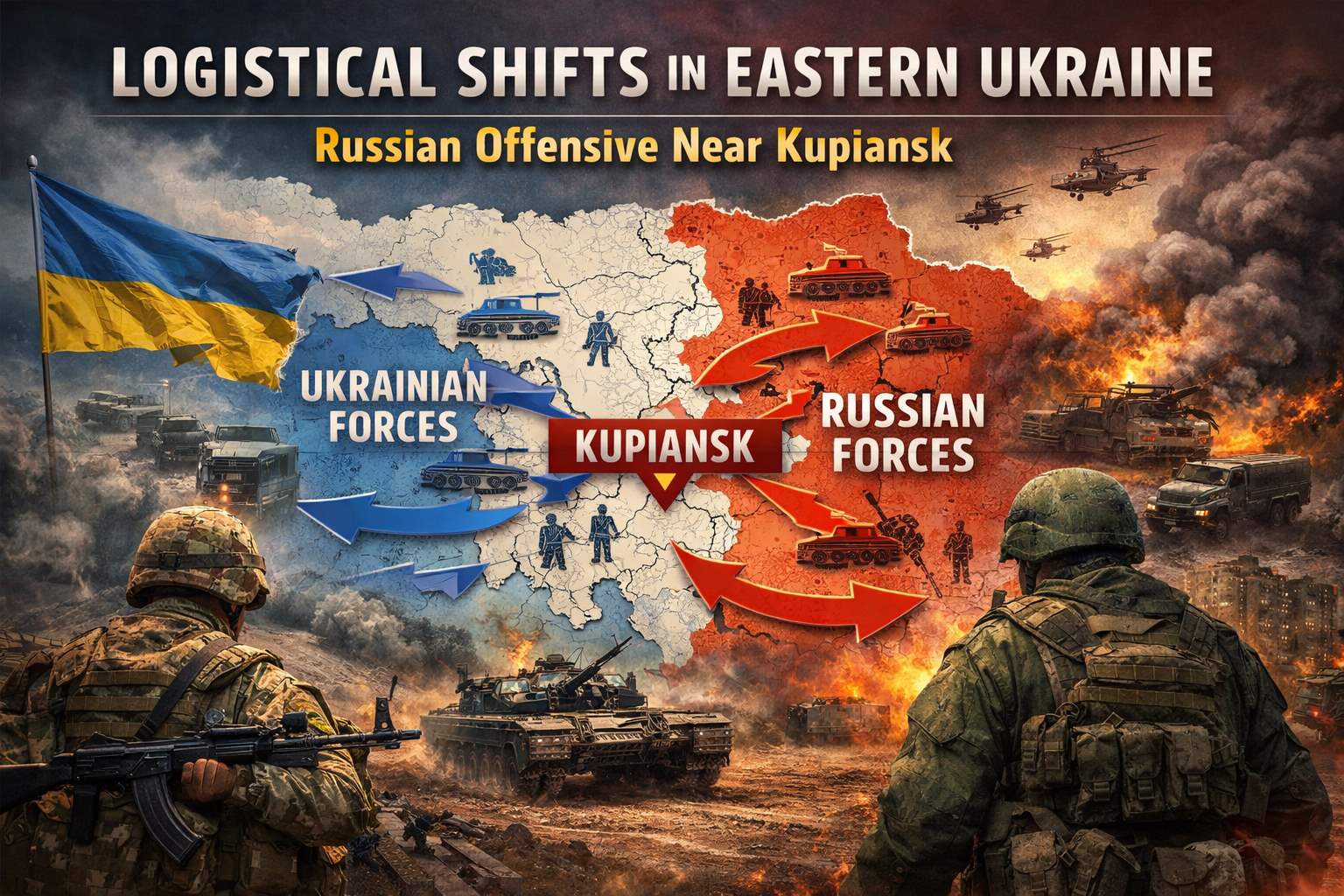
Analysis of troop movements and reinforcement lines following updates from the Ukrainian General Staff and the Russian Ministry of Defence.
Publication date: May 6, 2026
Last updated: May 6, 2026
By Staff Writer, Global War News
Recent military activity in Northeast Ukraine suggests a significant shift in operational focus. Reports from both Kyiv and Moscow indicate a renewed intensity in the Kupiansk sector, a vital logistics hub in the Kharkiv region that has remained a focal point of contention since its liberation by Ukrainian forces in late 2022.
According to the General Staff of the Armed Forces of Ukraine, Russian forces have increased their use of guided aerial bombs and heavy artillery against defensive positions on the eastern bank of the Oskil River. Ukrainian officials stated in a morning briefing that several “assault groups” supported by armored vehicles attempted to breach lines near the village of Synkivka. While the Ukrainian command maintains that its positions remain intact, the increased tempo of these strikes suggests a transition from localized skirmishing to a broader offensive push.
The Russian Ministry of Defence, in its daily operational update, reported that its “Western Group of Forces” has successfully improved its tactical positions along the front line near Kupiansk. The ministry claimed that Russian units have neutralized several Ukrainian observation posts and disrupted supply routes moving toward the Pishchane area. These claims, however, could not be independently verified.
The Strategic Value of the Kupiansk Hub
Kupiansk serves as a critical junction for rail and road networks in the Kharkiv region. For the Russian military, reclaiming this territory would provide a springboard for further operations into the Donbas from the north. Conversely, for Ukraine, holding the city is essential to protecting the flank of its forces operating further south in the Luhansk region.
Military observers note that the current escalation coincides with a noticeable shift in Russian logistical patterns. According to satellite imagery analysis discussed by independent research groups, new Russian supply depots have been established in the Belgorod region, just across the border, potentially to support a sustained offensive in this direction.
Analysis: What This Could Mean
The timing of this renewed pressure suggests a strategic attempt by Moscow to force Ukraine to divert its reserves from other active fronts, such as the southern Zaporizhzhia axis. If Russian forces manage to secure heights overlooking the Oskil River, they could potentially threaten the Ukrainian logistics chain across the entire northeastern theater.
However, analysts from the Institute for the Study of War have previously pointed out that Russian progress in this sector has historically been measured in hundreds of meters rather than kilometers, hampered by dense minefields and Ukrainian drone surveillance. The current push appears to be an effort to exploit the current window before seasonal weather changes impact the mobility of heavy armor.
Outlook
The situation in the Kupiansk sector remains fluid. Observers will be watching for whether Russia commits its larger reserve divisions to this front or continues to rely on smaller, incremental “meat grinder” assaults. For the Ukrainian side, the priority remains the stabilization of the Oskil line while managing ammunition supplies, which remain a decisive factor in their defensive capabilities.
Source Disclosure: This report relies on official daily briefings from the Ukrainian General Staff, the Russian Ministry of Defence, and independent operational analysis from the Institute for the Study of War.
This article is based on publicly available reporting from named international news agencies and attributed official statements. All claims about ongoing events are attributed to their original sources. Analysis sections represent the editorial interpretation of reported facts and do not constitute advocacy for any party to the described conflict. AI tools may be utilized for image generation to assist in explaining complex concepts, as well as for refining grammar, spelling, and other linguistic enhancements. However, all original content is produced, fact-checked, and revised by the editorial team. This publication does not take political positions on active military conflicts.