
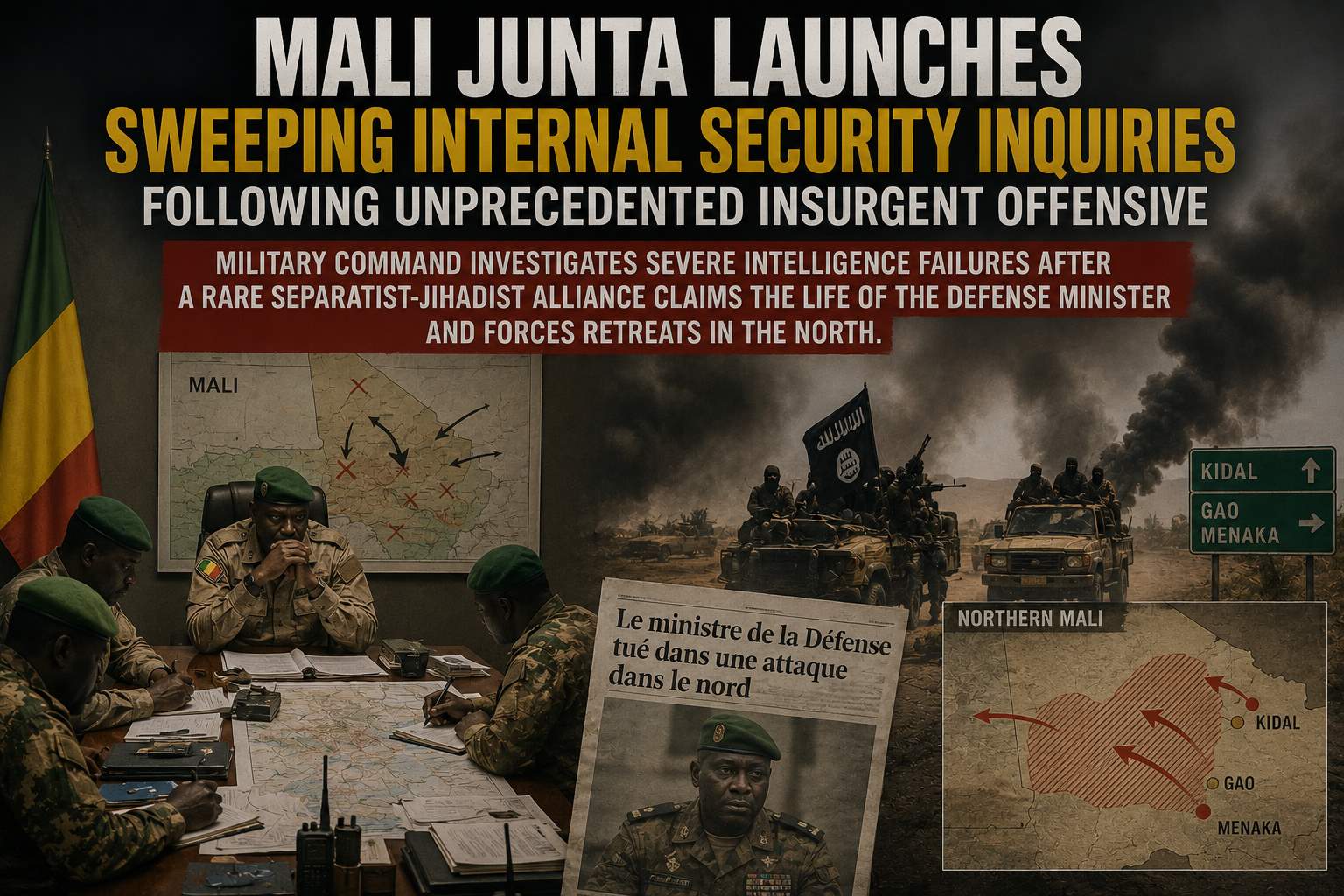
Military command investigates severe intelligence failures after a rare separatist-jihadist alliance claims the life of the Defense Minister and forces retreats in the north.
Published: May 21, 2026
By: Global War News Editorial
The military government of Mali has initiated expansive internal investigations and a nationwide security crackdown following highly synchronized insurgent attacks that targeted the country’s most secure political and military installations.
The investigations come in the wake of an unprecedented offensive launched on April 25, 2026, which exposed profound gaps in the state’s intelligence apparatus and shook the baseline stability of the ruling junta. According to official bulletins from the Malian Armed Forces General Staff, military prosecutors are reviewing operational lapses that allowed heavily armed columns to simultaneously strike six major urban centers, spanning from the capital, Bamako, in the south to central regional hubs and northern desert strongholds.
High-Profile Casualties and Territorial Losses
The most critical focal point of the military’s internal inquiry centers on Kati, a heavily fortified garrison town located roughly 15 kilometers outside Bamako that serves as the core of the junta’s executive authority. In Kati, a highly coordinated assault involving a devastating suicide car bombing directly targeted and destroyed the residence of Mali’s Defense Minister, General Sadio Camara.
Malian state media subsequently confirmed that General Camara—one of the most powerful and influential architects of the current military government—was killed in the blast. The initial explosion was reported to be so powerful that it damaged surrounding military quarters and completely leveled a local neighborhood mosque. Concurrently, separate insurgent units targeted the Modibo Keita International Airport in Bamako and ambushed military compounds, leaving senior intelligence officials wounded and causing panic within the capital’s command structure.
While security forces in the south eventually re-established physical control through intensive sweeping operations, the military faced severe reversals in the north. A spokesperson for the Tuareg-led Azawad Liberation Front announced that its forces had completely seized the strategic northern town of Kidal.
The rebel advances forced a rapid retreat of Malian state troops and their state-contracted international partners, the Russian Africa Corps, an organization operating under the direct oversight of the Russian Ministry of Defence. The separatist forces publicly circulated videos documenting the capture of significant quantities of state military hardware, including functional armored vehicles and heavy transport trucks left behind at abandoned desert bases.
A Pragmatic Convergence of Historical Foes
The sweeping scope of the offensive has alarmed regional security analysts due to the highly unusual operational alliance that executed it. Responsibility for the synchronized strikes was claimed jointly by Jama’at Nusrat al-Islam wal-Muslimin, an Al-Qaeda-affiliated militant Islamist group, and the Azawad Liberation Front, a coalition of secular Tuareg separatist factions.
Historically, these two factions have maintained deep ideological contradictions and intermittent hostility. The Al-Qaeda affiliate fights to establish strict Sharia governance across the Sahel, whereas the Tuareg separatists pursue secular autonomy or independence for the northern region they refer to as Azawad.
Security trackers from the Stimson Center indicate that the two groups have established a pragmatic, temporary alliance based on shared opposition to the central military government in Bamako. Security analyst Paul Oula reported to media networks that the groups are sharing tactical intelligence, logistical supply lines, and operational planning at a level of sophistication never recorded in previous Sahelian rebellions.
Domestic Crackdown and Shifting Geopolitics
In the aftermath of the military failures, international human rights monitors have flagged a severe contraction of civil liberties within government-controlled territories. The International Federation for Human Rights published a report detailing the enforced disappearance of several high-profile political dissidents and critics in Bamako.
According to the monitoring group, individuals including prominent lawyer Mountaga Tall were abducted from their homes by masked, armed men traveling in unregistered vehicles. Rights advocates allege these actions match the historical methodology of the state security apparatus, though domestic judicial authorities have not opened formal inquiries into the disappearances.
| Region of Attack | Target Types | Reported Outcome | Attributed Faction |
| Kati (South) | Defense Minister Residence, Garrisons | Minister Killed, Heavy Infrastructure Destruction | JNIM |
| Bamako (South) | International Airport, Air Bases | Heavy Gunfire, Security Lockdowns | JNIM |
| Kidal (North) | Strategic Military Outposts | Total State Withdrawal, Capture of Armor | FLA |
| Sévaré & Mopti (Center) | Regional Army Barracks | Frontline Sabotage, Logistical Disruptions | JNIM |
The twin pressures of territorial fragmentation and internal dissent are forcing the Malian junta to evaluate its international defense dependencies. While the government initially claimed that its transition away from Western partnerships toward Russian Africa Corps personnel would stabilize the country, the scale of the April 25 disaster has brought that strategy under intense domestic scrutiny. Analysts observe that the junta is quietly exploring alternative defense procurement lines, including expanding technological ties with Turkey and attempting tentative re-engagement with security officials from the United States.
What to Watch Next
The immediate priority for the Malian military command is restructuring its leadership hierarchy following the death of General Camara. Replacing a figure of his political weight during an active national crisis risks exposing internal rivalries within the ruling military council.
Meantime, the counter-offensive operations launched by the Malian Armed Forces have reportedly claimed the lives of dozens of insurgent fighters in central Mali, but state forces have yet to mount a credible attempt to recapture Kidal or the northern border corridors. Observers are closely monitoring whether the fragile alliance between the Tuareg separatists and Al-Qaeda’s regional wing will hold as they attempt to consolidate their newly acquired territories, or if competing governance models will cause the coalition to fracture from within.
Source Disclosure Note: This report relies on official public statements from the Malian Armed Forces General Staff, field dispatches from the international news agencies Reuters, Agence France-Presse, and Associated Press, and data published by the semi-official Tasnim News Agency. Additional context and casualty data were drawn from formal briefings by the International Federation for Human Rights, security assessments from the Stimson Center, and reporting by Al Jazeera and the Africa Center for Strategic Studies.
This article is based on publicly available reporting from named international news agencies and attributed official statements. All claims about ongoing events are attributed to their original sources. Analysis sections represent the editorial interpretation of reported facts and do not constitute advocacy for any party to the described conflict. AI tools may be utilized for image generation to assist in explaining complex concepts, as well as for refining grammar, spelling, and other linguistic enhancements. However, all original content is produced, fact-checked, and revised by the editorial team. This publication does not take political positions on active military conflicts.