
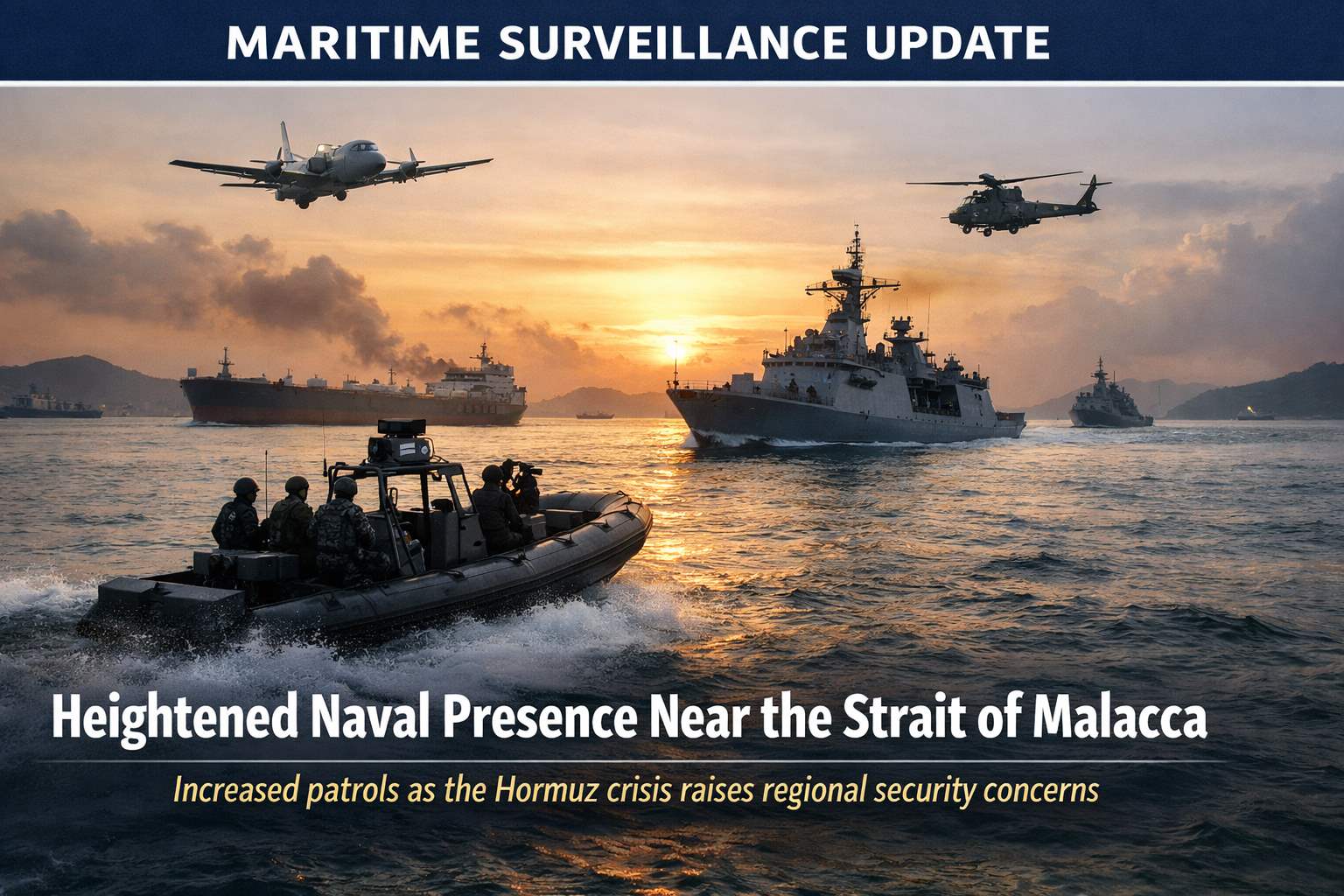
Littoral states and international monitors report increased patrols as the Hormuz crisis triggers new regional security and economic debates.
May 7, 2026
Last updated: May 7, 2026
By Staff Writer, Global War News
Regional maritime authorities have noted a significant increase in naval and coast guard presence throughout the Strait of Malacca over the past 48 hours. The surge in surveillance comes as the global maritime community shifts its focus toward Southeast Asia’s primary chokepoint following the collapse of commercial traffic in the Strait of Hormuz.
According to a report from the Maritime Security Center, the heightened activity involves intensified patrols by the littoral states, Indonesia, Malaysia, and Singapore, aimed at ensuring the “right of transit passage” remains uninterrupted. While no kinetic engagements have been reported in the strait itself, the increased visibility of military hardware reflects a growing regional anxiety over the potential for “chokepoint contagion.”
Securing the “Artery of the East”
The Strait of Malacca, which handles approximately 40% of global seaborne trade and more than 23 million barrels of oil per day, has long been a focal point for maritime security. However, recent geopolitical shifts have elevated its strategic stakes.
As reported by Al Jazeera and Reuters, the Malaysian Maritime Enforcement Agency recently committed to a billion-ringgit modernization plan, including helicopters and radar systems, to address a “patrol deficit” in the northern approaches. Simultaneously, Indonesia established a “major defense cooperation partnership” with Washington in April 2026, signaling a move toward more integrated maritime domain awareness with international partners.
The Toll Dispute and Legal Friction
The increase in naval presence is occurring against a backdrop of diplomatic friction. In April 2026, Indonesian Finance Minister Purbaya Yudhi Sadewa floated the idea of imposing “tolls” on ships transiting the strait to help monetize the maintenance of the waterway.
The proposal was met with immediate resistance. Malaysia’s Foreign Minister, Mohamad Hasan, stated publicly that no country could unilaterally impose such charges, noting they would violate the United Nations Convention on the Law of the Sea (UNCLOS). Singaporean officials also delivered a joint statement to the UN Security Council on April 27, 2026, emphasizing that transit passage is “a right under international law and not a privilege.”
Economic Impact and Market Repricing
The heightened security environment is already impacting maritime economics. According to data from Kpler, while flows through the strait remain uninterrupted, the cost of “chokepoint risk” is being repriced globally.
Analysts at the European Policy Centre have noted that as freedom of navigation becomes less certain in the Middle East, the EU and major Asian importers like Japan and South Korea are increasingly viewing the Strait of Malacca as their “last reliable artery.” This has led to a 5-8% increase in transit insurance for certain high-value cargo categories, as insurers account for the possibility of “physical obstruction tactics” migrating from other disputed waters, such as Scarborough Shoal, to the Malacca approaches.
Analysis: Deterrence vs. Escalation
The current “show of force” in the Strait of Malacca is a double-edged sword. On one hand, the increased presence of the Indonesian, Malaysian, and Singaporean navies serves as a necessary deterrent against piracy and opportunistic non-state actors who might seek to exploit the Hormuz crisis.
On the other hand, the introduction of more military hardware into a waterway that is only 2.8 kilometers wide at its narrowest point increases the risk of “accidental friction.” By reinforcing their presence, littoral states are asserting “ASEAN centrality”, the principle that regional powers, rather than external navies, should be the primary architects of local security. However, the internal disagreement over tolls suggests that even within this regional bloc, the consensus on how to manage this “geoeconomic vulnerability” is beginning to fracture.
What to Watch
The upcoming ASEAN Regional Forum in June will be a critical venue for resolving the toll dispute and formalizing a coordinated patrol framework. Observers will also be monitoring the “Project Freedom” naval operation in the Middle East; if that operation succeeds in reopening Hormuz, the pressure on the Strait of Malacca may subside. Conversely, any persistent loitering behavior by non-littoral naval units in the Malacca approaches would likely signal a more permanent shift in the regional security architecture.
Sources: UN Security Council Joint Statement (April 27, 2026), Reuters Maritime Reporting, Al Jazeera regional coverage, Kpler/MarineTraffic vessel data, CFR Article (May 6, 2026), Malaysian Ministry of Foreign Affairs official remarks.
This article is based on publicly available reporting from named international news agencies and attributed official statements. All claims about ongoing events are attributed to their original sources. Analysis sections represent the editorial interpretation of reported facts and do not constitute advocacy for any party to the described conflict. AI tools may be utilized for image generation to assist in explaining complex concepts, as well as for refining grammar, spelling, and other linguistic enhancements. However, all original content is produced, fact-checked, and revised by the editorial team. This publication does not take political positions on active military conflicts.