
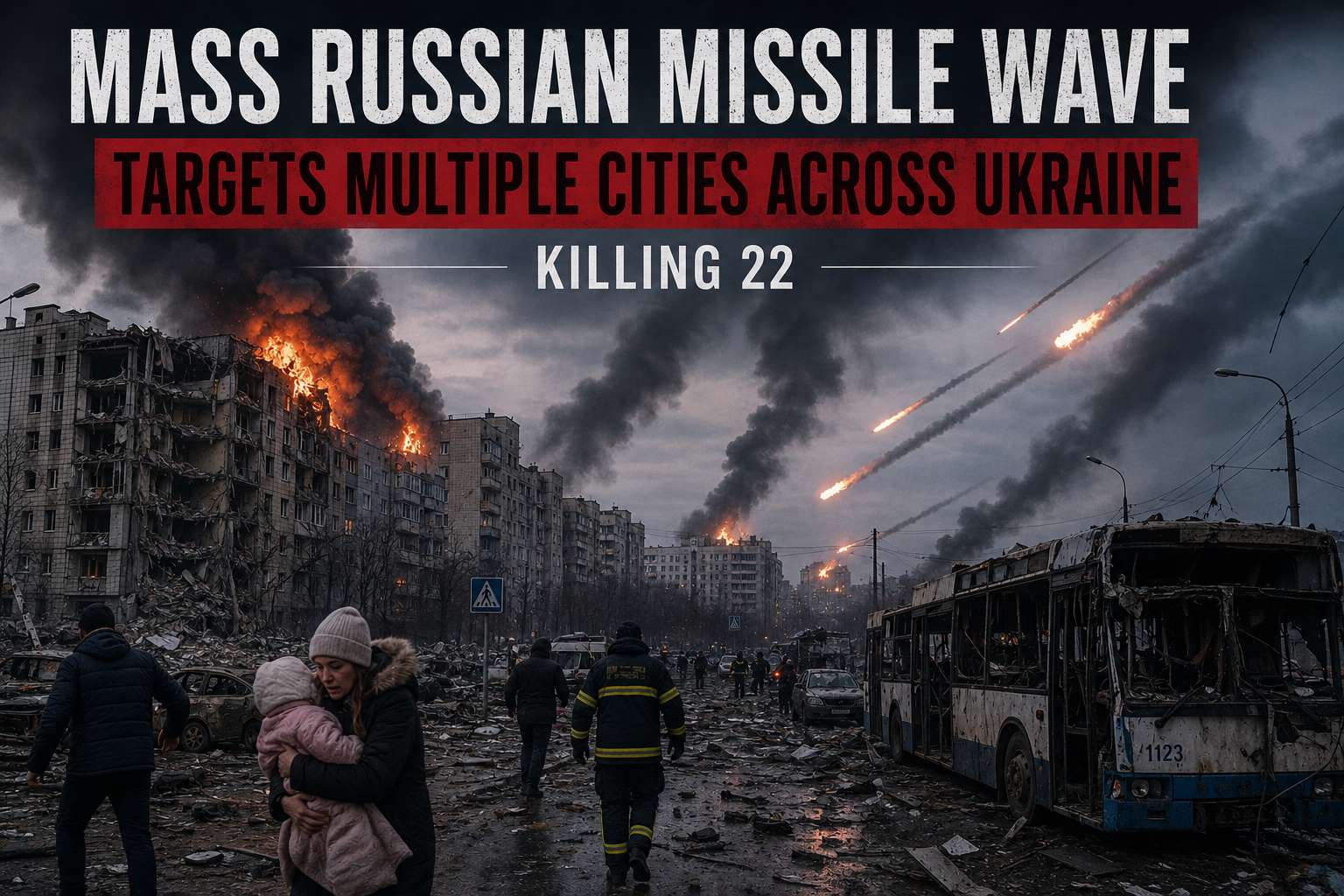
Heavy strikes disrupt urban centers as international monitors report a sharp rise in long-range civilian casualties.
Publication Date: June 4, 2026
Last Updated: June 4, 2026
Byline: Global War News Editorial
KYIV; A coordinated overnight bombardment of long-range cruise and ballistic missiles struck urban centers across Ukraine, killing at least 22 civilians and wounding more than 130 others. The widespread assault hit critical infrastructure, medical centers, and residential districts in the capital, Kyiv, alongside major secondary cities including Dnipro, Kharkiv, and Zaporizhzhia.
According to official data released by the Ukrainian Air Force, Russian forces deployed 73 missiles and 656 long-range drones during the overnight operation. Ukrainian air defence units reported that they successfully intercepted or suppressed 40 missiles and 602 drones. However, remaining projectiles breached security perimeters, causing explosions at a minimum of 38 distinct locations nationwide.
The Russian Ministry of Defence issued a public statement confirming the large-scale operation, asserting that the strikes successfully targeted military-industrial facilities across multiple regions. Russian authorities added that the bombardment served as a direct retaliatory response to a Ukrainian strike the previous week in Starobilsk, a town in the Russian-controlled Luhansk region, which reportedly resulted in the deaths of 21 civilians.
Distribution of Casualties and Physical Damage
The localized impacts of the bombardment fell most heavily on civilian spaces in Kyiv and the central city of Dnipro. Local government administrators and emergency rescue personnel spent Tuesday digging through collapsed concrete and shattered brick structures to locate survivors.
The recorded consequences of the strikes include the following developments:
- Dnipro: Regional authorities reported that 16 people were killed in the city, including a three-year-old child. Emergency crews recovered multiple victims from beneath the rubble of an apartment complex. Dnipro Mayor Borys Filatov declared a formal day of mourning to honour those killed.
- Kyiv City: Public health officials confirmed six fatalities in the capital. Kyiv Mayor Vitali Klitschko reported that falling debris and direct impacts inflicted structural damage on residential buildings across eight city districts, additionally striking a local medical clinic and a commercial petrol station.
- Wider Regional Impact: Separate strikes and subsequent air raid alerts disrupted public utilities and caused injuries in the regions of Poltava, Kharkiv, Zaporizhzhia, Sumy, and Chernihiv. In the northern Sumy region, local monitoring groups reported one civilian fatality from matching artillery and drone fire along the immediate border zones.
The United Nations Human Rights Monitoring Mission in Ukraine (HRMMU) dispatched field teams to assess impact areas in Kyiv and Dnipro. Danielle Bell, the head of the monitoring mission, stated that the heavy loss of life and extensive destruction of residential property highlight the predictable human toll associated with using explosive weapons inside densely populated municipal areas.
Strategic Context and Air Defence Shortages
The mass missile wave followed days of public warnings issued by Russian state authorities, who had openly cautioned that systematic strikes against targets in the Ukrainian capital were imminent. The heightened threat level had driven an estimated 41,000 residents in Kyiv to seek overnight shelter inside the city’s underground metro network.
In a public address via social media, Ukrainian President Volodymyr Zelenskyy utilized the aftermath of the bombardment to appeal urgently to Western partners for expanded anti-ballistic missile defence systems. Zelenskyy described the massive scale of the raid as an explicit demonstration that without comprehensive, high-altitude air defence interceptors, major population centers remain vulnerable to modern ballistic arrays.
Military analysts note that the current strike pattern exposes a growing operational challenge for Ukraine. Independent observers indicate that a significant portion of international air defence assets, including US-manufactured Patriot interceptor stockpiles, have faced competing logistical demands due to active military escalations in the Middle East. This reallocation has left European air defense corridors increasingly stretched as Moscow capitalizes on localized interceptor shortages by deploying multi-tiered missile salvos containing hypersonic Zirkon and Iskander-M ballistic units.
Analysis: Rising Casualty Trends and War Economy Drivers
The scale of Tuesday’s operation underscores a broader shift in the intensity of long-range aerial warfare. Data compiled by international human rights monitors indicates that civilian casualty figures during the opening months of 2026 are approximately 20 per cent higher than those recorded during the exact same period in 2025. This upward trajectory is directly linked to the expanded domestic manufacture and deployment of long-range cruise missiles and uncrewed aircraft by both combatants.
While Russia continues to strike Ukrainian urban hubs to degrade logistical infrastructure and strain civil morale, Ukraine has responded by expanding its own over-the-horizon operations. Hours after the strikes on Kyiv and Dnipro, Ukrainian long-range drones successfully penetrated deep into Russian territory, striking oil terminal infrastructure and naval repair facilities in St. Petersburg, over 1,000 kilometres from the frontlines. This expanding tit-for-tat dynamic reveals that neither side is currently capable of fully insulating its critical domestic infrastructure from long-range precision instruments.
What to Watch
Moving forward, international monitors are focusing on whether NATO member states will accelerate the delivery of supplementary air defence batteries to stabilize Ukraine’s urban centers before summer. Attention is also directed toward a planned visit to Kyiv by NATO Secretary General Mark Rutte, where discussions are expected to center on joint ammunition production and defensive logistics. Concurrently, observers will watch whether the increasing frequency of reciprocal long-range infrastructure strikes will prompt further adjustments to maritime insurance rates and energy transit security across both the Black Sea and the Baltic regions.
Source Disclosure Note: This report is compiled from verified field documentation and statements provided by official agencies, including the Ukrainian State Emergency Service, the Ukrainian Air Force, and the United Nations Human Rights Monitoring Mission in Ukraine (HRMMU). Regional operational updates are drawn from statements by Kyiv Mayor Vitali Klitschko, Dnipro Mayor Borys Filatov, and the Russian Ministry of Defence. Secondary verification and contextual reporting were sourced from Reuters, the Associated Press (AP), and Agence France-Presse (AFP).
This article is based on publicly available reporting from named international news agencies and attributed official statements. All claims about ongoing events are attributed to their original sources. Analysis sections represent the editorial interpretation of reported facts and do not constitute advocacy for any party to the described conflict. AI tools may be utilized for image generation to assist in explaining complex concepts, as well as for refining grammar, spelling, and other linguistic enhancements. However, all original content is produced, fact-checked, and revised by the editorial team. This publication does not take political positions on active military conflicts.