
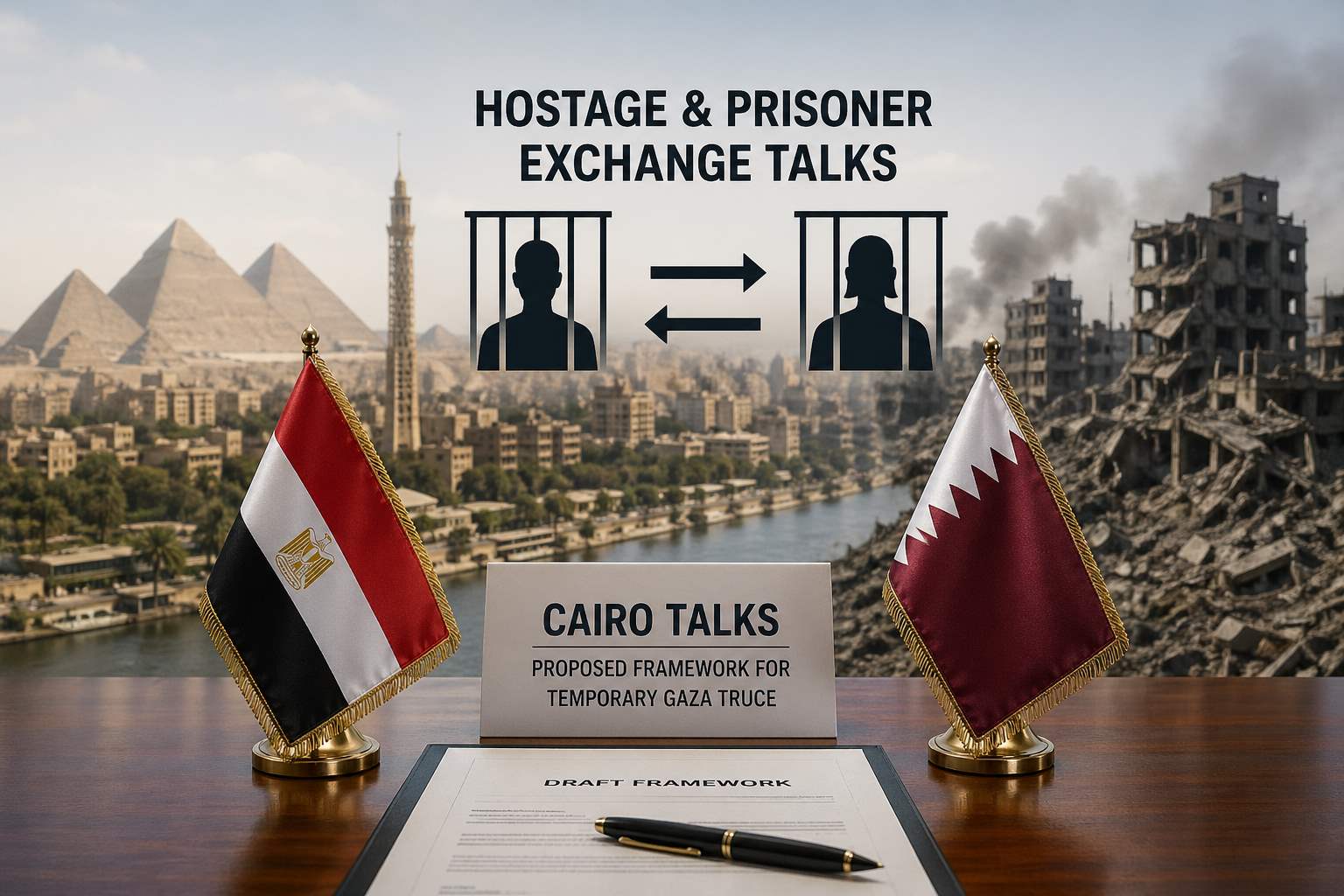
Egyptian and Qatari diplomats outline a 60-day temporary truce proposal to bridge the gap between hostage repatriation and the permanent demilitarization of the enclave.
April 28, 2026
Last Updated: April 28, 2026
By Global War News Editorial
Diplomatic mediators from Egypt and Qatar have presented a revised framework intended to stabilize the second phase of the “Comprehensive Plan to End the Gaza Conflict.” Following intensive consultations in Cairo, official joint statements indicate that the new proposal centers on a 60-day temporary truce. This period is designed to facilitate the final exchange of remains and establish a verifiable timeline for the demilitarization of armed groups in the Gaza Strip.
The initiative follows months of fragile calm and a significant regional escalation in early 2026, which had stalled international efforts to transition Gaza from interim governance to a stable, demilitarized territory. According to the Egyptian Foreign Ministry, the proposed framework seeks to address “contentious points” regarding the sequencing of Israeli troop withdrawals and the decommissioning of heavy weaponry by Hamas.
Details of the 60-Day Framework
According to a joint statement released by the Qatari and Egyptian governments on April 23, the proposed truce serves as a “stepping stone” toward a permanent ceasefire. The framework, which reportedly aligns with a proposal from US Middle East envoy Steve Witkoff, includes several key provisions:
- Hostage and Remains Exchange: The plan calls for a staged release of the ten remaining Israeli captives still held in the enclave—four on the first day, two on day 30, and four on day 60, alongside a phased return of the remains of those who died in captivity.
- Humanitarian Corridors: Mediators have proposed the full reopening of the Rafah border crossing to Egypt and the entry of significant relief aid to address what the UN describes as an “unprecedented humanitarian crisis.”
- Reconstruction Integration: The truce would signal the beginning of a 10-year, $71.4 billion reconstruction effort, as estimated by the World Bank and the European Union, contingent upon continued adherence to the ceasefire.
In a public statement on Monday, US Secretary of State Marco Rubio noted “promising signs” that Hamas leadership may be nearing an agreement on the demilitarization aspects of the plan. However, Hamas spokespersons have reportedly called for stricter adherence to “Phase One” obligations before fully committing to the Phase Two decommissioning schedule.
The Role of the International Board of Peace
The negotiations in Cairo are being held in coordination with the International Board of Peace (BoP), an oversight body currently chaired by the United States. Under UN Security Council Resolution 2803, the BoP is tasked with overseeing the transition of Gaza to a technocratic government, known as the National Committee for the Administration of Gaza (NCAG).
According to Nickolay Mladenov, the BoP’s High Representative for Gaza, the revised proposal is built on five core principles, including “reciprocity” linking weapon decommissioning to staged Israeli withdrawals and “verification” as a precondition for major reconstruction projects.
Diplomatic sources in Doha suggest that while the 60-day truce does not explicitly guarantee an indefinite end to the war, it is intended to create the “political space” necessary for the BoP to deploy an International Stabilization Force (ISF) to Gaza. This force would be responsible for securing the territory during the transition to a reformed Palestinian Authority (PA).
Analysis: Challenges to a Permanent Settlement
Despite the optimism expressed by mediators, several significant obstacles remain. Analysts point to the “gridlock” between the US and regional actors following the strikes in early 2026, which has injected fresh uncertainty into the negotiation track.
Observers note that:
- Sequencing Disagreements: Hamas continues to demand that the withdrawal of Israeli forces precedes the decommissioning of small arms, while the BoP framework prioritizes the removal of heavy weapons first.
- Regional Instability: The ongoing negotiations are taking place against the backdrop of broader regional tensions, which have frequently led to the closure of border crossings and the interruption of aid delivery.
- Economic Viability: With Gaza’s economy having reportedly contracted by 84% since October 2023, mediators emphasize that a temporary truce without a permanent security guarantee may struggle to attract the $26.3 billion required for the first 18 months of recovery.
Closing Summary
As of Tuesday, the Security Council is scheduled to hold an open debate to review the progress of these mediation efforts. While the 60-day framework offers a potential path out of the current stalemate, the success of the proposal depends on the willingness of all parties to accept the verified demilitarization terms. We will continue to report on any official confirmation of a signed agreement from the Cairo talks.
Sources: This report is based on joint statements from the Egyptian Foreign Ministry and the Qatari Ministry of Foreign Affairs. It incorporates reporting from the Associated Press, Anadolu Agency, and the Security Council Report (SCR). Economic data is sourced from the World Bank and UN OCHA.
This article is based on publicly available reporting from named international news agencies and attributed official statements. All claims about ongoing events are attributed to their original sources. Analysis sections represent the editorial interpretation of reported facts and do not constitute advocacy for any party to the described conflict. AI tools may be utilized for image generation to assist in explaining complex concepts, as well as for refining grammar, spelling, and other linguistic enhancements. However, all original content is produced, fact-checked, and revised by the editorial team. This publication does not take political positions on active military conflicts.