
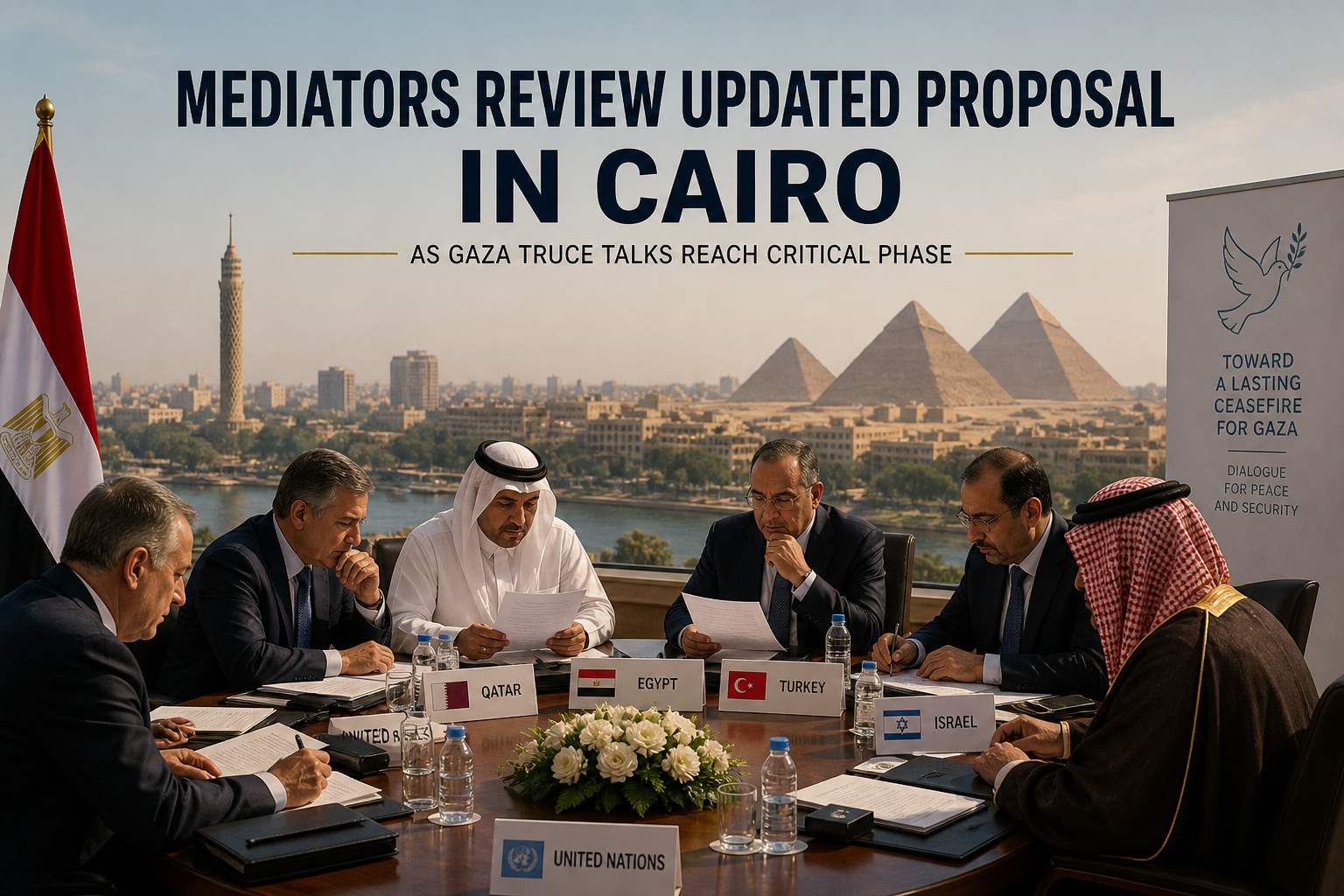
High-level delegations evaluate a restructured framework for a long-term ceasefire and prisoner exchange amid shifting regional pressures.
May 4, 2026
Last Updated: May 4, 2026
By Staff Writer, Global War News
International mediators from Egypt, Qatar, and the United States have convened in Cairo this week to review an updated proposal aimed at formalizing a permanent end to hostilities in the Gaza Strip. According to reports from the Associated Press and Al Qahera News, the current draft represents a significant restructuring of previous frameworks, focusing on a phased withdrawal of military forces and a comprehensive exchange of detainees.
Sources close to the negotiations stated that the high-level delegations are working under intense diplomatic pressure to finalize a deal before the current temporary arrangements expire. The Egyptian state information service confirmed that the meetings have entered a “technical phase,” where legal language regarding border monitoring and humanitarian access is being debated by specialist sub-committees.
While official spokespeople for the negotiating parties have expressed “cautious optimism,” they have also emphasized that several core issues remain unresolved. The primary sticking point continues to be the definition of a “sustainable calm” and the specific timeline for the reconstruction of Gaza’s civilian infrastructure.
The Three-Phase Framework
The updated proposal currently under review is reportedly built on a three-phase structure designed to build trust between the warring parties. According to leaks detailed by Reuters and confirmed in part by regional officials, the stages are as follows:
- Phase One: A six-week total cessation of military activity, the release of humanitarian-category detainees, and the limited return of displaced civilians to northern Gaza.
- Phase Two: A permanent cessation of hostilities contingent on the release of all remaining military-aged detainees and a full withdrawal of Israeli forces from the central corridor.
- Phase Three: The commencement of a multi-year reconstruction plan for Gaza, overseen by an international committee and funded by regional and global donors.
The success of this framework depends heavily on “verification mechanisms.” Mediators are reportedly discussing the deployment of a neutral monitoring force, possibly comprised of personnel from non-belligerent regional states, to oversee the buffer zones and ensure compliance with the withdrawal schedule.
Economic and Reconstruction Stakes
The economic stakes of these talks are immense. A May 2026 report from the United Nations Conference on Trade and Development (UNCTAD) suggests that even with an immediate ceasefire, it would take Gaza’s economy until the 2050s to return to its 2022 levels without a massive, coordinated international “Marshall Plan” style intervention.
Current estimates from the World Bank suggest that over 70% of Gaza’s housing units have been damaged or destroyed. The cost of clearing unexploded ordnance and rubble alone is projected to exceed $1.2 billion. For the neighboring economies, particularly Egypt and Jordan, a stabilized Gaza is seen as essential for restoring regional trade routes and reducing the fiscal burden of hosting displaced populations.
Analysis: The “Day After” Problem
Analysts have suggested that the Cairo talks are no longer just about stopping the fire, but about the “day after” governance. Observers note that a major hurdle remains the question of who will administer Gaza once the military forces withdraw. The proposal currently includes provisions for a “technocratic government” not affiliated with any specific military faction, but the selection process for these officials remains a point of contention.
Furthermore, the regional backdrop, including the recent naval interceptions in the Red Sea and skirmishes on the Lebanon border—adds a layer of urgency. Mediators are aware that the Gaza conflict serves as a primary driver for these auxiliary fronts. A failure in Cairo could trigger a synchronized escalation across the Middle East, potentially drawing in larger regional powers.
Current Standing
As of May 4, the delegations remain in Cairo. While the “technical phase” suggests progress, the history of these negotiations is marked by last-minute collapses over phrasing and mutual distrust. High-ranking officials from the U.S. State Department have stated that the “gap is narrowing,” but they warned that the window for a diplomatic breakthrough is closing as tactical military operations continue on the ground. The coming 72 hours are expected to determine whether this proposal moves to the signature phase or joins previous failed attempts.
Source Disclosure: Factual reporting on the Cairo talks is based on statements from the Egyptian State Information Service, the Qatari Ministry of Foreign Affairs, and the U.S. State Department. Detail regarding the proposal’s phases was sourced from Reuters and Al Qahera News. Economic data and reconstruction projections are provided by UNCTAD, the World Bank, and the Palestinian Central Bureau of Statistics.
This article is based on publicly available reporting from named international news agencies and attributed official statements. All claims about ongoing events are attributed to their original sources. Analysis sections represent the editorial interpretation of reported facts and do not constitute advocacy for any party to the described conflict. AI tools may be utilized for image generation to assist in explaining complex concepts, as well as for refining grammar, spelling, and other linguistic enhancements. However, all original content is produced, fact-checked, and revised by the editorial team. This publication does not take political positions on active military conflicts.