
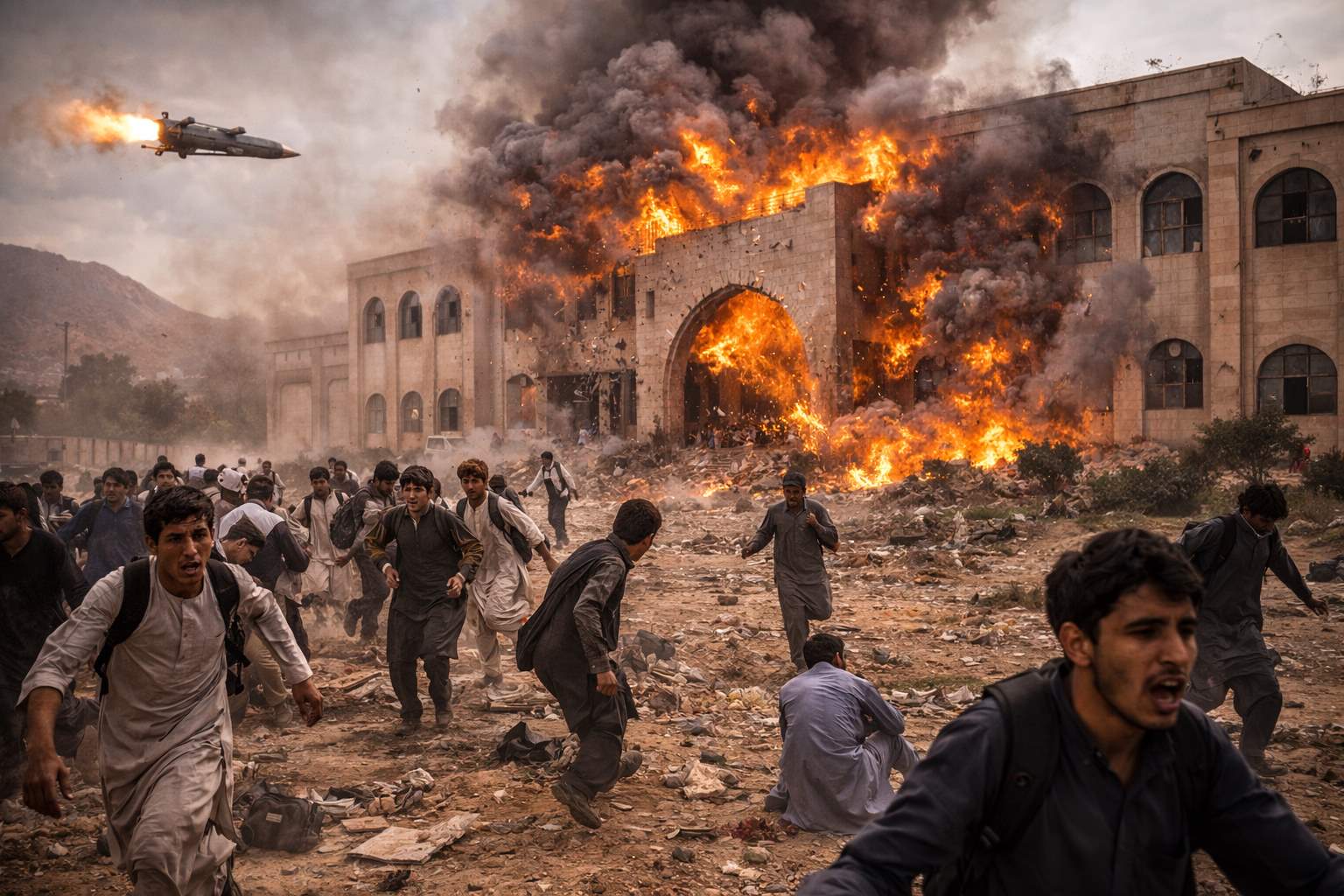
Afghan officials point to cross-border fire as the cause of a deadly explosion at Sayed Jamaluddin Afghani University in Kunar province.
April 30, 2026
By Global War News Editorial
A deadly mortar and missile strike targeted the Sayed Jamaluddin Afghani University in Asadabad, the capital of Afghanistan’s eastern Kunar province, on Monday. The attack, which Afghan authorities attribute to Pakistani forces, killed at least seven people and wounded 85 others, according to regional information officials.
Hamdullah Fitrat, a deputy spokesperson for the Afghan government, characterized the event as a “provocative act” that targeted civilian neighborhoods and educational infrastructure. According to a statement from the Ministry of Higher Education, approximately 30 students and professors were among the injured, and several university buildings sustained extensive structural damage.
The Pakistani Ministry of Information and Broadcasting has denied the allegations, describing the reports of a strike on the university as a “blatant lie.” In a statement, Islamabad maintained that its military operations are “precise and intelligence-based” and explicitly denied targeting the academic institution, though officials did not deny broader military activity in the border region.
Escalation Despite Mediation
The strike marks the first major violent incident since Chinese-mediated peace talks between Afghan and Pakistani delegations took place in Urumqi, China, earlier this month. Those discussions were intended to establish a framework for de-escalation following a series of deadly cross-border clashes that began in late February.
The border between the two nations has been a site of significant tension for months. Pakistan has frequently accused the Afghan government of harboring militants from the Tehrik-e-Taliban Pakistan (TTP), a group that has claimed responsibility for numerous attacks within Pakistan. The Afghan government consistently denies these charges, arguing that Pakistan uses security concerns as a pretext for violating Afghan sovereignty.
Witness Accounts: “A Scene of Total Destruction”
Students who survived the blast described a sudden and violent impact during afternoon sessions. One student, speaking on condition of anonymity to local reporters, described the moment of the strike as “harrowing,” noting that the explosion occurred near a crowded lecture hall.
At a hospital in Asadabad, residents and relatives gathered to identify the wounded. Reporters from the Associated Press (AP) documented families treating children and university staff for shrapnel injuries. Najibullah Hanafi, the Kunar Information and Culture Director, stated that the casualty count included women and children who were in nearby civilian homes when the shelling commenced.
Analysis: The Fragility of the Ceasefire
The strike on Sayed Jamaluddin Afghani University represents a critical test for the recent diplomatic efforts led by Beijing. While both sides had expressed a desire to “explore a comprehensive solution” during the Urumqi talks, the underlying issues—primarily the presence of TTP militants and border demarcation disputes—remain unresolved.
Analysts note that the discrepancy between Afghan claims of a direct hit on a university and Pakistan’s categorical denial suggests a significant gap in battlefield monitoring and verification. If the ceasefire collapses entirely, it could lead to a renewed cycle of attrition that threatens the stability of the entire border region. The involvement of civilian educational infrastructure, whether intentional or accidental, significantly raises the political stakes for both governments.
What to Watch For
- Independent Verification: Whether international monitoring groups or UN agencies can provide a definitive assessment of the weapons used and the exact origin of the fire.
- Diplomatic Fallout: Potential statements from the Chinese Ministry of Foreign Affairs regarding the status of the mediation process.
- Military Movements: Reports of SAF or RSF equivalent troop build-ups on either side of the Durand Line that might signal further escalations.
Source Disclosure: This report relies on official statements from the Afghan Ministry of Higher Education and the Pakistani Ministry of Information and Broadcasting. Factual details regarding casualty figures and the location of the strike were corroborated by reporting from the Associated Press (AP), The Guardian, and Al Jazeera.
This article is based on publicly available reporting from named international news agencies and attributed official statements. All claims about ongoing events are attributed to their original sources. Analysis sections represent the editorial interpretation of reported facts and do not constitute advocacy for any party to the described conflict. AI tools may be utilized for image generation to assist in explaining complex concepts, as well as for refining grammar, spelling, and other linguistic enhancements. However, all original content is produced, fact-checked, and revised by the editorial team. This publication does not take political positions on active military conflicts.