
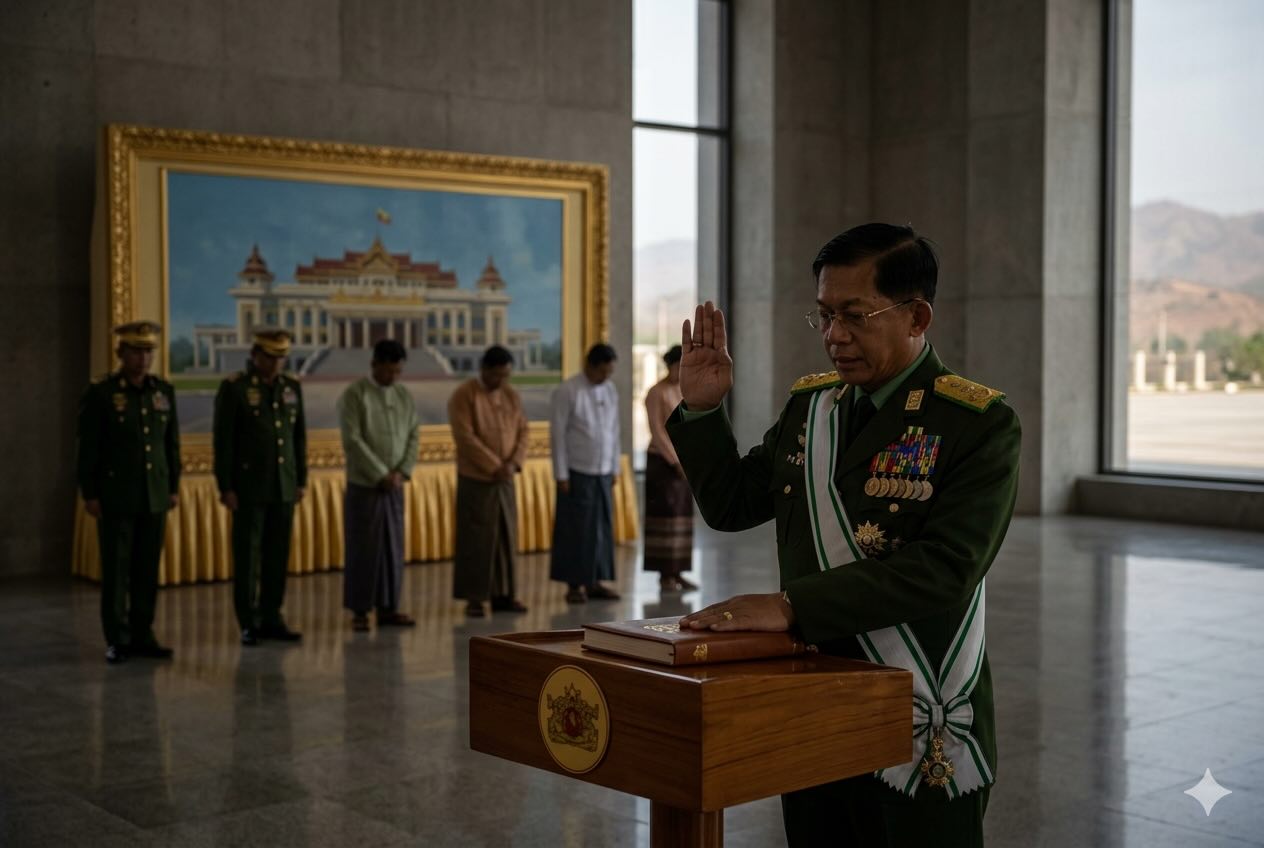
Senior General consolidates executive power following widely criticized polls; resistance groups vow to intensify “Spring Revolution.”
Published: April 14, 2026 Last Updated: 18:30 GMT
By Global War News Editorial
Senior General Min Aung Hlaing has been officially sworn in as the President of Myanmar during a ceremony in the capital, Naypyidaw, on Tuesday. The move follows a series of February elections that were organized by the military-led State Administration Council (SAC) but dismissed as a “sham” by the United Nations and numerous international monitoring bodies.
The inauguration marks a significant shift in the country’s political structure since the 2021 coup, moving from a temporary military council toward a formalized, military-controlled presidency. While the junta characterizes the move as a return to “disciplined democracy,” the ceremony took place against a backdrop of intensified fighting across the country’s heartland and border regions.
A Disputed Mandate
The February elections were held under a state of emergency, with polling conducted primarily in urban centers and military-controlled zones. According to reports from the Associated Press (AP), voting did not occur in over 40% of the country’s townships due to active conflict.
- International Condemnation: In a statement issued by the EU External Action Service, officials declared that the polls lacked “the minimum conditions for a free and fair democratic process.”
- Resistance Rejection: The National Unity Government (NUG)—Myanmar’s government-in-exile—released a statement declaring the presidency “illegal and void,” urging the international community to maintain a policy of non-recognition.
- Security Crackdown: Local media outlets reported that security was heightened in major cities like Yangon and Mandalay to prevent protests, with at least 50 activists reportedly detained in the 48 hours leading up to the swearing-in.
The Ground Reality: A Fractured State
Despite the formalization of power in Naypyidaw, Min Aung Hlaing’s administration faces an unprecedented challenge from a coalition of Ethnic Armed Organizations (EAOs) and the People’s Defense Forces (PDF).
- Territorial Losses: Independent analysts, including those from the International Crisis Group, note that the military has lost significant ground in Shan and Rakhine States over the last six months.
- Economic Paralysis: The Myanmar Kyat has hit record lows against the US dollar this week, as the announcement of the new presidency triggered fears of further Western sanctions. According to World Bank data, approximately 40% of the population now lives below the poverty line.
- Humanitarian Crisis: The UN Office for the Coordination of Humanitarian Affairs (OCHA) estimates that 2.8 million people are currently displaced within Myanmar, with nearly 18 million in need of urgent humanitarian assistance.
Analysis: Consolidation as a Survival Tactic
Observers note that the move to the presidency is likely an attempt by Min Aung Hlaing to gain a veneer of international legitimacy and secure continued diplomatic support from regional partners, particularly China and Russia. By adopting the title of President, the Senior General seeks to present himself as a legitimate head of state rather than a coup leader.
However, analysts suggest this consolidation may be a sign of internal military pressure. “By formalizing his role, Min Aung Hlaing is attempting to stabilize his own leadership within the military hierarchy,” noted a regional security specialist. “As the battlefield situation worsens, he needs the constitutional authority of the presidency to manage a state that is increasingly slipping from the military’s grasp.”
What to Watch
The primary indicator of the new administration’s viability will be the reaction from ASEAN members. While Thailand and Laos have maintained open channels with the junta, Malaysia and Indonesia have historically been more critical. The international community will also be watching for a potential new wave of targeted sanctions on state-owned enterprises, particularly those in the timber and mining sectors, which remain the regime’s primary sources of foreign currency.
Sources: Associated Press (AP), Reuters, Myanmar Now, The Irrawaddy, International Crisis Group, UN OCHA, World Bank Economic Update.
This article is based on publicly available reporting from named international news agencies and attributed official statements. All claims about ongoing events are attributed to their original sources. Analysis sections represent the editorial interpretation of reported facts and do not constitute advocacy for any party to the described conflict. AI tools may be utilized for image generation to assist in explaining complex concepts, as well as for refining grammar, spelling, and other linguistic enhancements. However, all original content is produced, fact-checked, and revised by the editorial team. This publication does not take political positions on active military conflicts.