
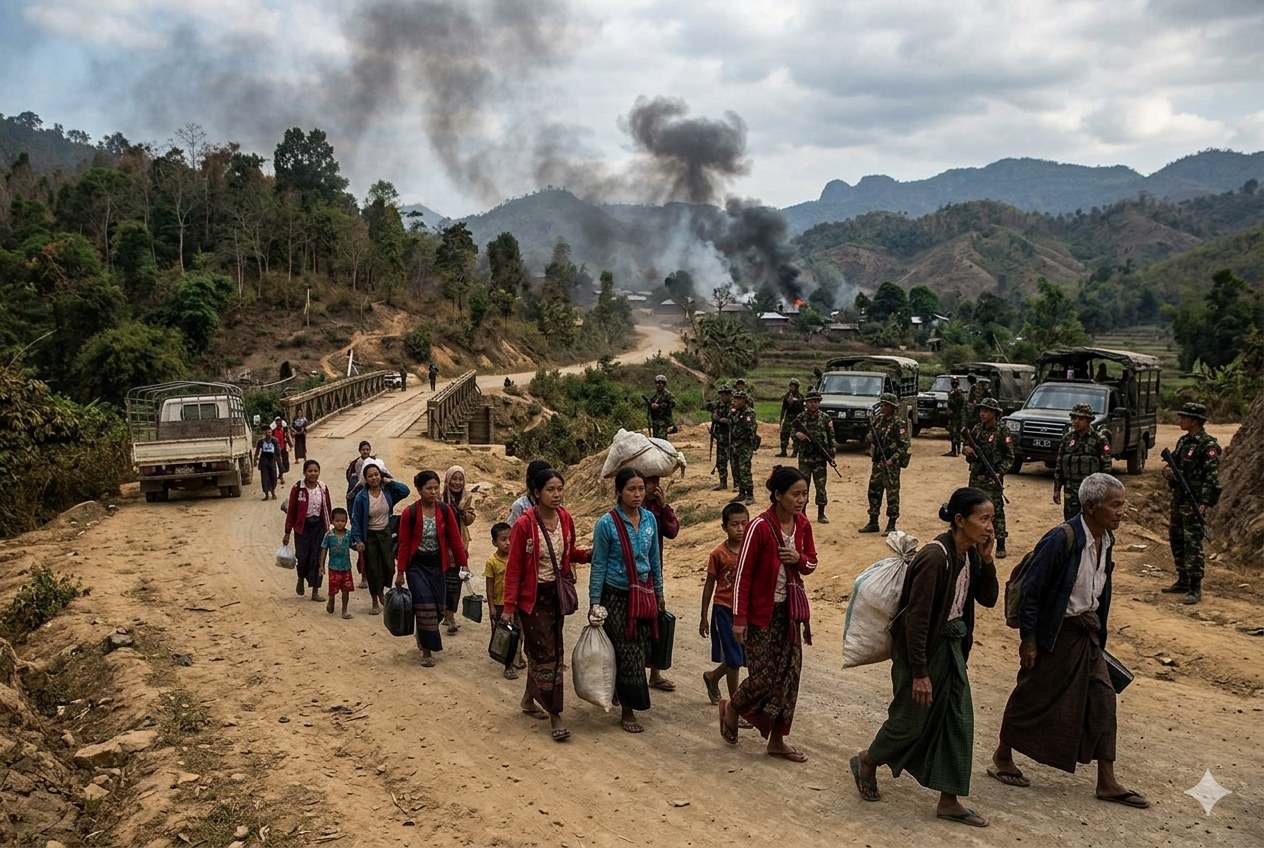
Escalating clashes between the military government and ethnic armed groups threaten to collapse regional trade routes as civilian displacement reaches new peaks.
Monday, May 11, 2026
Last updated: 01:45 PM GMT
Global War News Editorial
Military operations by Myanmar’s ruling State Administration Council (SAC) have intensified across Rakhine and Karen States over the weekend, according to reports from regional monitoring groups and official statements from ethnic armed organizations. The surge in kinetic activity marks a significant escalation in the country’s multi-front civil conflict, which has seen a dramatic shift in territorial control since the beginning of 2026.
According to the Associated Press, the Arakan Army (AA) claimed to have seized several additional military outposts in northern Rakhine State, while the Myanmar military responded with heavy aerial bombardments near the coastal township of Maungdaw. Simultaneously, in the southeast, the Karen National Union (KNU) reported sustained artillery exchanges near the vital trade hub of Myawaddy on the Thai-Myanmar border.
The United Nations Office for the Coordination of Humanitarian Affairs (OCHA) stated on Sunday that the renewed fighting has forced an additional 35,000 civilians to flee their homes in the last 72 hours alone. The total number of internally displaced persons (IDPs) across Myanmar is now estimated by verified UN data to exceed 3.2 million.
Conflict Background: A Nationwide Struggle
The current instability is rooted in the February 2021 military coup that ousted the elected government of Aung San Suu Kyi. Since late 2023, a coordinated offensive known as “Operation 1027” and its subsequent phases have seen a coalition of ethnic armed groups and People’s Defense Forces (PDFs) capture hundreds of military posts and several key border crossings with China, India, and Thailand.
In Rakhine State, the conflict is particularly acute as the Arakan Army seeks to establish complete administrative control over the region. In Karen State, the fighting revolves around control of the Asian Highway, a critical economic artery that facilitates the majority of land-based trade between Myanmar and Thailand.
The Situation in Rakhine State
In northern Rakhine, unverified reports suggest that the military has increasingly relied on scorched-earth tactics to prevent the Arakan Army from consolidating its gains. According to Reuters, local residents in Maungdaw reported that several neighborhoods were set ablaze following a series of airstrikes on Friday.
The SAC has not provided a specific casualty count for its personnel but stated through its official media channels that “security forces are conducting necessary counter-terrorism operations to restore law and order.” Independent observers note that the military’s loss of the border trade gate with Bangladesh has severely restricted its ability to resupply troops in the western theatre.
Escalation on the Thai Border (Karen State)
The situation in Karen State has direct implications for regional stability. The KNU reported that military jets conducted at least ten sorties near the town of Myawaddy over the weekend. This prompted the Thai Royal Army to increase its patrols on the opposite side of the Moei River.
Analysts note that the battle for Myawaddy is not merely a military objective but an economic one. According to data from the Thai Ministry of Commerce, trade through this gateway has fallen by 70% since the start of the year due to the ongoing insecurity. This disruption has led to a shortage of basic commodities and fuel within central Myanmar, further devaluing the national currency, the Kyat.
Analysis: The Strategic Dilemma for the SAC
Observers note that the Myanmar military is currently facing its most significant challenge since the 1940s. By fighting on multiple distant fronts simultaneously, Rakhine in the west, Karen in the southeast, and Shan in the north, the military’s logistical chains are being stretched to a breaking point.
Analysts have suggested that the military may be shifting toward a “fortress” strategy, prioritizing the defense of major urban centers like Naypyidaw, Yangon, and Mandalay while conceding rural and border territories to armed groups. However, the loss of border trade revenues makes funding a prolonged military campaign increasingly difficult. It remains unclear whether the SAC can maintain its current pace of aerial operations without a significant influx of foreign aviation fuel and spare parts, which are currently subject to international sanctions.
Source Disclosure: This report is based on official statements from the Myanmar State Administration Council (SAC), the Karen National Union (KNU), and the Arakan Army (AA). Humanitarian data was sourced from UN OCHA. Factual reporting was corroborated by the Associated Press (AP), Reuters, and the Kivu Security Tracker. Economic data was provided by the Thai Ministry of Commerce.
This article is based on publicly available reporting from named international news agencies and attributed official statements. All claims about ongoing events are attributed to their original sources. Analysis sections represent the editorial interpretation of reported facts and do not constitute advocacy for any party to the described conflict. AI tools may be utilized for image generation to assist in explaining complex concepts, as well as for refining grammar, spelling, and other linguistic enhancements. However, all original content is produced, fact-checked, and revised by the editorial team. This publication does not take political positions on active military conflicts.