
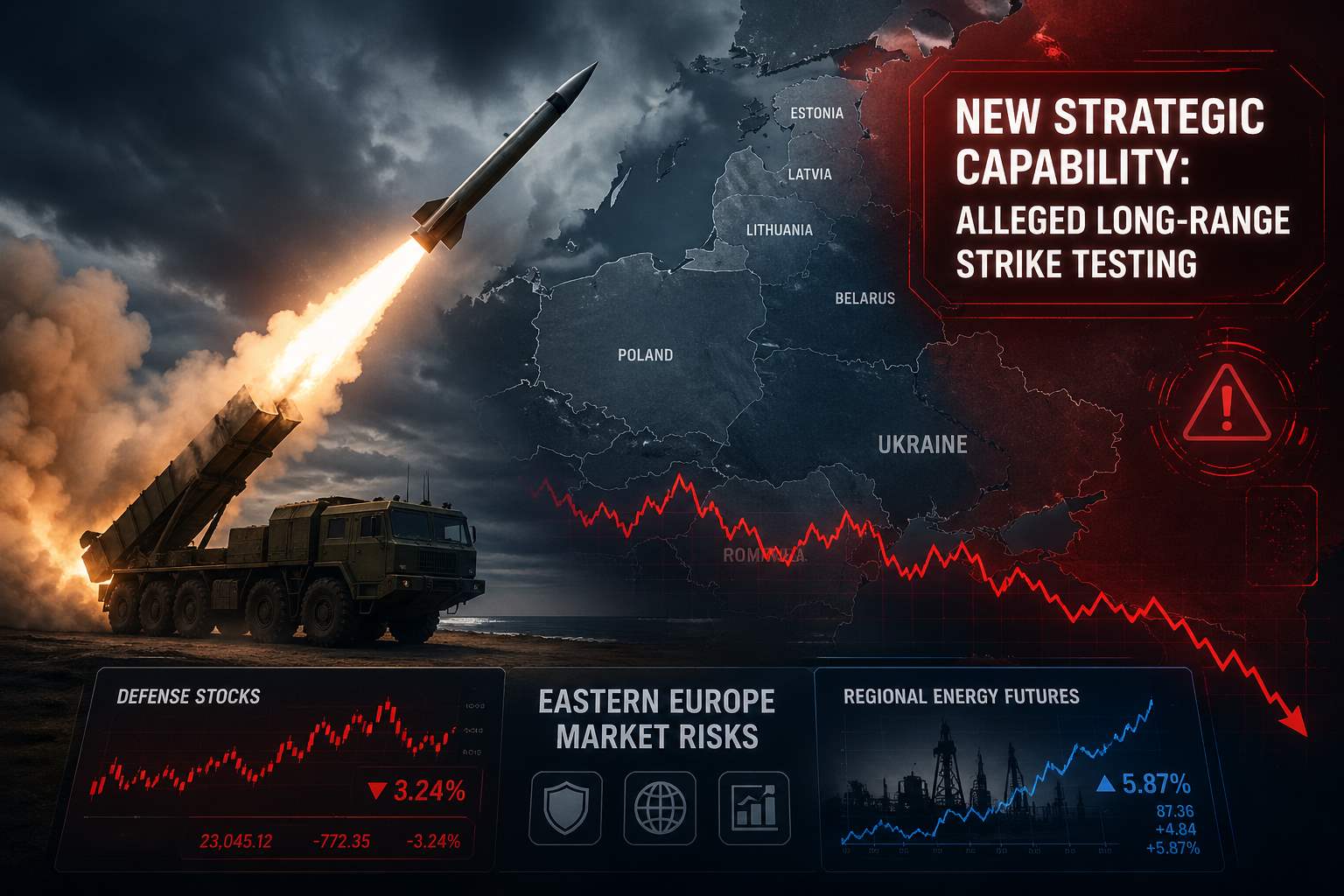
Reports of advanced missile trials near tactical theaters trigger fresh volatility in defense stocks and regional energy futures.
April 27, 2026
Last updated: April 27, 2026
By Global War News Editorial
Recent reports from defense monitors and satellite imagery analysts suggest the testing of a new class of long-range precision strike capabilities within the Eastern European theater. These alleged tests, reportedly involving hypersonic or extended-range ballistic systems, have introduced a new layer of strategic uncertainty across the continent. While official government sources have remained largely silent or issued brief denials, the financial markets have reacted with immediate shifts in defense sector valuations and regional energy risk premiums.
According to reporting from Reuters and analysis by the International Institute for Strategic Studies (IISS), the suspected testing took place in a restricted military zone during the early hours of Monday. The deployment of such technology, if confirmed, would significantly alter the reach and speed of tactical engagements, potentially placing deep-rear logistics hubs and energy infrastructure under a new level of threat.
Background: The Race for Deep-Strike Parity
The 2026 defense landscape in Eastern Europe has been defined by a rapid shift toward “deep-strike” doctrines. Following the expiration of several mid-range missile treaties in 2025, both regional powers and international alliances have accelerated the development of systems designed to bypass traditional air defense umbrellas.
Before this latest development, the focus of the conflict had largely remained on attrition-based trench warfare and short-range drone strikes. The introduction of long-range strategic assets suggests a transition toward a more expansive theater of operations, where the distinction between frontline combat and distant industrial support zones becomes increasingly blurred.
Economic Impact: Defense Markets and Energy Security
The rumor of advanced strike testing has sent ripples through global and regional economies. Investors and analysts are closely monitoring the potential for a renewed arms race, which carries significant fiscal implications for national budgets.
- Defense Sector Volatility: Shares in major aerospace and defense contractors saw a 4% uptick in early trading on Monday. Analysts cited by the Associated Press suggest that the emergence of new strike threats will likely drive increased government spending on sophisticated missile defense systems.
- Energy Infrastructure Risk: The potential for long-range strikes to reach critical oil and gas terminals in Eastern Europe has added a “security premium” to Brent crude futures. Traders are reportedly pricing in the risk of accidental or intentional strikes on transit pipelines that remain vital to the Central European heating market.
- Foreign Investment Deterrence: In Poland and the Baltic states, economic observers note that the perceived expansion of the “threat envelope” could slow down foreign direct investment (FDI) in manufacturing sectors located away from traditional border zones.
Analysis: Escalation Dominance and the “Shadow” Theater
The alleged testing of long-range systems is viewed by many military analysts as a move toward “escalation dominance.” By demonstrating the ability to strike targets hundreds of kilometers behind the contact line, a belligerent can theoretically deter an opponent’s logistics and mobilization efforts without ever firing a shot in the traditional sense.
However, observers note that this capability also increases the risk of miscalculation. If deep-strike systems are integrated into standard tactical rotations, the threshold for a wider, pan-European escalation is lowered. This “shadow theater”, where strategic weapons are used for tactical signaling, places a significant burden on regional central banks, which must account for sudden, conflict-driven inflationary shocks in their 2026 forecasts.
Current Status and Outlook
As of Monday afternoon, no official confirmation of the weapon’s specifications has been provided by the alleged testing party. NATO officials have stated they are “monitoring the situation closely” but have declined to provide specific intelligence assessments.
The outlook for the remainder of the quarter depends on whether these tests lead to a permanent deployment of long-range batteries near sensitive border corridors. If confirmed, the primary indicator for regional stability will be the reciprocal deployment of counter-battery and missile defense assets by opposing forces. For the global economy, the concern remains that a “long-range war” is significantly harder to contain than a localized border skirmish, posing a persistent threat to the stability of the European Single Market.
Sources:
- Reporting from Reuters and Associated Press (April 26–27, 2026).
- Tactical Analysis Brief by the International Institute for Strategic Studies (IISS).
- Satellite imagery reports from independent defense monitors.
- Market data from the London Stock Exchange and energy futures indices.
This article is based on publicly available reporting from named international news agencies and attributed official statements. All claims about ongoing events are attributed to their original sources. Analysis sections represent the editorial interpretation of reported facts and do not constitute advocacy for any party to the described conflict. AI tools may be utilized for image generation to assist in explaining complex concepts, as well as for refining grammar, spelling, and other linguistic enhancements. However, all original content is produced, fact-checked, and revised by the editorial team. This publication does not take political positions on active military conflicts.