
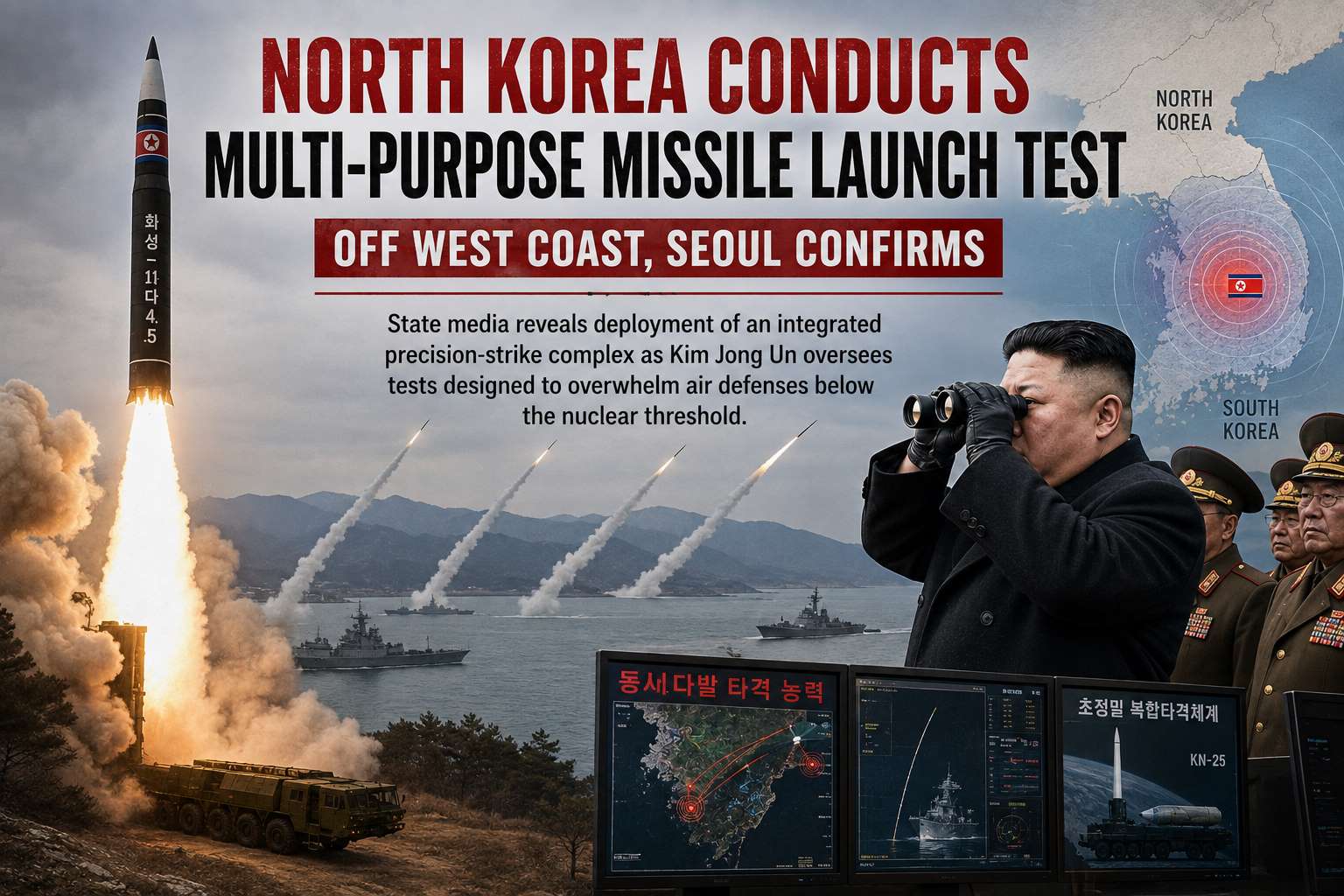
State media reveals deployment of an integrated precision-strike complex as Kim Jong Un oversees tests designed to overwhelm air defenses below the nuclear threshold.
Published: May 27, 2026
Last Updated: May 27, 2026
By Global War News Editorial
North Korea conducted a series of synchronized weapons tests off its western coastline on Tuesday, terminating a 37-day operational pause and triggering immediate regional surveillance protocols by neighboring states. According to data released by South Korea’s Joint Chiefs of Staff, multiple projectiles, including at least one short-range ballistic missile, were fired from the coastal city of Jongju in North Pyongan Province toward the Yellow Sea.
The official state-run Korean Central News Agency confirmed on Wednesday morning that North Korean leader Kim Jong Un personally oversaw the operational drills. Pyongyang identified the systems as a newly developed, lightweight multi-purpose missile launching system alongside an integrated tactical cruise missile platform. The simultaneous deployment of distinct weapons types has led regional security agencies to evaluate whether the exercise was specifically designed to evaluate automated capabilities to saturate and evade joint U.S.-South Korean air defense networks.
Tactical Details of the Integrated Test
According to tracking data compiled by South Korean defense units, the tactical ballistic missiles and associated artillery rockets launched from the Jongju area traversed approximately 80 kilometers before impacting specified maritime zones within the Yellow Sea. While initial military assessments from Seoul noted a mix of short-range ballistic signatures and unidentified projectiles, North Korean state media later clarified the structural intent of the exercise.
Pyongyang stated that the live-fire maneuvers were engineered to analyze and evaluate the ultimate destructive power of a specialized mission warhead attached to its primary tactical ballistic missile.
Concurrently, the exercises tested the operational reliability of a 240-millimeter controlled artillery rocket system featuring an expanded firing range. North Korean engineers asserted that this system relies on an ultra-precision autonomous navigation infrastructure to guide warheads to their coordinates. Photographic evidence published by official state channels depicted a missile launching from a multi-axle mobile platform, accompanied by heavy smoke and exhaust plumes, with military officials positioned adjacent to the launch apparatus.
Context and Background: Conventional Firepower Expansion
Tuesday’s operation marks North Korea’s eighth major weapons demonstration during the 2026 calendar year, following an April 19 test sequence where state media reported the successful validation of specialized cluster bomb warheads. The resumption of testing highlights a continuing technical effort by Pyongyang to expand its non-nuclear, conventional precision strike assets along the highly militarized southern border.
The operational timing is notable, occurring shortly after political statements from regional partners and a high-profile call by Kim Jong Un earlier this month instructing top commanders to turn the country’s southern boundary into an impregnable fortress. Security analysts at the Korea Institute for National Unification in Seoul suggested that the deployment indicates a deliberate shift toward creating a functional precision-strike complex. This architecture effectively integrates tactical cruise missiles, guided multiple-launch rocket systems, and short-range ballistic assets into a singular command frame.
Despite ongoing United Nations Security Council resolutions that explicitly prohibit North Korea from utilizing ballistic missile technology or conducting related research, Pyongyang has sustained its domestic developmental timeline without visible pause.
Analysis: The Doctrine of Sub-Nuclear Saturation
The technical composition of the latest West Coast launch reveals an evolving tactical priority within the North Korean high command. Rather than demonstrating strategic intercontinental range, the combination of close-range ballistic missiles and autonomous artillery rockets focuses directly on theater-level combat capabilities.
Tactical Insight: Simulating simultaneous launches of diverse weapon types complicates real-time interception, targeting the technical limitations of regional radar tracking networks.
By deploying lightweight, mobile platforms that utilize automated conventional firepower, North Korea appears to be building a credible capacity to overwhelm the defense networks of its immediate neighbors without immediately escalating to the nuclear threshold. This strategy offers two key military advantages:
- Evading Terminal Defenses: Mixing low-altitude cruise profiles with ballistic trajectories forces defensive systems, such as the Patriot and THAAD arrays, to track and engage highly disparate target profiles simultaneously.
- Rapid Mobility: Transitioning to lightweight multi-purpose mobile launchers limits the pre-launch detection window available to allied satellite reconnaissance, significantly improving platform survivability in an active combat environment.
This focus on advanced conventional superiority underscores the challenges facing regional deterrence frameworks, as tactical modernization continues despite long-standing international sanctions regimes.
Current Status and Regional Responses
Following the conclusion of the tests, Kim Jong Un expressed satisfaction with the results, stating that the introduction of ultra-high defense science and technologies is an essential condition to ensure his forces possess overwhelming destructive capability.
In response, South Korea’s Joint Chiefs of Staff confirmed they have enhanced their active surveillance posture, maintaining a solid defense alliance with the United States to address any potential escalation. Military data links between Seoul, Washington, and Tokyo remained fully operational throughout the flight duration, allowing real-time tracking of the projectiles. Diplomatic figures from the United States and Japan have strongly condemned the launch, noting that the continued introduction of unguided and guided missile systems near international shipping channels systematically threatens maritime security across the Yellow Sea corridor.
Source Disclosure Note: This report is compiled from official live tracking notices issued by South Korea’s Joint Chiefs of Staff, official English-language dispatches from the Korean Central News Agency (KCNA), operational analysis from the Korea Institute for National Unification, and regional coverage provided by Agence France-Presse (AFP), Reuters, and the Associated Press.
This article is based on publicly available reporting from named international news agencies and attributed official statements. All claims about ongoing events are attributed to their original sources. Analysis sections represent the editorial interpretation of reported facts and do not constitute advocacy for any party to the described conflict. AI tools may be utilized for image generation to assist in explaining complex concepts, as well as for refining grammar, spelling, and other linguistic enhancements. However, all original content is produced, fact-checked, and revised by the editorial team. This publication does not take political positions on active military conflicts.