
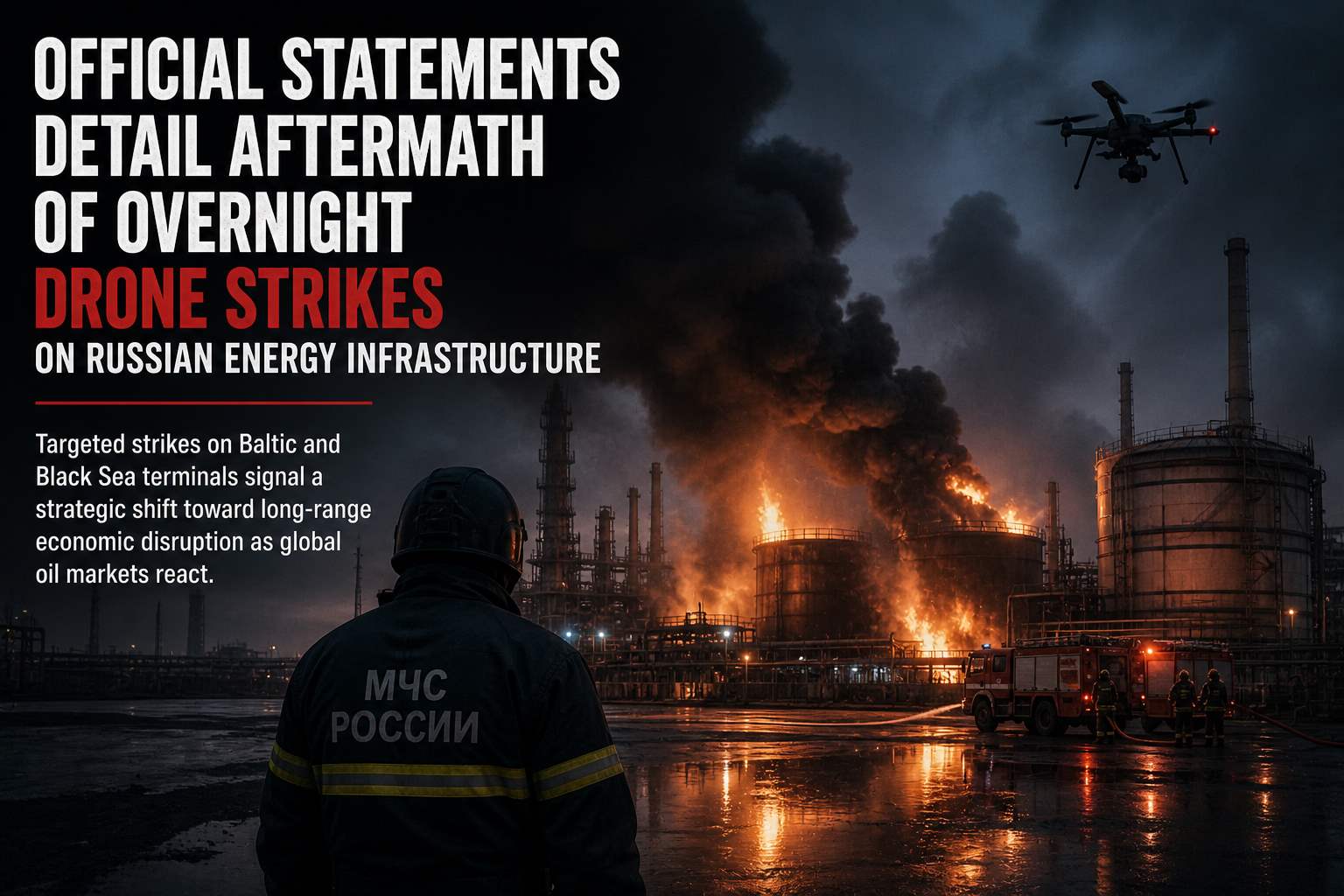
Targeted strikes on Baltic and Black Sea terminals signal a strategic shift toward long-range economic disruption as global oil markets react.
May 4, 2026
Last Updated: May 4, 2026
By Staff Writer, Global War News
A coordinated wave of long-range drone strikes reportedly targeted critical Russian oil export infrastructure overnight, marking one of the most geographically expansive aerial campaigns since the conflict began. According to official statements from regional governors and the Ukrainian General Staff, at least three major energy hubs, spanning from the Baltic Sea to the southern Black Sea coast, sustained varying degrees of damage.
In the Leningrad region, local authorities confirmed that emergency crews were dispatched to the Port of Primorsk, one of Russia’s primary gateways for Baltic crude exports. While the Russian Ministry of Defense stated that its air defense units intercepted “multiple unmanned aerial vehicles” (UAVs) over the region, NASA satellite imagery and local social media footage showed several persistent fires near the terminal’s storage farm.
Simultaneously, the Krasnodar Krai Operational Headquarters acknowledged a strike on the Tuapse oil refinery for the fourth time in less than three weeks. Official reports indicate that while the primary refining units remained intact, the port’s loading infrastructure suffered “technical damage” that has temporarily suspended maritime operations. These strikes represent a significant escalation in Ukraine’s strategy to degrade Russia’s ability to finance its military operations through energy revenue.
The Reach of the Baltic Strike
The strike on Primorsk is particularly notable due to its distance from the Ukrainian border, approximately 900 kilometers. According to a statement by Ukrainian President Volodymyr Zelenskyy, the operation targeted vessels and facilities belonging to Russia’s “shadow fleet”, aging tankers used to transport sanctioned oil. “Prolonging the war will only expand the scale of our defensive operations,” the President stated on social media, characterizing the strikes as a direct response to continued Russian attacks on Ukrainian civilian infrastructure.
Russian energy officials have not yet released a full assessment of the export delays. However, industry analysts note that Primorsk handles approximately 30% of Russia’s sea-borne crude exports. Any sustained disruption at this node could have immediate repercussions for global supply chains, particularly for buyers in Asia and those still utilizing Russian fuel under price-cap exceptions.
Environmental and Logistical Fallout
In the south, the repeated targeting of Tuapse has created an escalating environmental crisis. According to reporting from The Guardian, local Russian officials are struggling to contain toxic smoke clouds and oil slicks that have reached the coastline of the popular resort town. State media broadcasts showed blackened beaches, with authorities reporting the clearance of over 13,000 cubic meters of contaminated soil and fuel oil as of May 1.
The logistical impact is equally severe. Data from the analytics firm OilX suggests that the average output of Russian oil refineries has dropped to approximately 4.69 million barrels per day, the lowest daily processing average since December 2009. While Russia has benefited from windfall profits due to the ongoing energy crisis in the Middle East, the physical degradation of its refining capacity creates a structural bottleneck that cannot be easily repaired due to Western sanctions on specialized replacement parts.
Analysis: Economic Warfare and the “Strait of Hormuz” Factor
Economically, the timing of these strikes is significant. Observers note that Ukraine is capitalizing on the global volatility caused by the closure of the Strait of Hormuz. With Brent Crude hovering near $120 per barrel, Russia’s export revenues had nearly doubled in early 2026, reaching an estimated $19 billion in March alone.
By targeting the infrastructure required to move this oil, Kyiv is attempting to turn Russia’s logistical dependence into a strategic liability. Analysts suggest that if Ukraine can sustain high-precision strikes on both the Baltic and Black Sea outlets, it may force Moscow to divert more air defense assets away from the frontline to protect the inland economy. Furthermore, the targeting of “shadow tankers” introduces a new layer of risk for international shipping firms and insurers still willing to handle Russian crude.
Future Outlook
As of May 4, the Russian Ministry of Energy has yet to provide a timeline for the restoration of full capacity at the affected sites. Meanwhile, in Ukraine, officials have warned that they will continue to refine their long-range capabilities. Where the war was once defined by trench-based attrition, it has now entered a phase of high-stakes economic disruption, where the “battlefield” extends to any facility capable of fueling the state’s war machine.
Source Disclosure: Factual claims regarding the drone strikes and their locations are based on statements from the Ukrainian General Staff, the Russian Ministry of Defense, and regional governors in Krasnodar and Leningrad. Environmental data was sourced from The Guardian and local Russian media. Economic indicators and refinery output data were provided by OilX, Bloomberg, and the International Energy Agency (IEA).
This article is based on publicly available reporting from named international news agencies and attributed official statements. All claims about ongoing events are attributed to their original sources. Analysis sections represent the editorial interpretation of reported facts and do not constitute advocacy for any party to the described conflict. AI tools may be utilized for image generation to assist in explaining complex concepts, as well as for refining grammar, spelling, and other linguistic enhancements. However, all original content is produced, fact-checked, and revised by the editorial team. This publication does not take political positions on active military conflicts.