
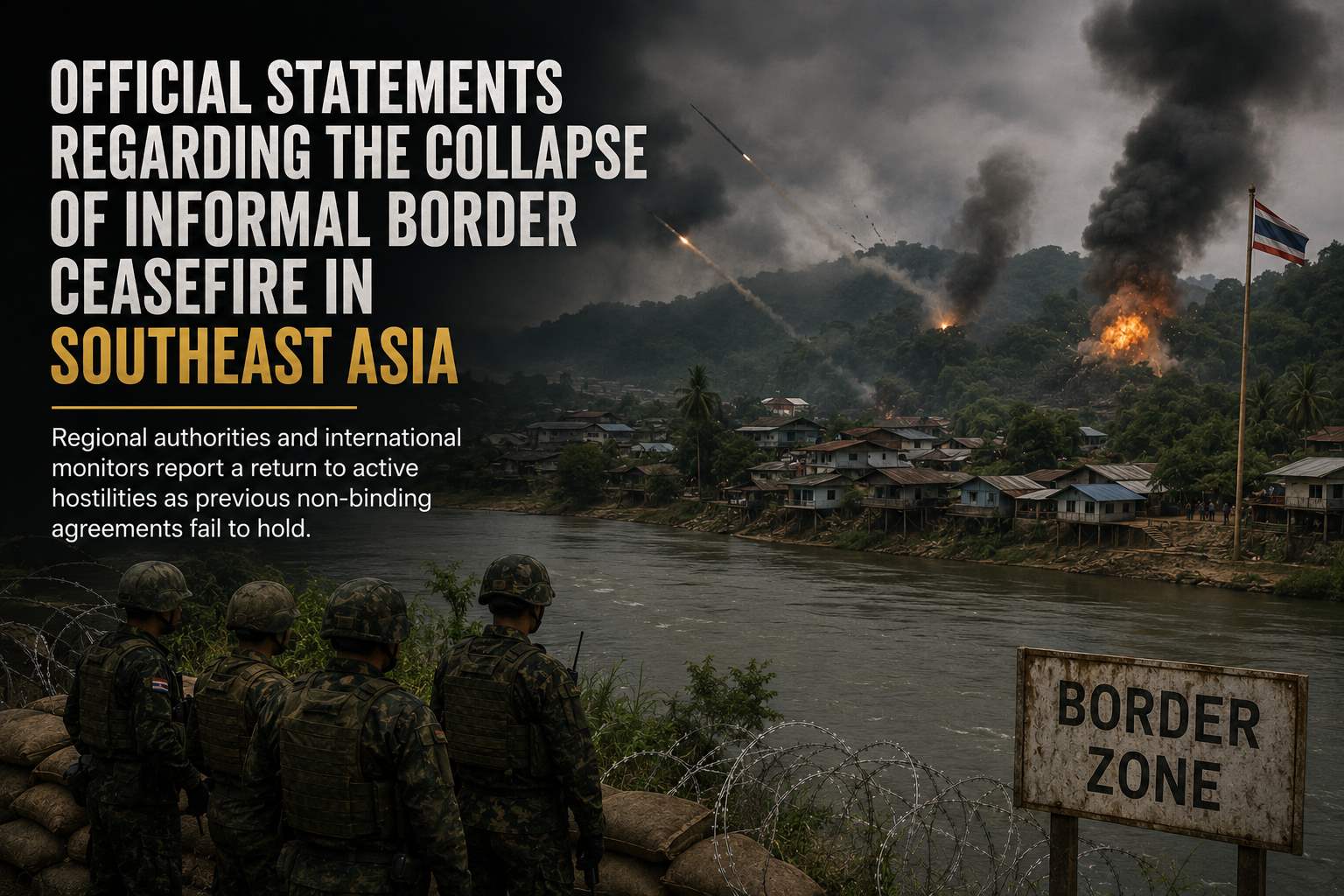
Regional authorities and international monitors report a return to active hostilities as previous non-binding agreements fail to hold.
May 7, 2026
Last updated: May 7, 2026
By Staff Writer, Global War News
Official statements from regional governments in Southeast Asia indicate a significant breakdown in the informal “border quiet” that has characterized several contested sectors over the last quarter. The collapse of these non-binding arrangements follows a series of localized skirmishes that have now escalated into what officials describe as a “renewed state of active engagement.”
According to a briefing from the Association of Southeast Asian Nations (ASEAN) Secretariat, the informal ceasefire, which was never ratified as a formal treaty, dissolved following disputes over troop movements near key resource-rich transit zones. While no single entity has claimed responsibility for the initial breach, the resulting military activity has prompted immediate responses from neighboring capitals.
Government Responses and Official Claims
The reaction from involved state actors has been swift, characterized by a return to defensive posturing. In a public address, the regional Defense Ministry stated that its forces were “responding to provocations” and had moved to secure strategic high ground to prevent further incursions.
As reported by Reuters, official statements from the opposing administration countered this narrative, alleging that the ceasefire was undermined by “unauthorized infrastructure development” in demilitarized zones. The United Nations Department of Political and Peacebuilding Affairs (DPPA) has issued a statement calling for an immediate return to the status quo, noting that the absence of a formal monitoring mechanism made the collapse of the informal truce “predictable.”
Impact on Regional Stability and Infrastructure
The end of the informal ceasefire has immediate consequences for the civilian and economic landscape of the border regions. Reports from the International Committee of the Red Cross (ICRC) suggest that at least two major crossing points, previously used for small-scale trade and humanitarian transit, have been closed due to artillery risks.
According to data released by the Regional Economic Coordination Council, the return to active hostilities has already impacted localized supply chains. “We are seeing an immediate 8% increase in transit insurance for cargo moving through these specific terrestrial corridors,” the Council’s chief economist stated in a press briefing this morning.
Analysis: The Perils of Informal Diplomacy
The collapse of this ceasefire highlights the inherent fragility of “gentleman’s agreements” in modern conflict resolution. Without a third-party monitoring body or a signed document outlining specific consequences for violations, informal truces often serve as little more than a period for forces to regroup.
Observers note that the breakdown likely stems from a “security dilemma,” where defensive preparations by one side were interpreted as offensive posturing by the other. By failing to transition the informal quiet into a formal de-escalation framework, mediators allowed a vacuum to form that has now been filled by tactical maneuvers. The immediate challenge for regional diplomacy is no longer about maintaining the peace, but about preventing this localized collapse from triggering a broader interstate friction.
What to Watch
The upcoming ASEAN Regional Forum (ARF) in June will be the first major diplomatic test for the parties involved. Analysts will be monitoring whether a new, formalized “buffer zone” can be negotiated or if the current engagements will solidify into a new permanent frontline. Additionally, watch for official statements from major power blocs, such as the U.S. and China, whose logistical interests in these corridors may prompt them to intervene as secondary mediators.
Sources: ASEAN Secretariat Official Briefing (May 2026), Reuters regional coverage, UN DPPA Public Statement, ICRC Field Report, Regional Economic Coordination Council (RECC) data.
This article is based on publicly available reporting from named international news agencies and attributed official statements. All claims about ongoing events are attributed to their original sources. Analysis sections represent the editorial interpretation of reported facts and do not constitute advocacy for any party to the described conflict. AI tools may be utilized for image generation to assist in explaining complex concepts, as well as for refining grammar, spelling, and other linguistic enhancements. However, all original content is produced, fact-checked, and revised by the editorial team. This publication does not take political positions on active military conflicts.