
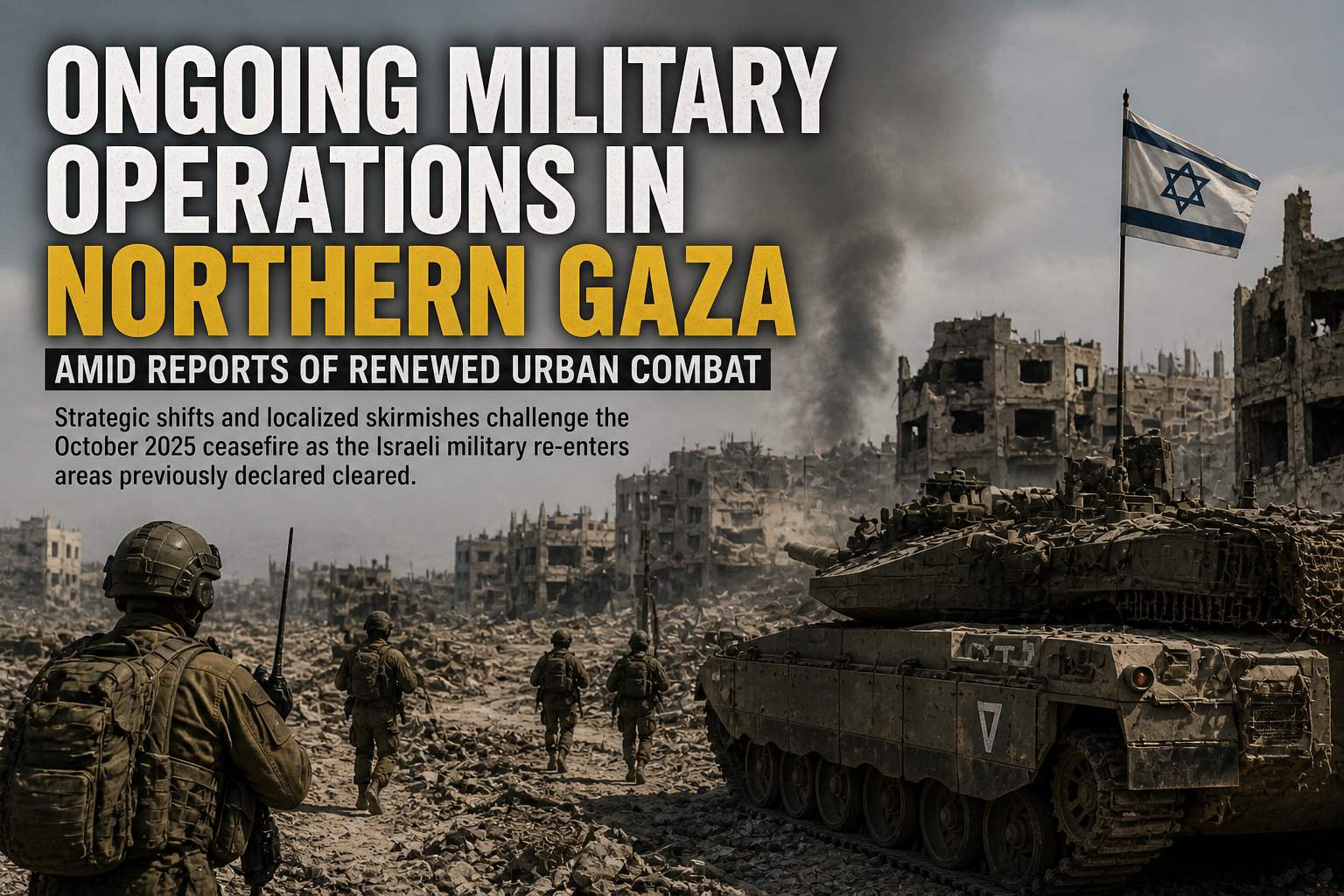
Strategic shifts and localized skirmishes challenge the October 2025 ceasefire as the Israeli military re-enters areas previously declared cleared.
May 4, 2026
Last Updated: May 4, 2026
By Staff Writer, Global War News
Israeli ground forces have reportedly resumed localized operations in several districts of northern Gaza over the past 48 hours. According to reporting from Israeli Army Radio and international news agencies, the Israel Defense Forces (IDF) have re-entered neighborhoods in Beit Lahia and the Jabalia area, citing a resurgence of militant activity. These developments mark a significant escalation in a region where a formal ceasefire has been in place since October 2025.
Military officials stated that the current missions are “targeted operations” designed to dismantle rebuilt infrastructure used by armed groups. However, local media and residents report a return to intense urban combat, with the sound of heavy machinery and small arms fire echoing through the northern ruins. The Palestinian Ministry of Health reported several civilian casualties following strikes on residential clusters, though these figures have not been independently verified.
The United Nations has expressed concern over the “increasing volatility” in the north. A situation report from the UN Office for the Coordination of Humanitarian Affairs (OCHA) on May 1 noted that restrictions on movement and the renewal of hostilities are further hampering the delivery of essential supplies to an estimated 300,000 people still residing in the northern governates.
The Collapse of the “Yellow Line”
The current friction centers on the “yellow line,” a tactical demarcation established during the 2025 ceasefire. Satellite imagery analyzed by Al Jazeera in late April 2026 reportedly showed Israeli military vehicles operating beyond designated dirt berms and moving concrete boundary markers deeper into Palestinian territory.
Analysts suggest that the IDF is seeking to expand “buffer zones” to prevent the firing of short-range projectiles into southern Israeli communities. While the Israeli government maintains these actions are defensive and reactive, Palestinian factions have characterized the movements as a “clear violation” of the truce terms, insisting that any re-entry of ground troops constitutes a restart of the war.
Humanitarian and Economic Paralysis
The humanitarian landscape in northern Gaza remains dire. The UN’s May 2026 report highlights that only 10% of the required funding for 2026 humanitarian operations has been secured. In the north, the destruction of infrastructure has been near-total; the Palestinian Central Bureau of Statistics (PCBS) estimates that the agricultural sector in the strip has contracted by 92% compared to 2023 levels.
The economic impact is not limited to the enclave. The broader regional tension, exacerbated by the separate conflict in the Strait of Hormuz, has driven Brent Crude prices past $120 per barrel. This global surge has trickled down to Gaza’s aid-dependent economy, where the cost of basic fuel for water desalination plants and hospitals has tripled in the first quarter of 2026.
Analysis: The Futility of “Clearing” Operations
Observers note that the return of Israeli troops to northern Gaza reflects a persistent challenge: the difficulty of maintaining security control without a permanent military presence or a functioning alternative governing body. Analysts from the Institute for the Study of War (ISW) have suggested that militant groups have utilized the relative calm of the past six months to regroup in the “urban canyons” of destroyed high-rises.
This “mow the grass” strategy, returning to previously cleared areas to address resurgent threats, raises questions about the long-term sustainability of the current ceasefire. If the IDF continues to expand its footprint in the north, it may lead to a permanent re-occupation, a move that several Israeli ministers have openly advocated for in recent cabinet meetings, according to The Times of Israel.
Current Standing
As of May 4, 2026, the situation in northern Gaza remains a “bloody ceasefire.” While a full-scale regional war has not yet officially resumed, the frequency of urban skirmishes suggests that the truce is fraying. International mediators, led by the US and regional partners, are reportedly pushing for a “Board of Peace” framework that would address the disarmament of militant factions in exchange for a clear political path, but a breakthrough remains elusive.
Source Disclosure:
This article is based on reports from the Israeli Defense Forces (IDF), Israeli Army Radio, and The Times of Israel. Humanitarian data and economic figures are sourced from the UN Office for the Coordination of Humanitarian Affairs (OCHA), the Palestinian Central Bureau of Statistics (PCBS), and the Palestine Monetary Authority (PMA). Conflict mapping and satellite analysis were provided by Al Jazeera and independent military observers.
This article is based on publicly available reporting from named international news agencies and attributed official statements. All claims about ongoing events are attributed to their original sources. Analysis sections represent the editorial interpretation of reported facts and do not constitute advocacy for any party to the described conflict. AI tools may be utilized for image generation to assist in explaining complex concepts, as well as for refining grammar, spelling, and other linguistic enhancements. However, all original content is produced, fact-checked, and revised by the editorial team. This publication does not take political positions on active military conflicts.