
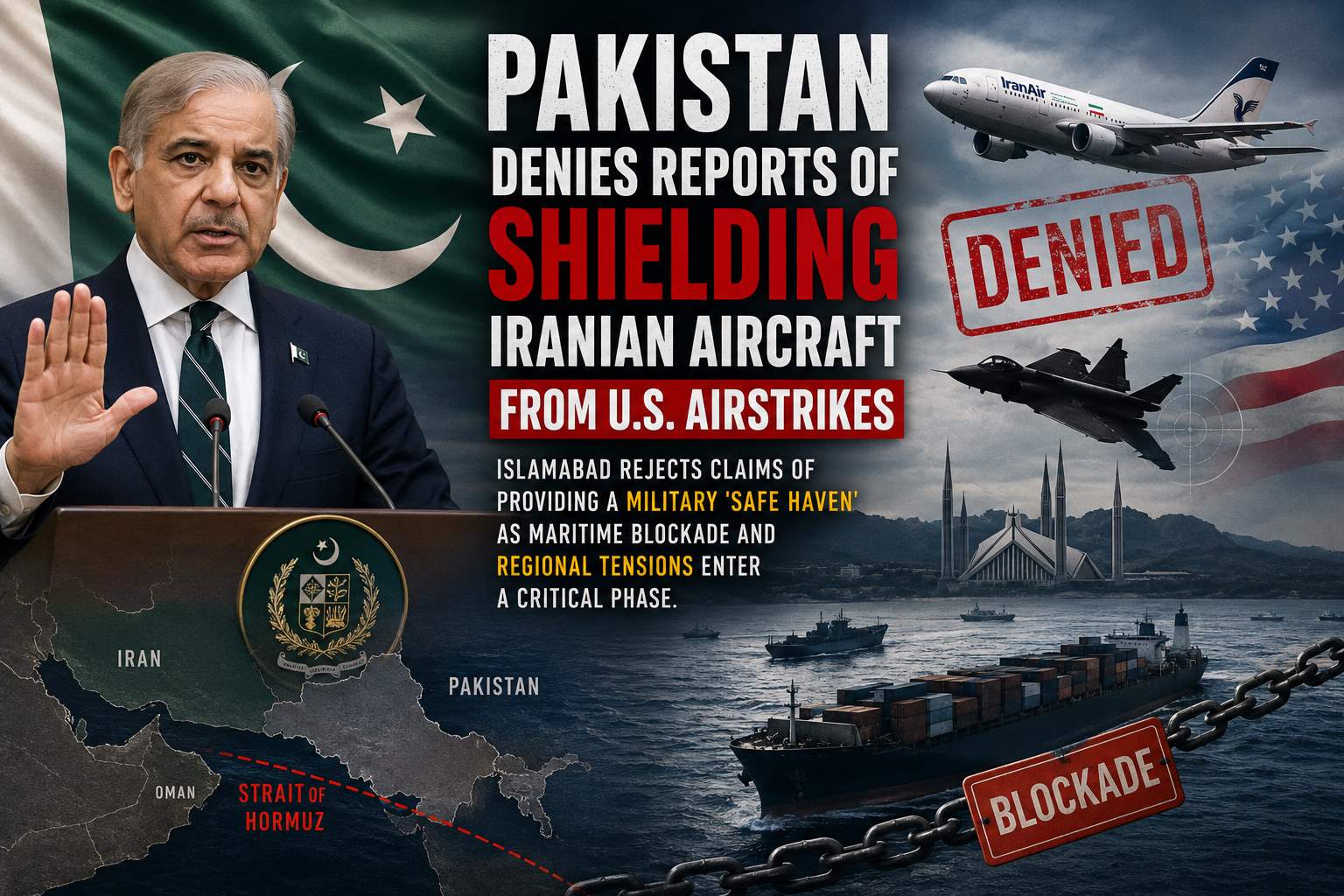
Islamabad rejects claims of providing a military “safe haven” as maritime blockade and regional tensions enter a critical phase.
May 12, 2026
Global War News Editorial
The Government of Pakistan has formally rejected international media reports suggesting it allowed Iranian military assets to use its airfields as a sanctuary from American strikes. In a statement released Tuesday, the Ministry of Foreign Affairs characterized a CBS News report—which alleged that Tehran had “quietly” moved aircraft to Pakistan’s Nur Khan Airbase to shield them from the U.S. campaign—as “misleading and sensationalized.”
The denial comes at a moment of extreme geopolitical fragility. While Islamabad has attempted to position itself as a neutral mediator in the escalating conflict between Washington and Tehran, the presence of Iranian hardware on Pakistani soil has raised questions about the limits of that neutrality.
Diplomatic Logistics vs. Military Preservation
The Ministry’s spokesperson clarified that while Iranian aircraft are indeed present at Nur Khan Airbase, their arrival was strictly logistical. According to the official statement, these planes were part of the administrative and security support for the initial round of peace talks held in Islamabad last month.
“A number of aircraft from both the United States and Iran arrived in Pakistan following the April 8 ceasefire to facilitate the movement of diplomatic personnel,” the spokesperson stated. The Ministry further noted that some assets remained in the country in anticipation of subsequent rounds of engagement, which have since stalled.
The CBS News report, cited by NDTV and other regional outlets, claimed that an Iranian Air Force RC-130, a reconnaissance and intelligence-gathering variant, was among the military hardware sent to Rawalpindi. Islamabad has countered this, asserting that these movements bear “no linkage whatsoever to any military contingency or preservation arrangement.”
Regional Mediation Under Pressure
The timing of these allegations is particularly sensitive. On Sunday, U.S. President Donald Trump described the current ceasefire as being on “life support” and dismissed Iran’s latest counterproposal as “totally unacceptable.” As the primary diplomatic conduit between the two warring parties, Pakistan finds its role increasingly scrutinized by both Western intelligence and regional rivals.
Reports have also emerged suggesting that Iran may have moved civilian aircraft into neighboring Afghanistan for similar protection. While the Taliban administration has denied these claims, the narrative of a coordinated “dispersal” of Iranian assets underscores the fear within Tehran of a renewed and expanded U.S. air campaign.
Analysis: The Cost of Neutrality
Observers note that Pakistan is walking a dangerous diplomatic tightrope. By hosting both U.S. and Iranian diplomatic flights, Islamabad provides a necessary “green zone” for dialogue. However, the presence of military-spec aircraft like the RC-130 provides critics with ammunition to suggest that “mediation” may be serving as a cover for strategic assistance.
For Islamabad, the stakes are not merely diplomatic but economic. With the Strait of Hormuz effectively closed since late February, the Pakistani economy is reeling from skyrocketing fuel costs and supply chain disruptions. Maintaining a functional relationship with both Washington, its primary security partner, and Tehran, its neighbor and potential energy provider, is becoming an increasingly difficult balancing act.
What to Watch
The situation is likely to intensify as Iranian Foreign Minister Abbas Araghchi travels to New Delhi this week for the BRICS Foreign Ministers meeting. His discussions there may reveal whether Tehran is seeking a broader coalition of support to bypass the U.S.-led blockade. Meanwhile, the international community remains focused on whether the “logistical” aircraft in Pakistan will be repatriated or if their presence will become a permanent flashpoint in U.S.-Pakistan relations.
Source Disclosure: This report is based on official statements from the Pakistan Ministry of Foreign Affairs, reporting from CBS News, Reuters, AP News, and NDTV, and data regarding the Strait of Hormuz closure from the IEA and shipping industry monitors.
This article is based on publicly available reporting from named international news agencies and attributed official statements. All claims about ongoing events are attributed to their original sources. Analysis sections represent the editorial interpretation of reported facts and do not constitute advocacy for any party to the described conflict. AI tools may be utilized for image generation to assist in explaining complex concepts, as well as for refining grammar, spelling, and other linguistic enhancements. However, all original content is produced, fact-checked, and revised by the editorial team. This publication does not take political positions on active military conflicts.