
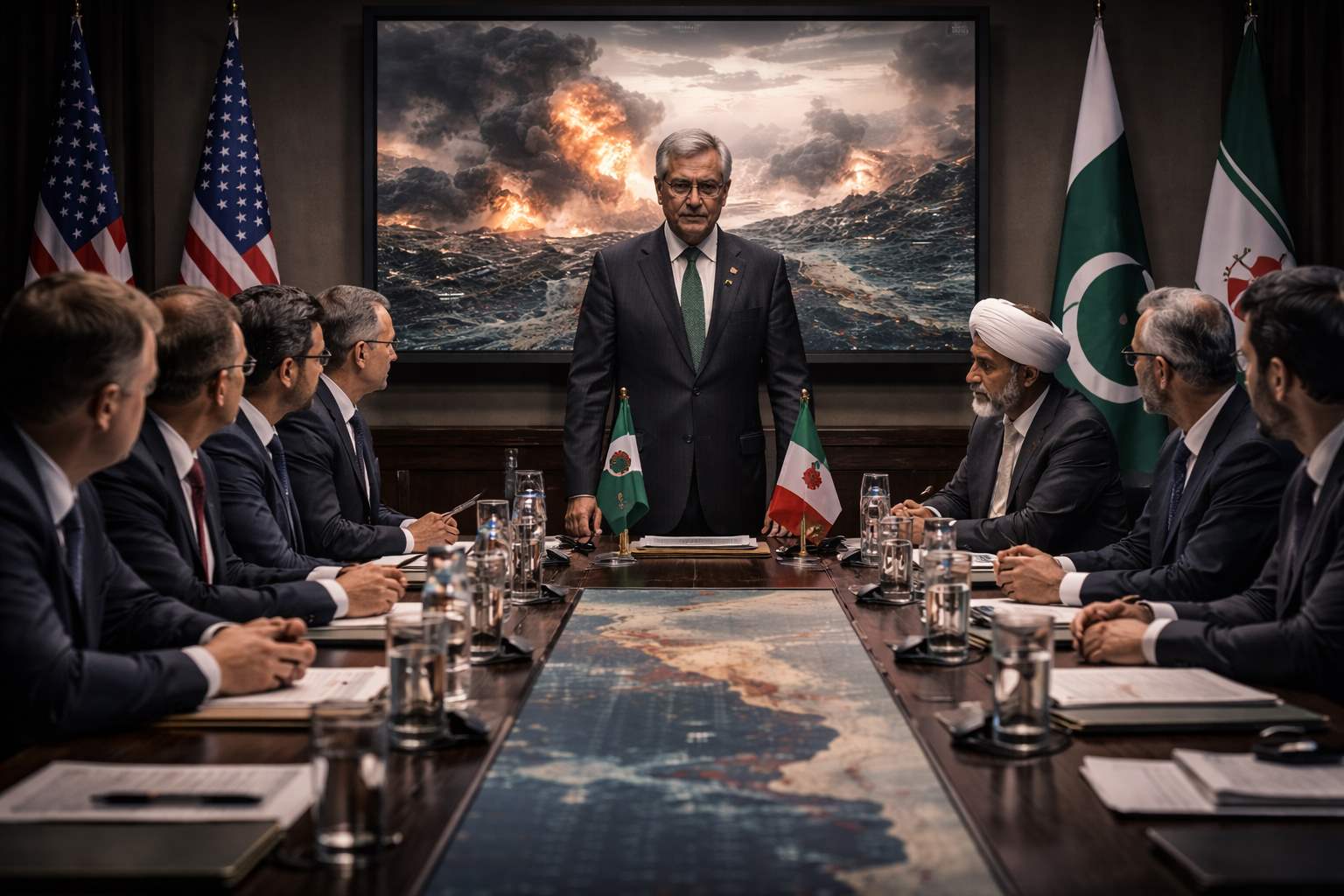
Islamabad navigates a high-stakes diplomatic tightrope as the two-week truce extension faces mounting pressure from regional strikes.
April 29, 2026
By Global War News Editorial
Pakistan has emerged as the central, albeit unlikely, arbiter in the 2026 Iran War, facilitating a series of high-level diplomatic engagements aimed at preventing a regional catastrophe. Following the “Islamabad Talks” held on April 11–12, the mediation team, led by Prime Minister Shehbaz Sharif and Field Marshal Asim Munir, has worked to sustain a conditional ceasefire that originally came into effect on April 8.
While the truce was officially extended by President Donald Trump on April 21 to allow Tehran more time to submit a formal peace proposal, the situation on the ground remains precariously fluid. Reports from the Jinnah Convention Centre, which has served as a media hub for the negotiations, suggest that while both sides have found common ground on minor logistical points, fundamental disagreements over the Strait of Hormuz and Iran’s nuclear program continue to stall a permanent settlement.
The Islamabad Framework and its Sticking Points
The mediation efforts are currently focused on a multi-stage de-escalation plan. According to Pakistani Foreign Office briefings, the discussions at the Serena Hotel in Islamabad earlier this month involve five critical pillars: the reopening of the Strait of Hormuz, the status of Iran’s nuclear enrichment, regional proxy activities, sanctions relief, and reconstruction.
- Nuclear Enrichment: The Trump administration has maintained a “zero enrichment” mandate. Reports from The Guardian indicate that Vice President JD Vance left the first round of talks citing Iran’s refusal to dismantle its nuclear program as the primary cause for the lack of a final deal.
- The Strait of Hormuz: While the ceasefire theoretically calls for the reopening of the world’s most vital energy artery, the IRGC has reportedly continued to restrict vessel movement, characterizing the US demands as a “spectacle.”
- The “Lebanon Gap”: A significant source of friction in the mediation is whether the ceasefire includes Southern Lebanon. Pakistani and Iranian authorities stated publicly that it does; however, Israeli and US officials have rejected this inclusion, continuing “Operation Eternal Darkness” against Hezbollah assets throughout the truce period.
Violations and Military Posturing
The “shaky” nature of the ceasefire is evidenced by a series of reported kinetic actions that have occurred since its declaration. On April 8, within hours of the truce’s commencement, Israel launched a wave of airstrikes across Southern Lebanon and the Beqaa Valley. Furthermore, Iranian authorities have claimed violations near Tehran and Isfahan, asserting that Israeli drones have entered their airspace despite the Islamabad-brokered agreement.
In response to the naval blockade that persists despite the ceasefire, the Pakistan Navy launched Operation Muhafiz-ul-Bahr to escort essential oil tankers to Karachi. This move underscores Pakistan’s dual role: as a neutral diplomatic bridge and as a regional power directly suffering from the economic fallout of the conflict.
Analysis: Mediation Under Maximum Pressure
Analysts suggest that Pakistan’s role is “indispensable but fragile.” By hosting direct talks, the first of their kind since 1979, Islamabad has successfully delayed the “apocalyptic” strikes on Iranian energy infrastructure that President Trump threatened in early April. However, observers note that Pakistan is navigating this role while facing its own internal pressures, including sectarian protests and a severe energy crisis linked to the maritime blockade.
The central challenge for Pakistani mediators remains the “maximalist” positions of both primary actors. If Washington views the ceasefire merely as a pause to prepare for further strikes, and Tehran views it as a way to gain sanctions relief without nuclear concessions, the Islamabad Talks risk becoming a footnote in a larger escalation. Analysts have suggested that the second round of talks, expected toward the end of April, will be the true test of whether Pakistan can transform a temporary cessation of hostilities into a durable regional architecture.
What to Watch
The coming days are critical as the current ceasefire extension approaches its informal deadline. Watch for whether the Trump administration follows through on its threat to resume “blasting Iran into oblivion” if a nuclear agreement is not reached. Additionally, the arrival of a formal Iranian 10-point proposal, reportedly being shuttled by Pakistani diplomats today, may determine if a second round of direct negotiations will commence in Islamabad or if the region will return to active, high-intensity conflict.
Source Disclosure: This article is based on official statements from the Government of Pakistan, the US State Department, and the Iranian Foreign Ministry. Reporting was synthesized from the Financial Times, The Washington Post, Al Jazeera, and the House of Commons Library. Statistical data on civilian impact and airstrikes were sourced from Amnesty International and local regional monitors.
This article is based on publicly available reporting from named international news agencies and attributed official statements. All claims about ongoing events are attributed to their original sources. Analysis sections represent the editorial interpretation of reported facts and do not constitute advocacy for any party to the described conflict. AI tools may be utilized for image generation to assist in explaining complex concepts, as well as for refining grammar, spelling, and other linguistic enhancements. However, all original content is produced, fact-checked, and revised by the editorial team. This publication does not take political positions on active military conflicts.