
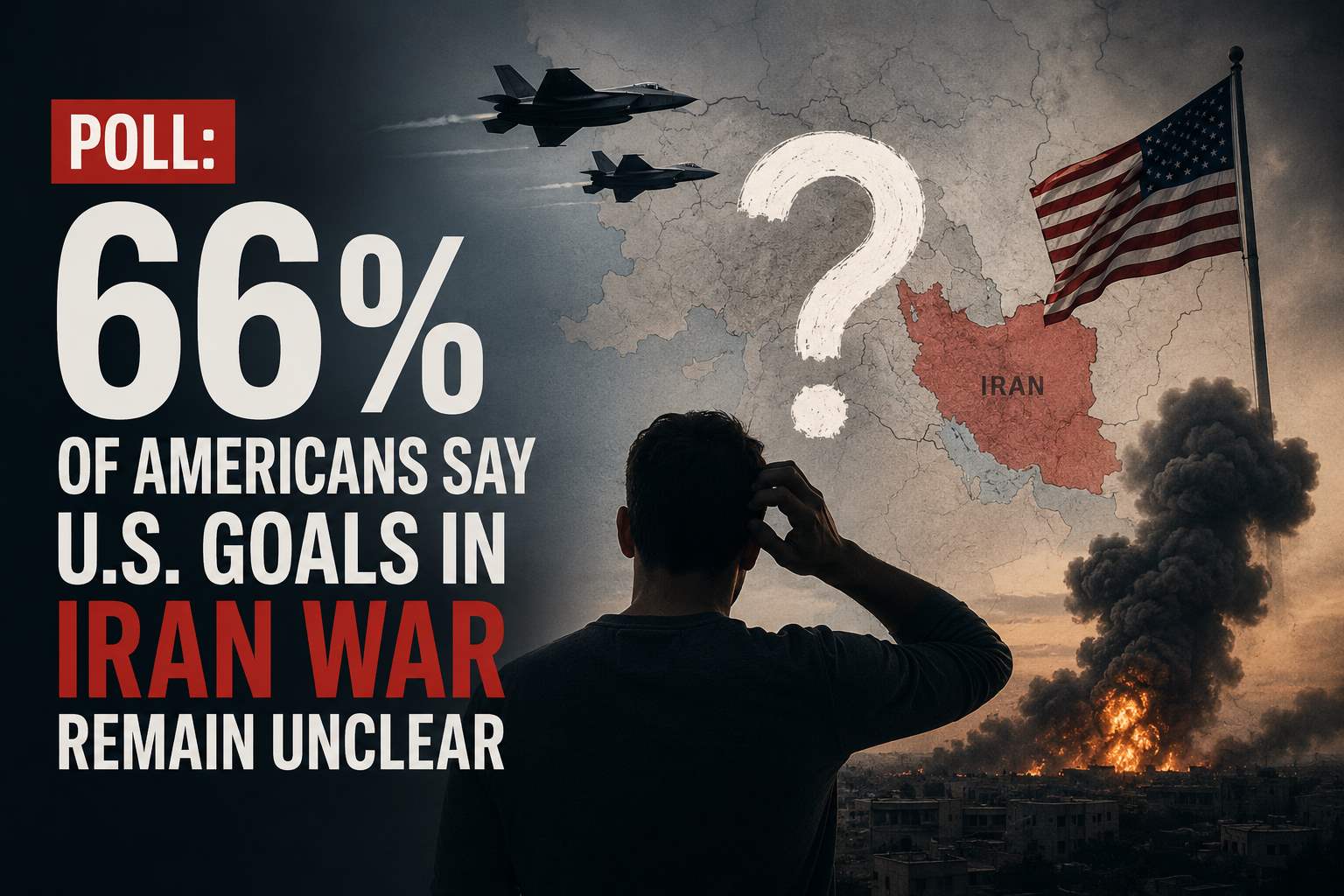
Public skepticism grows as military engagement enters new phase without a defined exit strategy or articulated endgame.
May 12, 2026
Global War News Editorial
A significant majority of the American public remains uncertain about the strategic objectives of the ongoing military conflict with Iran. According to a new Reuters/Ipsos poll released Monday, 66% of respondents stated that the United States’ goals in the conflict are “unclear.” This data emerges as the administration faces mounting pressure to define what a “victory” or a successful exit strategy looks like in a theater characterized by maritime blockades and long-range strikes.
The survey, which sampled over 1,200 adults across the United States, indicates a widening gap between the White House’s rhetoric and public perception. While officials have consistently cited “regional stability” and the “restoration of maritime freedom” as primary drivers for the intervention, the poll suggests these broad terms have failed to resonate as concrete military or political objectives with the domestic audience.
A Partitioned Public Sentiment
The lack of clarity has begun to impact broader support for the mission. Reuters reported that while initial support for defensive naval operations in the Strait of Hormuz was high, that enthusiasm has eroded as the conflict transitioned into more frequent strikes against inland targets.
According to the poll data:
- 22% of respondents believe the U.S. has a “very clear” understanding of its objectives.
- 12% remain “unsure” or declined to answer.
- 66% feel the mission lacks a transparently defined goal.
The findings reflect a trend seen in previous long-term interventions, where public support often correlates with the government’s ability to articulate a specific, achievable endgame. Analysts suggest that the “mission creep” often associated with Middle Eastern theaters is a primary concern for the American electorate.
Analysis: The Strategic Communication Gap
The ambiguity cited by the American public may stem from the administration’s attempt to balance multiple, sometimes conflicting, geopolitical priorities. Observers note that the U.S. is currently attempting to degrade Iranian military capabilities while simultaneously avoiding a full-scale ground invasion or a total collapse of the Iranian state, which could trigger a massive power vacuum.
“The administration is walking a tightrope,” noted one regional analyst. “They want to exert enough pressure to reopen the Strait of Hormuz, but they are wary of defining ‘regime change’ as a goal, as that would commit the U.S. to a decades-long reconstruction project they cannot afford.”
This “middle-path” strategy often results in vague public messaging. To a domestic audience, “strategic degradation” does not carry the same clarity as “total surrender” or “withdrawal.” Consequently, the 66% figure in the Reuters poll may represent a demand for a binary outcome in a conflict that the Pentagon currently views as a modular, multi-year engagement.
What to Watch
As the 2026 mid-term election cycle approaches, the clarity of the Iran mission is expected to become a central campaign issue. Members of the Senate Foreign Relations Committee have already signaled intentions to hold hearings demanding a “Statement of Purpose” from the Department of Defense.
The public’s demand for clarity will likely force the administration to either narrow its scope of operations or provide a more detailed roadmap for de-escalation. Whether this leads to a formal “Exit Strategy” document or a renewed effort to sell the current “Regional Stability” framework to the public remains the key question for the summer legislative session.
Source Disclosure: This report is based on polling data and reporting provided by Reuters and Ipsos, with additional context from public statements made by U.S. administration officials and congressional records.
This article is based on publicly available reporting from named international news agencies and attributed official statements. All claims about ongoing events are attributed to their original sources. Analysis sections represent the editorial interpretation of reported facts and do not constitute advocacy for any party to the described conflict. AI tools may be utilized for image generation to assist in explaining complex concepts, as well as for refining grammar, spelling, and other linguistic enhancements. However, all original content is produced, fact-checked, and revised by the editorial team. This publication does not take political positions on active military conflicts.