
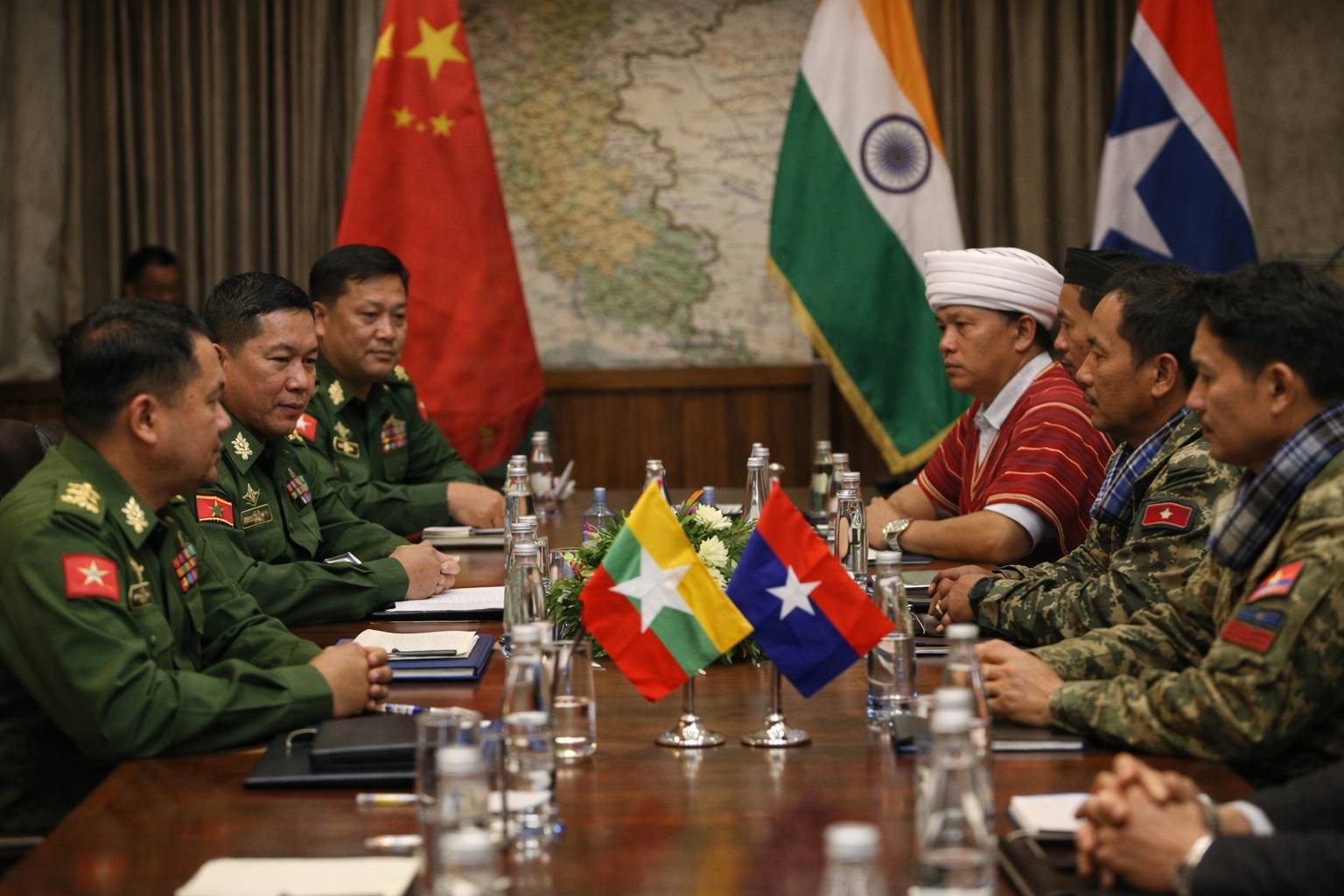
Regional diplomats report early-stage talks between the military junta and ethnic armed organizations as pressure from neighboring powers increases.
April 16, 2026
Last Updated: 10:45 AM
By Staff Writer, Global War News
Internal armed groups in Myanmar’s Shan State have reportedly entered preliminary discussions regarding localized ceasefire terms with the military government. According to regional diplomatic sources and reports from independent monitoring groups, the talks involve representatives from the State Administration Council (SAC)—the military junta—and several major Ethnic Armed Organizations (EAOs) that have dominated the northern and southern sectors of the state for decades.
These developments follow a period of significant territorial shifts and a cooling of tensions between former allies within the “Brotherhood Alliance.” While the junta has sought to stabilize frontlines ahead of its newly initiated political transition, ethnic leadership remains cautious, emphasizing that any cessation of hostilities must address long-standing demands for federal autonomy.
A Fragmented Landscape of Negotiations
The mediation landscape in Shan State is currently divided into two primary tracks. In Northern Shan, the Ta’ang National Liberation Army (TNLA) and the Myanmar National Democratic Alliance Army (MNDAA) have reportedly faced intense pressure from Chinese authorities to stabilize the border region. According to The Irrawaddy, the TNLA signed a bilateral ceasefire with the military regime in late 2025, agreeing to hand over strategic hubs such as Mogoke and Mongmit in exchange for a halt to aerial bombardments on Ta’ang-held territory.
Simultaneously, a second track of mediation has emerged to resolve “fraternal” disputes between the ethnic groups themselves. Reports from Burma News International suggest that the MNDAA and TNLA reached a separate internal truce in late March 2026 following a week of territorial clashes in Kutkai. Diplomats suggest that the junta is attempting to leverage these internal fractures to secure its own localized “security zones” along vital trade routes.
The Role of Regional Power Dynamics
The influence of neighboring China remains the most decisive factor in the current stability of Shan State. According to regional analysts, Beijing’s primary interest lies in the security of the Hseni-Muse highway and the 105-Mile Trade Zone. Reports indicate that Chinese special envoys have been instrumental in “strongarming” both the junta and the Brotherhood Alliance into the current state of “becalmed” hostilities.
However, the military junta’s recent political shifts have added a layer of complexity. General Min Aung Hlaing was reportedly sworn in as President on April 10, 2026, following elections that were widely condemned by international observers as fraudulent. According to the Council on Foreign Relations, the junta is using this transition to present a veneer of civilian governance, hoping it will provide a more palatable framework for EAOs to sign onto a renewed “Nationwide Ceasefire Agreement” (NCA) style framework.
Analysis: A Tactical Pause or a Lasting Peace?
Observers suggest that the current ceasefire discussions are born more of tactical necessity than political reconciliation. For the military junta, a localized truce in Shan State allows for the redeployment of fatigued units to more active fronts in Rakhine and Sagaing. For the ethnic armed groups, the pause provides an opportunity to consolidate governance in newly captured territories and address the humanitarian needs of displaced populations.
Analysts from the International Institute for Strategic Studies (IISS) note that the “Shan-Man” (Shan-Mandalay) corridor remains a flashpoint. While the TNLA has withdrawn from several urban centers, it continues to demand the creation of a “Ta’ang Autonomous State.” Similarly, the MNDAA is focused on reinstating its historic administrative authority in the Kokang region. The fundamental “trust deficit” between the junta’s desire for centralized control and the EAOs’ pursuit of federalism remains unaddressed.
Current Outlook on the Ground
As of mid-April, the situation in northern Shan State is described by locals as “tense but quiet.” While large-scale offensives have paused, the humanitarian impact of the previous years of conflict remains staggering. The Assistance Association for Political Prisoners (AAPP) estimates that thousands of civilians remain displaced within Shan State, facing severe shortages of food and medical supplies as trade routes remain under intermittent military control.
Whether these preliminary talks evolve into a formal, transparent agreement depends largely on the junta’s willingness to offer genuine political concessions—a prospect that many regional observers remain skeptical of given the military’s recent consolidation of power in Naypyidaw.
Sources: This article is based on reporting and official statements from The Irrawaddy, Burma News International (BNI), the Associated Press, the Council on Foreign Relations, and the IISS Myanmar Conflict Map.
This article is based on publicly available reporting from named international news agencies and attributed official statements. All claims about ongoing events are attributed to their original sources. Analysis sections represent the editorial interpretation of reported facts and do not constitute advocacy for any party to the described conflict. AI tools may be utilized for image generation to assist in explaining complex concepts, as well as for refining grammar, spelling, and other linguistic enhancements. However, all original content is produced, fact-checked, and revised by the editorial team. This publication does not take political positions on active military conflicts.