
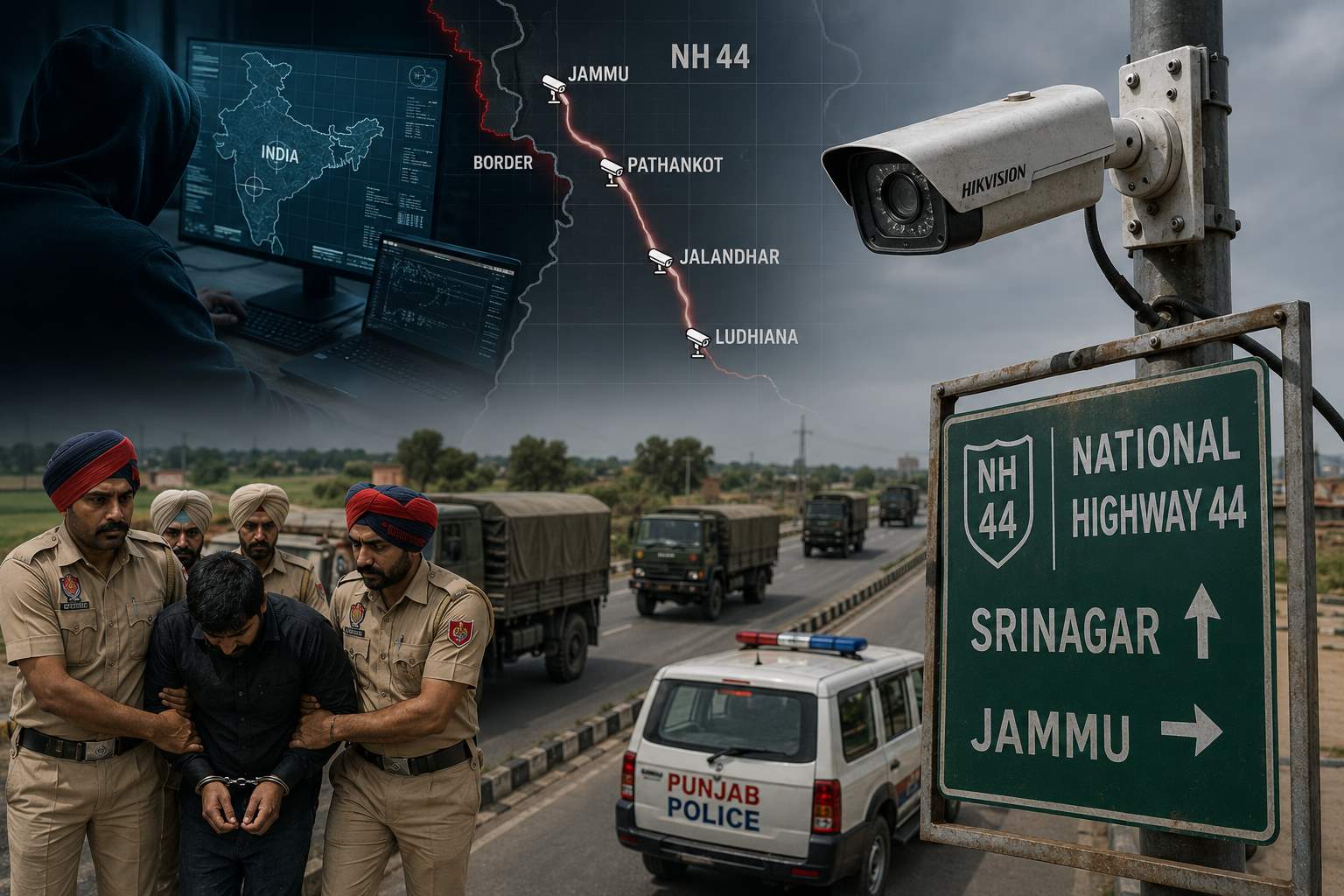
The deployment of digital surveillance infrastructure on National Highway 44 reveals how foreign handlers use low-cost commercial hardware to map Indian military logistics.
Published: May 22, 2026
Last Updated: May 22, 2026
Byline: Staff Writer, Global War News
Indian law enforcement agencies in the border state of Punjab have dismantled a localized espionage apparatus that utilized commercial, internet-enabled surveillance hardware to monitor domestic troop movements. According to formal announcements from regional police officials, a resident of Pathankot district was arrested after security operatives uncovered a hidden digital camera system positioned adjacent to a critically strategic national transport corridor.
The incident underscores a shifting paradigm in cross-border intelligence gathering, where foreign state handlers increasingly swap traditional human assets for off-the-shelf, internet-linked hardware to perform remote observation. Because the targeted transit route serves as the primary ground logistics link connecting mainland India to Jammu and Kashmir, the installation of digital surveillance systems along this axis presents immediate challenges for operational security and military transit confidentiality.
Coming on the heels of similar counter-espionage operations in Punjab over recent weeks, this latest discovery has prompted security agencies to expand their technical audits of commercial establishments, cellular links, and utility infrastructure situated near major military cantonments.
The Pathankot Interception and Technical Assets
According to a detailed operational briefing delivered by Daljinder Singh Dhillon, the Senior Superintendent of Police (SSP) for Pathankot, the primary suspect was identified as Baljit Singh, also known as Bittu, a resident of Chakk Dhariwal village. Acting on specific technical intelligence supplied by central security agencies, the Crime Investigation Agency (CIA) wing of the Pathankot Police executed a targeted raid that led to the suspect’s arrest and the recovery of the surveillance equipment.
Investigators revealed that the suspect had strategically installed an internet-linked, standalone Closed-Circuit Television (CCTV) camera at a roadside commercial shop. The device was positioned near a critical bridge located between bridges 4 and 5 on the Sujanpur section of National Highway 44 (NH-44).
Local police reports indicate that this specific viewpoint was chosen because it provided an unobstructed, continuous view of all military, paramilitary, and heavy logistics convoys traveling along the Pathankot-Jammu corridor. The camera was paired with a high-speed Wi-Fi router, enabling it to broadcast a live, unencrypted data feed of highway traffic directly to foreign-based operatives.
Financial Networks and Cross-Border Coordination
During initial custodial interrogations, the suspect reportedly conceded that the digital surveillance system had been operational since January 2026. According to the Punjab Police, Baljit Singh asserted that he was acting under direct instructions received from an unidentified coordinator operating out of Dubai, United Arab Emirates. Police records indicate the suspect received a digital financial transfer of approximately 40,000 Indian Rupees to procure, install, and maintain the internet-linked setup.
Security officials have initiated a comprehensive financial audit to trace the routing path of these funds, focusing on informal remittance channels or digital payment applications designed to obscure cross-border origin points. The police have also named three additional accomplices in the formal First Information Report (FIR).
According to SSP Dhillon, one of these individuals provided localized logistical support, while the remaining two are believed to be positioned abroad, maintaining direct links with hostile foreign intelligence agencies. Two of the named co-conspirators are currently incarcerated in separate, unrelated cases, and are scheduled to be transferred to face specialized interrogation regarding their roles in this transmission ring.
The state police have formally booked the primary suspect under multiple provisions of the Bharatiya Nyaya Sanhita (BNS), alongside stringent sections of the Official Secrets Act, which governs the unauthorized collection and transmission of data vital to national defense.
Context: The Proliferation of “Off-Grid” Border Surveillance
The arrest in Pathankot is not an isolated breach but part of a documented, broader trend observed across Punjab’s border districts throughout early 2026. According to statements from Punjab Director General of Police (DGP) Gaurav Yadav, counter-intelligence units recently dismantled two distinct espionage modules backed by Pakistan’s Inter-Services Intelligence (ISI) that deployed similar technical configurations.
In those prior actions, which took place across Jalandhar and Kapurthala, security forces recovered Chinese-manufactured, solar-powered CCTV cameras fitted with integrated 4G cellular subscriber identity module (SIM) cards. These specialized systems were found mounted discreetly on utility poles and commercial facades overlooking sensitive military bases and airfields.
The utilization of these specific technical systems introduces distinct complications for internal security frameworks, as outlined in the comparative summary below:
| Technical Challenge | Operational Vulnerability | Strategic Security Consequence |
| Off-Grid Independence | Solar charging plates eliminate the need for traditional electrical wiring connections. | Devices can be deployed in remote areas without drawing utility line scrutiny. |
| Direct 4G/Cellular Routing | Data avoids local local-area networks (LANs), transmitting directly via commercial cellular towers. | Standard cybersecurity firewalls and network monitoring tools cannot flag the traffic. |
| Mobile App Interfacing | Live video feeds are routed through ubiquitous commercial cloud applications. | Handlers can monitor live troop movements on standard smartphones anywhere globally. |
Analysis: Logistics Mapping and Tactical Risks
From a defense and warfare analysis perspective, the targeting of the Pathankot-Jammu highway axis reflects a deliberate effort by foreign adversaries to build an accurate, real-time data repository of Indian troop movements. The Pathankot district serves as a highly vital geostrategic bottleneck; it is the point where the borders of Punjab, Himachal Pradesh, and Jammu and Kashmir converge, hosting major military installations and serving as the primary launch pad for high-altitude logistical re-supply.
By running a continuous, live digital archive of traffic across the Sujanpur bridges, remote intelligence analysts can effectively calculate order-of-battle metrics without needing physical scouts on the ground. A continuous look at the highway allows foreign handlers to record the specific types of armor being moved, count artillery pieces, determine unit designations via vehicle markings, and estimate overall troop strength shifts heading toward northern command sectors.
Furthermore, local police officials noted that the suspect’s motivation was partially tied to funding a localized narcotics dependency. This detail highlights a persistent cross-border vulnerability where intelligence agencies exploit local smuggling networks and substance vulnerabilities to recruit low-level operatives for high-impact technical espionage tasks.
Outlook and What to Watch
In the wake of these recurring technological discoveries, security agencies are anticipated to modify their surveillance counter-measures along critical border infrastructure. Observers should watch for an intensification of localized checking routines targeting roadside commercial shops, temporary stalls, and telecommunication poles within a five-kilometer radius of strategic transport links and defense cantonments.
The investigation will also likely pressure local cellular service providers to enforce stricter identity verification protocols for 4G and 5G SIM card activations within border zones, given how easily these espionage networks have acquired operational data links. Additionally, the technical extraction of data from the seized routers and cameras will be a key focal point for intelligence agencies seeking to identify the exact IP addresses and cloud servers utilized by the handlers based in Dubai and Pakistan.
Source Disclosure Note: This report is constructed from verified operational updates provided directly by the Punjab Police department, including on-record press briefings by Pathankot Senior Superintendent of Police Daljinder Singh Dhillon and public directives from Director General of Police Gaurav Yadav. Supplementary context regarding recent regional espionage rings and technical hardware tracking was drawn from regional wire service dispatches published by the Press Trust of India (PTI), Akashvani News, and tracking reports from The Times of India and The Hindu.
This article is based on publicly available reporting from named international news agencies and attributed official statements. All claims about ongoing events are attributed to their original sources. Analysis sections represent the editorial interpretation of reported facts and do not constitute advocacy for any party to the described conflict. AI tools may be utilized for image generation to assist in explaining complex concepts, as well as for refining grammar, spelling, and other linguistic enhancements. However, all original content is produced, fact-checked, and revised by the editorial team. This publication does not take political positions on active military conflicts.