
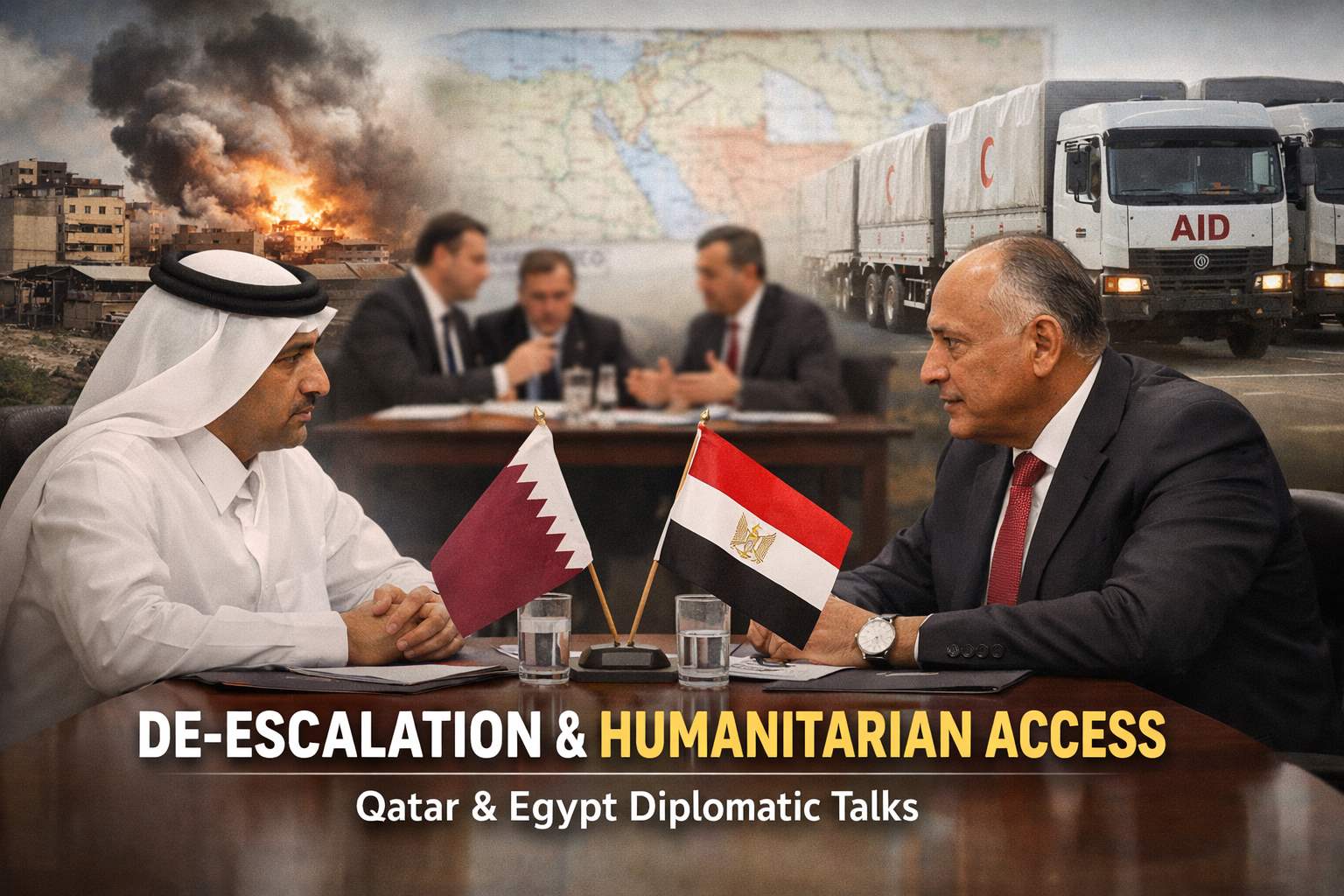
Regional mediators evaluate diplomatic frameworks to secure a sustainable truce and restore vital supply corridors.
May 8, 2026
Global War News Editorial
High-level officials from Qatar and Egypt met on Friday to coordinate a joint diplomatic strategy aimed at de-escalating regional hostilities and expanding humanitarian access to conflict zones. The meeting in Doha represents a critical push by the two primary regional mediators to find a sustainable path toward a truce as the 69-day conflict continues to impact global trade and civilian stability.
According to a statement from the Qatari Ministry of Foreign Affairs, the discussions focused on harmonizing the various peace proposals currently being reviewed by international parties. Egypt’s State Information Service reported that the talks also addressed the technical requirements for reopening key land crossings to allow for the consistent delivery of food and medical supplies, which have been frequently interrupted by kinetic activity.
The Role of Regional Mediation
Qatar and Egypt have maintained their roles as central interlocutors throughout the current crisis, leveraging their unique diplomatic ties to bridge the gap between Western powers and regional actors. This latest review of joint efforts follows reports from Al Jazeera that the mediators are working on a “sequenced roadmap” that would link a cessation of hostilities to specific humanitarian milestones.
A spokesperson for the Egyptian Foreign Ministry stated that the priority remains the establishment of “safe corridors” that are recognized by all combatants. As reported by Reuters, these diplomatic efforts are running parallel to Pakistani-mediated talks involving the United States and Iran, suggesting a multi-layered approach to regional stabilization.
Humanitarian Challenges and Trade Logistics
The humanitarian situation remains a primary driver for the current diplomatic urgency. According to data from the United Nations Office for the Coordination of Humanitarian Affairs (OCHA), the disruption of maritime trade in the Strait of Hormuz and the Red Sea has significantly increased the cost of aid delivery to the Middle East and East Africa.
Analysts note that Egypt and Qatar are particularly concerned with the “Adre corridor” and other northern logistics hubs that have been restricted during the conflict. Observers have suggested that without a formal de-escalation agreement, the risk of a widespread food security crisis remains high. “The mediators are not just looking for a ceasefire; they are looking for a functional logistics agreement that can survive the current political volatility,” noted a regional analyst from the Cairo Center for Strategic Studies.
Analysis: Navigating a Multipolar Peace Process
The collaboration between Doha and Cairo highlights a shift in how regional crises are managed. By presenting a unified front, the two nations aim to increase their leverage over combatants who may be resistant to unilateral pressure. However, it remains unclear whether this regional framework can successfully integrate with the broader U.S.-led proposals currently under review in Tehran.
The primary obstacle remains the verification of “on-the-ground” compliance. While diplomatic statements often reflect optimism, military commanders in various theaters have continued to pursue tactical objectives. Analysts observe that for any Qatar-Egypt roadmap to succeed, it will require a formal mechanism for monitoring ceasefire violations, a task that has proven difficult in previous iterations of regional truces.
Outlook
The joint committee established by Qatar and Egypt is expected to brief UN and U.S. representatives early next week on the progress of their roadmap. While a formal breakthrough has not yet been announced, the frequency of these high-level reviews indicates that mediators believe a diplomatic window remains open. The international community will be watching for any signs that these talks lead to a tangible increase in the volume of aid reaching affected civilian populations.
Source Disclosure: Reporting from Reuters, Al Jazeera, the Qatar News Agency (QNA), and Egypt’s State Information Service (SIS). Official statements from the Qatari and Egyptian Foreign Ministries.
This article is based on publicly available reporting from named international news agencies and attributed official statements. All claims about ongoing events are attributed to their original sources. Analysis sections represent the editorial interpretation of reported facts and do not constitute advocacy for any party to the described conflict. AI tools may be utilized for image generation to assist in explaining complex concepts, as well as for refining grammar, spelling, and other linguistic enhancements. However, all original content is produced, fact-checked, and revised by the editorial team. This publication does not take political positions on active military conflicts.