
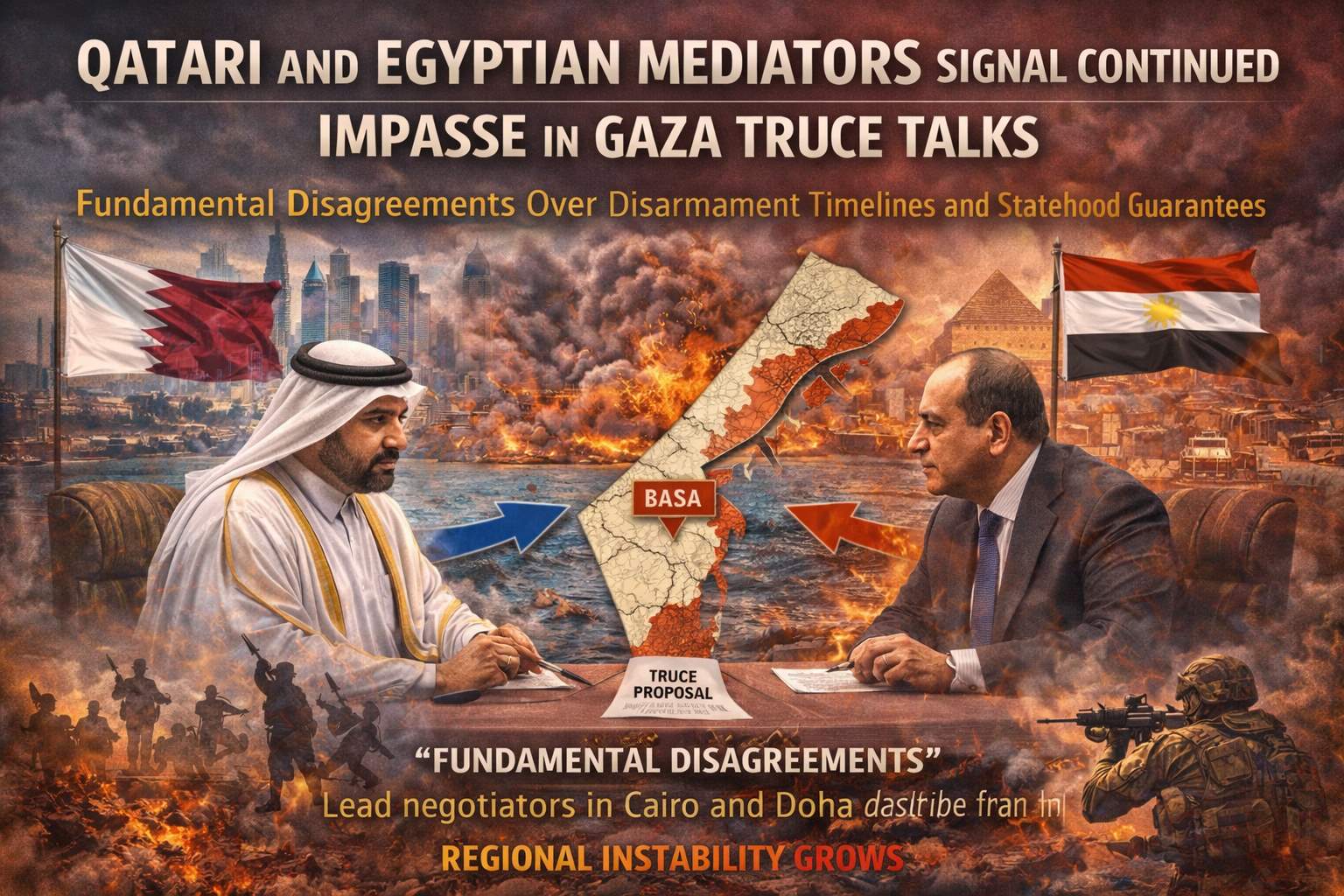
Lead negotiators in Cairo and Doha describe “fundamental disagreements” over disarmament timelines and statehood guarantees as regional instability grows.
Publication date: May 6, 2026
Last updated: May 6, 2026
By Staff Writer, Global War News
Diplomatic efforts to solidify the “Comprehensive Plan to End the Gaza Conflict” have hit a critical deadlock. Qatari and Egyptian mediators, who have spearheaded indirect negotiations between Israel and Hamas for over two years, issued separate but aligned statements on Wednesday indicating that the latest round of talks in Cairo has failed to produce a breakthrough.
The impasse centers on the transition from Phase I, a fragile cessation of hostilities, to Phase II, which mandates the total demilitarization of armed groups in Gaza. According to a senior Egyptian diplomatic source, the “gap between the parties’ core requirements remains substantial,” particularly regarding the sequencing of security guarantees and political recognition.
Public Remarks from Lead Negotiators
In a press briefing in Doha, Qatari officials expressed concern that the “Board of Peace”, the US-led body overseeing the October 2025 agreement—may be moving toward a position that could nullify existing truce commitments.
“We have consistently urged all parties to adhere to the humanitarian obligations of Phase I,” a spokesperson for the Qatari Ministry of Foreign Affairs stated publicly. “Mediation cannot succeed if the foundational terms of the initial ceasefire are treated as conditional upon future concessions that were not part of the signed October framework.”
Simultaneously, Egyptian intelligence officials confirmed that a joint proposal submitted by Palestinian factions, including Hamas, was rejected by both Israel and the United States earlier this week. The proposal reportedly sought to link the handover of weapons to a concrete, internationally-guaranteed timeline for Palestinian statehood.
The Disarmament Deadlock
The central point of contention remains the disarmament of Hamas. Under the “Trump 20-Point Plan,” which became the basis for the current ceasefire, Phase II requires the handover of all medium and heavy weaponry to an International Stabilization Force.
- The Israeli Position: Prime Minister Benjamin Netanyahu’s office stated on May 5 that Israel “will not move forward with reconstruction or total withdrawal” until a verifiable disarmament framework is accepted. Israeli officials have characterized the Palestinian counter-proposal as a “manipulative trap” designed to preserve Hamas’s military capabilities.
- The Hamas Position: Through spokesmen in Cairo and Beirut, Hamas has maintained that it will not discuss the specifics of disarmament until Israel “fully implements” Phase I, which includes a complete withdrawal to agreed-upon lines and the unrestricted entry of 4,200 aid trucks per week.
Analysis: What This Means for Regional Stability
The stall in negotiations is occurring against a backdrop of deteriorating security across the Middle East. Mediators note that the “Gaza Impasse” is no longer an isolated issue. The recent resumption of Iranian-linked strikes in the Gulf and ongoing IDF “preventative” operations in Gaza have created a feedback loop of escalation.
Analysts from the Middle East Council suggest that the mediators, Qatar and Egypt, are increasingly frustrated by what they perceive as a shift in the US-led Board of Peace’s neutrality. A leaked document obtained by The Times of Israel suggests the Board may stop holding Israel to its Phase I ceasefire obligations if Hamas does not accept the decommissioning framework by a mid-May deadline.
Should the mediation process collapse entirely, the “sustainable calm” achieved in late 2025 faces a total breakdown. For the 1.5 million civilians in Gaza and the surrounding region, this impasse likely signals a return to high-intensity kinetic warfare and a further suspension of the $71 billion reconstruction plan estimated to be needed over the next decade.
Source Disclosure: This report utilizes official statements from the Qatari Ministry of Foreign Affairs, the Egyptian State Information Service, and reporting from the National Committee for the Administration of Gaza (NCAG). Supplemental data provided by UN Security Council Resolution 2803 briefings and The Times of Israel.
This article is based on publicly available reporting from named international news agencies and attributed official statements. All claims about ongoing events are attributed to their original sources. Analysis sections represent the editorial interpretation of reported facts and do not constitute advocacy for any party to the described conflict. AI tools may be utilized for image generation to assist in explaining complex concepts, as well as for refining grammar, spelling, and other linguistic enhancements. However, all original content is produced, fact-checked, and revised by the editorial team. This publication does not take political positions on active military conflicts.