
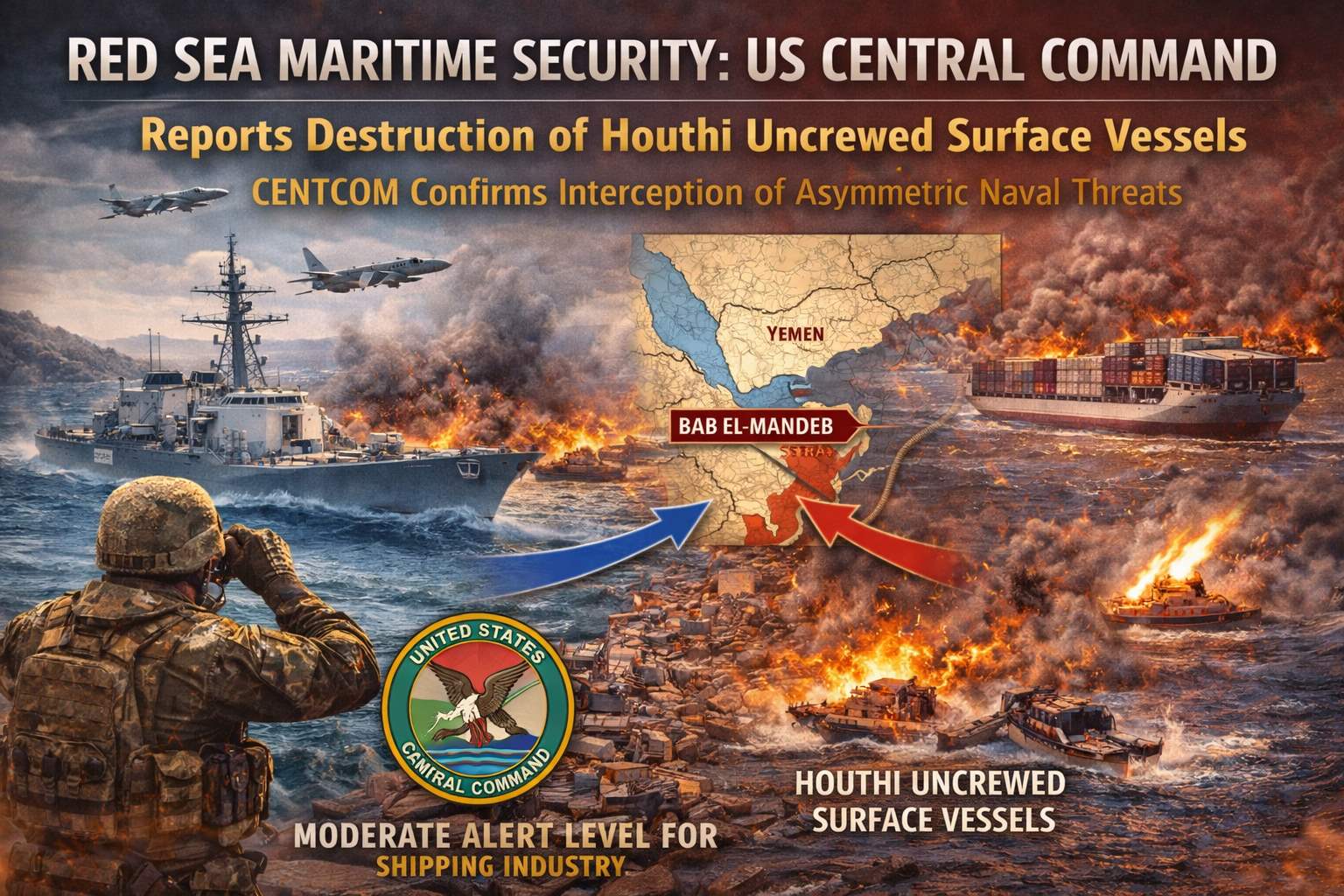
CENTCOM confirms successful interception of asymmetric naval threats as shipping industry maintains moderate alert levels for the Bab el-Mandeb Strait.
Publication date: May 6, 2026
Last updated: May 6, 2026
By Staff Writer, Global War News
U.S. Central Command (CENTCOM) has announced the destruction of several uncrewed surface vessels (USVs) launched from Houthi-controlled territories in Yemen. The engagement, which took place over the last 48 hours, marks a resurgence of asymmetric naval activity in the southern Red Sea, a region that has seen a fragile decrease in direct commercial attacks since late 2025.
According to an official statement released by CENTCOM on May 5, U.S. forces identified the USVs as presenting an “imminent threat” to both merchant vessels and U.S. Navy ships operating in international waters. The command reported that the unmanned boats were intercepted and destroyed in self-defense strikes. No injuries or damage to commercial or coalition assets were reported following the engagement.
“These actions are necessary to protect our forces and ensure the freedom of navigation in one of the world’s most vital waterways,” the CENTCOM statement read. The report follows a period of heightened surveillance as the regional security environment remains volatile due to broader geopolitical tensions.
Asymmetric Threats to International Trade
The use of USVs, essentially remote-controlled, explosive-laden boats, represents a persistent tactical challenge for maritime security forces. Unlike traditional anti-ship missiles, these “drone boats” can be difficult to detect on radar due to their low profile and small size.
Recent alerts from the United Kingdom Maritime Trade Operations (UKMTO) and the U.S. Maritime Administration (MARAD) have cautioned that while large-scale missile volleys have decreased, the risk of “waterborne improvised explosive devices” remains significant. Shipping industry advisories updated in early May 2026 indicate that the Bab el-Mandeb Strait and the southern Red Sea continue to be categorized at a “moderate to high” threat level for vessels with perceived links to the U.S., UK, or Israel.
Industry data suggests that despite the naval presence of “Operation Prosperity Guardian,” many major container lines continue to divert a portion of their fleets around the Cape of Good Hope, citing the unpredictable nature of Houthi drone and USV capabilities.
Analysis: Testing the Deterrence Gap
The destruction of these USVs suggests that the Houthi movement maintains a significant inventory of asymmetric weaponry despite repeated coalition strikes on their launch infrastructure over the past two years. Analysts from the Soufan Center suggest that these intermittent launches serve a dual purpose: testing the reaction times of Western naval assets and signaling continued regional relevance.
While a general ceasefire in the Gaza Strip in October 2025 led to a substantial pause in Houthi attacks on commercial shipping, the group has publicly warned that it reserves the right to resume operations if regional tensions escalate or if its domestic territory is threatened. The latest interceptions occur against a backdrop of increased naval activity in the nearby Strait of Hormuz, where U.S. forces have recently launched “Project Freedom” to counter Iranian naval interference.
Economic Impact and Supply Chain Stability
The Red Sea corridor traditionally accounts for approximately 12% of global trade and 30% of global container traffic. While Suez Canal transits have recovered from their 2024 lows, they remain below pre-crisis levels.
Marine insurance premiums for transiting the Red Sea have stabilized but remain significantly higher than 2023 rates. Sourcing from Lloyd’s Market Association suggests that insurers are closely monitoring the “success rate” of Houthi USV deployments; any successful strike on a commercial tanker could trigger an immediate spike in war risk surcharges, potentially affecting fuel prices in Europe and East Africa.
Source Disclosure: This report is based on official operational updates from U.S. Central Command (CENTCOM), maritime security advisories from UKMTO and MARAD, and trade impact analysis from World Atlas and the Diplomatic Insight.
This article is based on publicly available reporting from named international news agencies and attributed official statements. All claims about ongoing events are attributed to their original sources. Analysis sections represent the editorial interpretation of reported facts and do not constitute advocacy for any party to the described conflict. AI tools may be utilized for image generation to assist in explaining complex concepts, as well as for refining grammar, spelling, and other linguistic enhancements. However, all original content is produced, fact-checked, and revised by the editorial team. This publication does not take political positions on active military conflicts.